
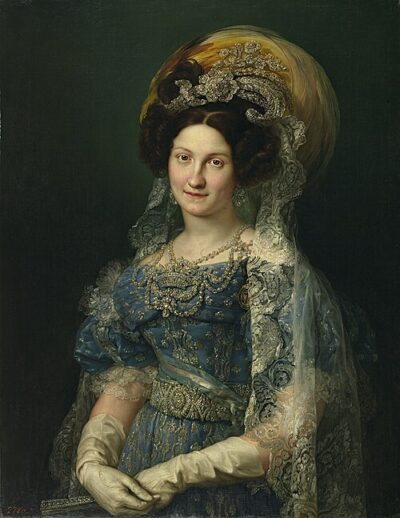
Maria Christina of the Two Sicilies
Maria Christina of the Two Sicilies was a Queen consort of Spain. Born April 27, 1806, in Palermo. Died August 22, 1878, in Le Havre. Positions held include Regent of Spain, Consort of Spain and Member of the Board of Ladies of Honour and Merit (1829–). Awards include Grand Cross of the Order of the Immaculate Conception of Vila Viçosa.
Facts
39 facts · 2 confirmed by two sources · 13 cited · 24 from one source
Where this comes from
Papalocal keeps its own record. It started from these sources; what each one said is kept here as it was copied, so a change on their side never changes this page by itself. Tap one to read its version.
What Wikidata says · copied November 16, 2026 · revision 2569774649
- Described as
- Queen consort of Spain (1806-1878)
- Other names
- Marie Christine Ferdinande, María Cristina Ferdinanda de Borbón, María Cristina Ferdinanda de Bourbon, Doña María Cristina de Borbón, Marie Christine de Bourbon, Maria Cristina Ferdinanda de Borbon, Maria Cristina Ferdinanda de Bourbon, Maria Christina
- Born
- April 27, 1806 · 13 references
- Died
- August 22, 1878 · 6 references
- Born in
- Palermo · 2 references
- Died in
- Le Havre · 1 reference
- Buried in
- Royal Crypt of the Royal Monastery of San Lorenzo de El Escorial
- Citizen of
- Kingdom of Italy (1861–)
- Occupation
- politician; monarch · 1 reference
- Positions held
- Regent of Spain; Consort of Spain; Member of the Board of Ladies of Honour and Merit (1829–) · 1 reference
- Member of
- Real Academia de Nobles y Bellas Artes de San Luis
- Awards
- Grand Cross of the Order of the Immaculate Conception of Vila Viçosa
- Field
- politics · 1 reference
- Spouse
- Ferdinand VII of Spain (1829–1833) · 1 reference; Agustín Fernando Muñoz, 1st Duke of Riánsares (1833–) · 1 reference
- Children
- Isabella II of Spain; Luisa Fernanda of Spain, Duchess of Montpensier · 1 reference; Agustín Muñoz, 1st Duke of Tarancón; Antonio Muñoz y de Borbón · 1 reference; María Amparo Muñoz, 1st Countess of Vista Alegre · 1 reference; Maria de los Milagros Muñoz · 1 reference; Fernando Muñoz, 2nd Duke of Tarancón · 1 reference; María Cristina Muñoz y Borbón · 1 reference; Juan Muñoz y de Borbón, Conde de Recuerdo · 1 reference; Jose Muñoz y de Borbón, Conde de Gracia · 1 reference
- Father
- Francis I of the Two Sicilies
- Mother
- Maria Isabella of Spain
- Siblings
- Princess Maria Carolina, Duchess of Berry; Princess Luisa Carlotta of the Two Sicilies; Ferdinand II of the Two Sicilies; Prince Carlo Ferdinando, Prince of Capua; Leopold of the Two Sicilies, Count of Syracuse; Princess Maria Antonia of the Two Sicilies; Prince Antonio, Count of Lecce; Princess Maria Amalia of the Two Sicilies; Princess Maria Carolina of the Two Sicilies; Teresa Cristina of the Two Sicilies
- Religion
- Catholic Church
- Wikipedias with a page
- 45
Wikidata item Q230566 (wikidata.org/wiki/Q230566), public domain (CC0). Copied November 16, 2026.
What Wikipedia says · copied November 16, 2026 · revision 1376989634
Maria Christina of the Two Sicilies (Italian: Maria Cristina Ferdinanda di Borbone, Principessa delle Due Sicilie, Spanish: María Cristina de Borbón, Princesa de las Dos Sicilias; 27 April 1806 – 22 August 1878) was the Queen of Spain from 1829 to 1833 and Queen regent of the kingdom from 1833, when her daughter became queen at age two, to 1840. By virtue of her short marriage to King Ferdinand VII of Spain, she became a central character in Spanish history for nearly 50 years, thanks to introducing a bicameral model of government based on the Bourbon Restoration in France: the Spanish Royal Statute of 1834.
- Born, in its opening lines
- April 27, 1806
- Died, in its opening lines
- August 22, 1878
From the Wikipedia article “Maria Christina of the Two Sicilies” (en.wikipedia.org/wiki/Maria_Christina_of_the_Two_Sicilies), by its contributors, under CC BY-SA 4.0 (creativecommons.org/licenses/by-sa/4.0/). Copied November 16, 2026; not changed.
Confirmed Two sources agree. Cited One source, and it names where it got it. One source One source, without a reference of its own. Sources disagree The sources disagree. We show the best-supported value and keep theirs below.
