
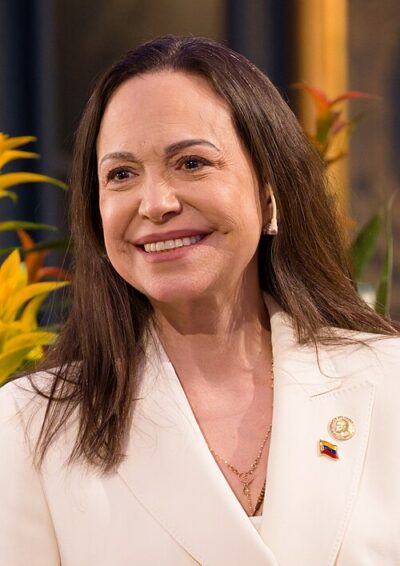
María Corina Machado
María Corina Machado is a Venezuelan politician, activist and Nobel laureate. Born October 7, 1967, in Caracas. Positions held include member of the National Assembly of Venezuela (2010–2014). Educated at Andrés Bello Catholic University and Institute of Advanced Studies in Administration. Awards include BBC 100 Women, Sakharov Prize and Václav Havel Human Rights Prize.
Facts
22 facts · 1 confirmed by two sources · 10 cited · 11 from one source
Where this comes from
Papalocal keeps its own record. It started from these sources; what each one said is kept here as it was copied, so a change on their side never changes this page by itself. Tap one to read its version.
What Wikidata says · copied November 16, 2026 · revision 2563739698
- Described as
- Venezuelan politician, activist and Nobel laureate (born 1967)
- Other names
- Corina Machado, MCM, Maria Corina Machado, María Corina Machado Parisca
- Born
- October 7, 1967 · 4 references
- Born in
- Caracas · 3 references
- Citizen of
- Venezuela
- Occupation
- politician · 2 references; human rights defender; industrial engineer
- Positions held
- member of the National Assembly of Venezuela (2010–2014)
- Political party
- Vente Venezuela (2012–) · 1 reference
- Worked for
- Andrés Bello Catholic University; Radio Caracas Radio
- Education
- Andrés Bello Catholic University; Institute of Advanced Studies in Administration; Siglo 21 University · 1 reference
- Member of
- Súmate (2002–2010)
- Awards
- BBC 100 Women (2018) · 1 reference; Sakharov Prize (2024) · 1 reference; Václav Havel Human Rights Prize (2024) · 1 reference; Nobel Peace Prize (2025) · 2 references; Time 100 (2025) · 1 reference
- Spouse
- Ricardo Sosa Branger (1990–2001) · 1 reference
- Mother
- Corina Parisca
- Religion
- Catholicism
- Wikipedias with a page
- 92
Wikidata item Q439564 (wikidata.org/wiki/Q439564), public domain (CC0). Copied November 16, 2026.
What Wikipedia says · copied November 16, 2026 · revision 1384384082
María Corina Machado Parisca (born 7 October 1967), also known as MCM, is a Venezuelan politician, activist, and prominent leader of the opposition to the administrations of Hugo Chávez, Nicolás Maduro, and Delcy Rodríguez. She served as a member of the National Assembly of Venezuela from 2011 to 2014, and has run as a candidate in presidential elections. She was awarded the 2025 Nobel Peace Prize.
An industrial engineer with a master's degree in finance, Machado began her political career as a founder of the vote-monitoring organization Súmate. She is the National Coordinator of the political party Vente Venezuela and ran in the 2012 opposition presidential primary, which she lost to Henrique Capriles. During the 2014 Venezuelan protests, she played a leading role in organizing demonstrations against Maduro's government.
In 2023, Machado won the opposition primary for the 2024 presidential election. She was barred from running for being disqualified according to the Venezuela’s Supreme Tribunal of Justice. Edmundo González ultimately replaced her as the candidate. The election results were highly disputed, the opposition parties mobilized to collect vote tallies from voting machines which portrayed González as the winner of the election, although the Maduro government claimed victory instead. In the aftermath, Machado said she went into hiding, expressing fears for her life and freedom.
Aside from the Nobel Peace Prize, she was named one of BBC's 100 Women in 2018, and listed among Time magazine's 100 most influential people in 2025. In 2024, Machado received the Václav Havel Human Rights Prize and the Sakharov Prize (shared with González) for representing Venezuelans fighting for democracy.
- Born, in its opening lines
- October 7, 1967
From the Wikipedia article “María Corina Machado” (en.wikipedia.org/wiki/María_Corina_Machado), by its contributors, under CC BY-SA 4.0 (creativecommons.org/licenses/by-sa/4.0/). Copied November 16, 2026; not changed.
Confirmed Two sources agree. Cited One source, and it names where it got it. One source One source, without a reference of its own. Sources disagree The sources disagree. We show the best-supported value and keep theirs below.
