
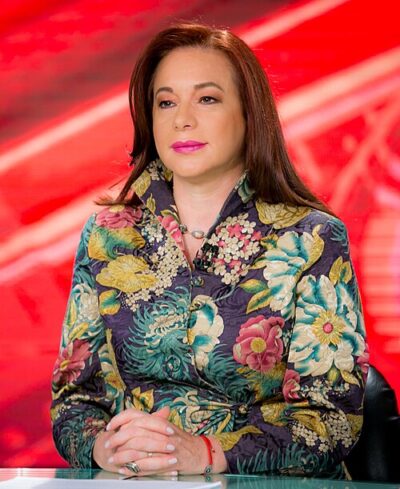
María Fernanda Espinosa
María Fernanda Espinosa is an Ecuadorian politician and poet. Born September 7, 1964, in Salamanca. Positions held include Minister of National Defence (2012–2014), Permanent Representative to the United Nations and President of the United Nations General Assembly (2018–2019). Educated at Pontificia Universidad Católica del Ecuador and Latin American School for Social Sciences. Awards include Grand Cross of the Order of the Sun of Peru, BBC 100 Women and Sir Brian Urquhart Award.
Facts
22 facts · 1 confirmed by two sources · 4 cited · 17 from one source
Where this comes from
Papalocal keeps its own record. It started from these sources; what each one said is kept here as it was copied, so a change on their side never changes this page by itself. Tap one to read its version.
What Wikidata says · copied November 16, 2026 · revision 2562809618
- Described as
- Ecuadorian politician and poet
- Other names
- María Fernanda Espinoza Garcés, Maria Fernanda Espinosa, María Fernanda Espinosa Garcés
- Born
- September 7, 1964 · 1 reference
- Born in
- Salamanca
- Citizen of
- Ecuador
- Occupation
- poet; diplomat; writer; politician
- Positions held
- Minister of National Defence (2012–2014) · 2 references; Permanent Representative to the United Nations; President of the United Nations General Assembly (2018–2019) · 1 reference; Minister of Foreign Affairs of Ecuador (2 times) (2007–2018) · 1 reference
- Political party
- PAIS Alliance (2006–2018)
- Worked for
- United Nations
- Education
- Pontificia Universidad Católica del Ecuador · 1 reference; Latin American School for Social Sciences
- Member of
- World Future Council
- Awards
- Grand Cross of the Order of the Sun of Peru · 1 reference; BBC 100 Women (2019) · 1 reference; Sir Brian Urquhart Award
- Field
- diplomat
- Spouse
- Eduardo Mangas
- Lived in
- New York City
- Wikipedias with a page
- 28
Wikidata item Q460904 (wikidata.org/wiki/Q460904), public domain (CC0). Copied November 16, 2026.
What Wikipedia says · copied November 16, 2026 · revision 1378147032
María Fernanda Espinosa Garcés (born 7 September 1964) is an Ecuadorian linguist, poet, politician, and diplomat. Currently, is Executive Director of GWL Voices, an NGO dedicated to achieve a gender-equal multilateral system. She served as an advisor on biodiversity and indigenous peoples (1999–2005) and was the regional director for South America (2005–2007) at the International Union for Conservation of Nature (IUCN). Espinosa Garcés was Ecuador's Minister of Foreign Affairs twice, from 2007 to 2008 and then from 2017 to 2018. She also served as ambassador and permanent representative to the United Nations in New York (2008–2009) and Geneva (2014–2017), and as Ecuador's Minister of National Defense (2012–2014). In June 2018, she was elected President of the United Nations General Assembly for the 73rd session by a two-thirds vote of the member states. Espinosa Garcés became the fourth woman in the seventy-three-year history of the United Nations to be elected President of the General Assembly. Besides her political career, she is also a poet and essayist.
- Born, in its opening lines
- September 7, 1964
From the Wikipedia article “María Fernanda Espinosa” (en.wikipedia.org/wiki/María_Fernanda_Espinosa), by its contributors, under CC BY-SA 4.0 (creativecommons.org/licenses/by-sa/4.0/). Copied November 16, 2026; not changed.
Confirmed Two sources agree. Cited One source, and it names where it got it. One source One source, without a reference of its own. Sources disagree The sources disagree. We show the best-supported value and keep theirs below.
