
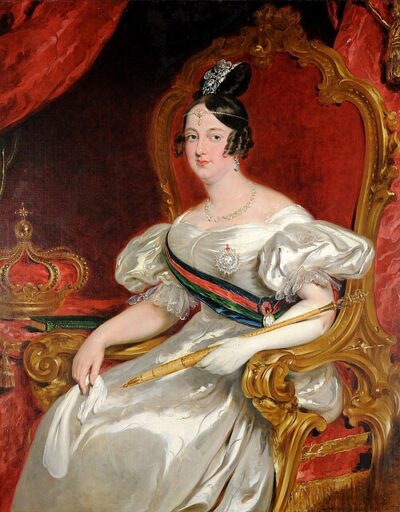
Maria II of Portugal
Maria II of Portugal was a Queen of Portugal (r. 1826–1828; 1834–1853). Born April 4, 1819, in Rio de Janeiro. Died November 15, 1853, in Lisbon. Positions held include Monarch of Portugal (2 times) (1826–1853) and Grand Mistress of the Order of Saint Isabel (1826–1853). Awards include Golden Rose, Grand Master of the Order of the Immaculate Conception of Vila Viçosa and Grand Cross of the Sash of the Three Orders.
Facts
41 facts · 2 confirmed by two sources · 3 cited · 36 from one source
Where this comes from
Papalocal keeps its own record. It started from these sources; what each one said is kept here as it was copied, so a change on their side never changes this page by itself. Tap one to read its version.
What Wikidata says · copied November 16, 2026 · revision 2559701186
- Described as
- Queen of Portugal (r. 1826–1828; 1834–1853)
- Other names
- Maria da Glória Joana Carlota Leopoldina da Cruz Francisca Xavier de Paula Isidora Micaela Gabriela Rafaela Gonzaga, Maria II the Educator, Maria II the Good Mother
- Born
- April 4, 1819 · 6 references
- Died
- November 15, 1853 · 6 references
- Born in
- Rio de Janeiro · 1 reference
- Died in
- Lisbon · 1 reference
- Buried in
- Pantheon of the House of Braganza · 1 reference
- Cause of death
- puerperal disorders
- Name at birth
- Maria da Glória Joana Carlota Leopoldina da Cruz Francisca Xavier de Paula Isidora Micaela Gabriela Rafaela Gonzaga
- Citizen of
- Brazil; Kingdom of Portugal
- Positions held
- Monarch of Portugal (2 times) (1826–1853) · 1 reference; Grand Mistress of the Order of Saint Isabel (1826–1853)
- Awards
- Golden Rose; Grand Master of the Order of the Immaculate Conception of Vila Viçosa; Grand Cross of the Sash of the Three Orders · 1 reference; Grand Cross of the Order of the Immaculate Conception of Vila Viçosa
- Spouse
- Auguste de Beauharnais (1835) · 1 reference; Ferdinand II of Portugal (1836–1853) · 1 reference
- Children
- Pedro V of Portugal; Luís I of Portugal; Infanta Maria of Portugal; Infante João, Duke of Beja; Infanta Maria Ana of Portugal; Infanta Antónia of Portugal; Infante Fernando of Portugal; Infante Augusto, Duke of Coimbra; Infante Leopoldo of Portugal; Infanta Maria da Glória of Portugal; Infante Eugénio of Portugal
- Father
- Pedro I of Brazil
- Mother
- Maria Leopoldina of Austria
- Siblings
- Infante Miguel of Portugal; Prince João Carlos, Prince of Beira; Princess Januária, Countess of Aquila; Princess Paula of Brazil; Rodrigo Delfim Pereira; Isabel Maria de Alcântara, Duchess of Goiás; Princess Francisca of Brazil; Pedro II of Brazil; Pedro de Alcántara Brasileiro; Maria Isabel de Alcântara, Countess of Iguaçu
- Religion
- Catholic Church
- Wikipedias with a page
- 51
Wikidata item Q221145 (wikidata.org/wiki/Q221145), public domain (CC0). Copied November 16, 2026.
What Wikipedia says · copied November 16, 2026 · revision 1382106342
Dona Maria II (Maria da Glória Joana Carlota Leopoldina da Cruz Francisca Xavier de Paula Isidora Micaela Gabriela Rafaela Gonzaga de Habsburgo-Lorena e Bragança; 4 April 1819 – 15 November 1853) also known as "the Educator" (Portuguese: a Educadora) or as "the Good Mother" (a Boa Mãe), was Queen of Portugal from 1826 to 1828, and again from 1834 to 1853. Her supporters considered her to be the rightful queen also during the period between her two reigns.
Maria was born in Rio de Janeiro during the reign of her paternal grandfather, King Dom João VI. She was the first child of the Duke and Duchess of Braganza, who later became Emperor Dom Pedro I and Empress Dona Maria Leopoldina of Brazil. In 1826, her father became king of Portugal but quickly abdicated in favour of the seven-year-old Maria. Both Pedro and Maria remained in Brazil, and her aunt Dona Isabel Maria initially served as regent for them in Portugal. Later, Emperor Pedro's brother Miguel replaced Isabel Maria as regent and was to marry Maria when she came of age. However, a few months after Miguel's arrival in Portugal in early 1828, he deposed the absent Maria and declared himself king, thus beginning the Liberal Wars over royal succession. Maria remained outside Portugal throughout her first reign, finally arriving in Gibraltar just in time to learn of her deposition. She proceeded to England and then returned to Brazil. In 1831, her father (having abdicated the Brazilian throne) returned to Europe with his daughter and led a military expedition in support of Maria's claim while she pursued her education in France. She finally set foot in Portugal for the first time in 1833 after Lisbon was occupied by forces supporting her. In 1834, Miguel was forced to abdicate and Maria was restored as undisputed queen. She remained a member of the Brazilian imperial family until 1835 when she was excluded from the Brazilian line of succession by law.
Maria's second reign was marked by continued political turmoil. In January 1835, she married Auguste, Duke of Leuchtenberg, who died two months after their marriage. In April 1836, Maria remarried to Prince Ferdinand of Saxe-Coburg and Gotha-Kohary. Maria's second husband was proclaimed King Dom Fernando II a year later in accordance with Portuguese law following the birth of their first child, Pedro. Maria faced a series of difficult pregnancies and ultimately died in childbirth in 1853 at the age of 34. She was succeeded by her eldest son, Dom Pedro V.
- Born, in its opening lines
- April 4, 1819
- Died, in its opening lines
- November 15, 1853
From the Wikipedia article “Maria II of Portugal” (en.wikipedia.org/wiki/Maria_II_of_Portugal), by its contributors, under CC BY-SA 4.0 (creativecommons.org/licenses/by-sa/4.0/). Copied November 16, 2026; not changed.
Confirmed Two sources agree. Cited One source, and it names where it got it. One source One source, without a reference of its own. Sources disagree The sources disagree. We show the best-supported value and keep theirs below.
