
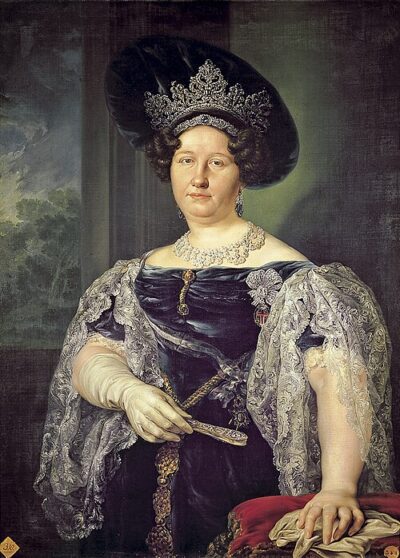
Maria Isabella of Spain
Maria Isabella of Spain was a Spanish infanta, Queen of the Two Sicilies. Born July 6, 1789, in Madrid. Died September 13, 1848, in Portici. Positions held include Consort of the Two Sicilies and Member of the Board of Ladies of Honour and Merit (1830–).
Facts
33 facts · 2 confirmed by two sources · 2 cited · 29 from one source
Where this comes from
Papalocal keeps its own record. It started from these sources; what each one said is kept here as it was copied, so a change on their side never changes this page by itself. Tap one to read its version.
What Wikidata says · copied November 16, 2026 · revision 2569434826
- Described as
- Spanish infanta, Queen of the Two Sicilies
- Other names
- María Isabella of Spain, María Isabella of the Two Sicilies, Maria Isabella of the Two Sicilies, María Isabella of Borbon, Maria Isabella of Borbon
- Born
- July 6, 1789 · 3 references
- Died
- September 13, 1848 · 4 references
- Born in
- Madrid
- Died in
- Portici
- Buried in
- Santa Chiara
- Citizen of
- Spain
- Occupation
- aristocrat; queen · 1 reference
- Positions held
- Consort of the Two Sicilies; Member of the Board of Ladies of Honour and Merit (1830–) · 1 reference
- Spouse
- Francis I of the Two Sicilies (1802–1830) · 1 reference; Francesco del Balzo (1839–) · 1 reference
- Children
- Princess Maria Antonia of the Two Sicilies; Princess Luisa Carlotta of the Two Sicilies; Ferdinand II of the Two Sicilies; Teresa Cristina of the Two Sicilies; Prince Francis, Count of Trapani; Leopold of the Two Sicilies, Count of Syracuse; Prince Louis, Count of Aquila; Prince Carlo Ferdinando, Prince of Capua; Princess Maria Carolina of the Two Sicilies; Princess Maria Amalia of the Two Sicilies; Maria Christina of the Two Sicilies; Prince Antonio, Count of Lecce
- Father
- Charles IV of Spain
- Mother
- Maria Luisa of Parma
- Siblings
- Ferdinand VII of Spain; Carlos de Borbón y Borbón-Parma; Infante Francisco de Paula of Spain; Maria Luisa I, Duchess of Lucca; Carlota Joaquina of Spain; Infanta María Amalia of Spain
- Religion
- Catholic Church
- Wikipedias with a page
- 33
Wikidata item Q233196 (wikidata.org/wiki/Q233196), public domain (CC0). Copied November 16, 2026.
What Wikipedia says · copied November 16, 2026 · revision 1382485026
Maria Isabella of Spain (Spanish: María Isabel de Borbón y Borbón-Parma; 6 July 1789 – 13 September 1848) was Queen of the Two Sicilies from 4 January 1825 until 8 November 1830 as the wife of Francis I of the Two Sicilies.
Maria Isabella was the youngest daughter of King Charles IV of Spain and Maria Luisa of Parma, the second daughter of Philip, Duke of Parma, and Louise-Élisabeth of France, and thus a granddaughter of King Louis XV and Queen Marie Leszczyńska. Maria Isabella's siblings included King Ferdinand VII of Spain, Carlota Joaquina, Queen of Portugal, and the Count of Molina.
Maria Isabella was born into political turmoil, coinciding with the events of the French Revolution and the rise of Manuel Godoy. She received a rudimentary education and was featured in the painting Charles IV of Spain and His Family, painted by the famed Goya.
Considered by her mother as a potential Empress of France, Maria Isabella instead married her cousin Prince Francesco, Duke of Calabria, later King Francis I of the Two Sicilies, and had many children. The family was forced to flee to Sicily in early 1806 when after several attempted invasions by Joachim Murat, brother-in-law of Emperor Napoleon, who had already succeeded in becoming King of Naples. However, they were returned to the mainland in Naples with the intervention of the British military.
In 1812, her husband was appointed regent for his elderly father and in 1825, the old king died, making Maria Isabella Queen consort of the Two Sicilies. She was known for her frivolity, and kept an active correspondence with her family in Spain, later marrying a young nobleman of the House of Baux. She died in 1848 at the age of 59; many of her children making marriages to their Spanish and Portuguese relatives.
- Born, in its opening lines
- July 6, 1789
- Died, in its opening lines
- September 13, 1848
From the Wikipedia article “María Isabel of Spain” (en.wikipedia.org/wiki/María_Isabel_of_Spain), by its contributors, under CC BY-SA 4.0 (creativecommons.org/licenses/by-sa/4.0/). Copied November 16, 2026; not changed.
Confirmed Two sources agree. Cited One source, and it names where it got it. One source One source, without a reference of its own. Sources disagree The sources disagree. We show the best-supported value and keep theirs below.
