
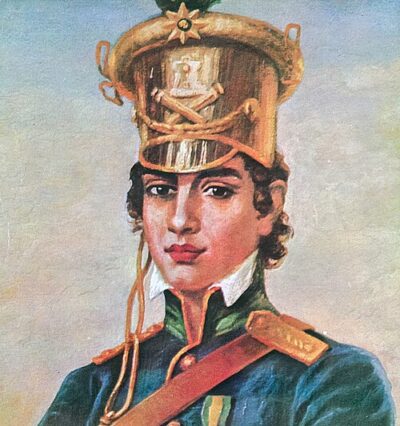
Maria Quitéria
Maria Quitéria was a Brazilian lieutenant and national heroine. Born July 27, 1792, in Feira de Santana. Died August 21, 1853, in Salvador. Awards include Imperial Order of the Southern Cross and Livro dos Heróis e Heroínas da Pátria.
Facts
12 facts · 2 confirmed by two sources · 4 cited · 6 from one source
Where this comes from
Papalocal keeps its own record. It started from these sources; what each one said is kept here as it was copied, so a change on their side never changes this page by itself. Tap one to read its version.
What Wikidata says · copied November 17, 2026 · revision 2533969001
- Described as
- Brazilian lieutenant and national heroine (1792–1853)
- Other names
- Maria Quitéria de Jesus, Soldado Medeiros
- Born
- July 27, 1792
- Died
- August 21, 1853
- Born in
- Feira de Santana
- Died in
- Salvador · 1 reference
- Buried in
- Igreja do Santíssimo Sacramento e Sant'Ana · 1 reference
- Citizen of
- Empire of Brazil
- Occupation
- military personnel; soldier · 1 reference
- Awards
- Imperial Order of the Southern Cross; Livro dos Heróis e Heroínas da Pátria · 1 reference
- Military branch
- Brazilian Army
- Military rank
- ensign
- Wikipedias with a page
- 25
Wikidata item Q2618916 (wikidata.org/wiki/Q2618916), public domain (CC0). Copied November 17, 2026.
What Wikipedia says · copied November 17, 2026 · revision 1380324676
Maria Quitéria de Jesus (27 July 1792 – 21 August 1853) was a Brazilian soldier and national heroine. She served in the Brazilian War of Independence in 1822–24 dressed as a man. She was promoted to cadet and lieutenant and later decorated with the Imperial Order of the Cross. Quitéria has been called the "Brazilian Joan of Arc", and has become a legendary figure in Brazil. Quitéria was the first woman to serve in a military unit in the country. She is known as one of the three Bahia women fighters against the Portuguese along with Maria Filipa de Oliveira (died 1873) and Sister Joana Angélica (1761-1822).
Against her father's will, an unmarried Maria Quitéria enlisted in the Parakeet Battalion, division of the Brazilian Army, as a man, in October 1822. Until June 1823, she fought in several battles against the Portuguese in Bahia, where she lived. Maria Quitéria's father outed her as a woman once he discovered her betrayal—but because of her skill in battle, she was allowed to continue to fight. She was promoted to cadet in July 1823, and then to lieutenant in August, where she was received and decorated by the Emperor.
Few details are known about her life. The historian Aristides Augusto Milton, a childhood friend of the poet Castro Alves, who in turn was a grandson of the major who defended Maria Quitéria for her skill with weapons and recognized military discipline, and incorporated it her to his troops, considered Maria Quitéria "a lady as brave as honest" in his Efemérides Cachoeiranas. She is briefly mentioned by English traveler and writer Maria Graham (later Lady Callcott) in her book Journal of a Voyage to Brazil: "Maria de Jesus is illiterate, but lively. She has clear intelligence and acute perception. I think that if they educated her, she would become a notable personality. One observes nothing masculine in her conduct, rather she is of gentle and friendly manners."
- Born, in its opening lines
- July 27, 1792
- Died, in its opening lines
- August 21, 1853
From the Wikipedia article “Maria Quitéria” (en.wikipedia.org/wiki/Maria_Quitéria), by its contributors, under CC BY-SA 4.0 (creativecommons.org/licenses/by-sa/4.0/). Copied November 17, 2026; not changed.
Confirmed Two sources agree. Cited One source, and it names where it got it. One source One source, without a reference of its own. Sources disagree The sources disagree. We show the best-supported value and keep theirs below.
