
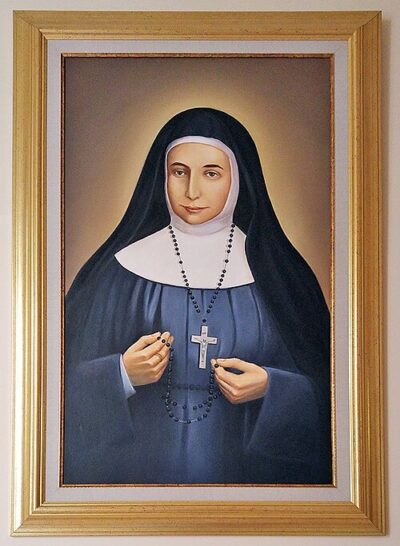
Marie-Alphonsine Danil Ghattas
Marie-Alphonsine Danil Ghattas was a Palestinian Christian nun and saint. Born October 4, 1843, in Jerusalem. Died March 25, 1927, in Ein Karem.
Facts
9 facts · 2 confirmed by two sources · 4 cited · 3 from one source
Where this comes from
Papalocal keeps its own record. It started from these sources; what each one said is kept here as it was copied, so a change on their side never changes this page by itself. Tap one to read its version.
What Wikidata says · copied November 18, 2026 · revision 2566850762
- Described as
- Palestinian Christian nun and saint (1843–1927)
- Born
- October 4, 1843 · 2 references
- Died
- March 25, 1927 · 2 references
- Born in
- Jerusalem · 1 reference
- Died in
- Ein Karem · 1 reference
- Citizen of
- Ottoman Empire; Mandatory Palestine
- Occupation
- nun · 1 reference; founder of Catholic religious community · 1 reference
- Religion
- Catholic Church
- Wikipedias with a page
- 22
Wikidata item Q444239 (wikidata.org/wiki/Q444239), public domain (CC0). Copied November 18, 2026.
What Wikipedia says · copied November 18, 2026 · revision 1354609376
Marie-Alphonsine Danil Ghattas, OP (4 October 1843 – 25 March 1927) was a Palestinian Catholic nun who founded the Dominican Sisters of the Most Holy Rosary of Jerusalem (the Rosary Sisters), the first Palestinian religious congregation. She was beatified by Archbishop Angelo Amato on behalf of Pope Benedict XVI in 2009. On 6 December 2014, Pope Francis recognized a miracle that had been attributed to her intercession, a requirement for her canonization. The date of her canonization was announced on 14 February 2015, and she was canonized on 17 May 2015.
- Born, in its opening lines
- October 4, 1843
- Died, in its opening lines
- March 25, 1927
From the Wikipedia article “Marie-Alphonsine Danil Ghattas” (en.wikipedia.org/wiki/Marie-Alphonsine_Danil_Ghattas), by its contributors, under CC BY-SA 4.0 (creativecommons.org/licenses/by-sa/4.0/). Copied November 18, 2026; not changed.
Confirmed Two sources agree. Cited One source, and it names where it got it. One source One source, without a reference of its own. Sources disagree The sources disagree. We show the best-supported value and keep theirs below.
