
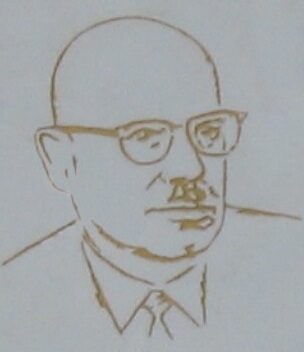
Mark Krein
Mark Krein was a Soviet mathematician. Born April 15, 1908, in Ivankiv. Died October 17, 1989, in Odesa. Known for Krein–Milman theorem, Markov–Krein theorem and Krein–Šmulian theorem. Educated at Odesa University. Awards include M. M. Krylov Prize of the NAS of Ukraine, Wolf Prize in Mathematics and State Prize of Ukrainian SSR in Science and Technology.
Facts
38 facts · 1 confirmed by two sources · 10 cited · 26 from one source · 1 where the sources disagree
What’s different
- Born: we show April 15, 1908 (Sources disagree). Wikipedia says April 3, 1907
Where this comes from
Papalocal keeps its own record. It started from these sources; what each one said is kept here as it was copied, so a change on their side never changes this page by itself. Tap one to read its version.
What Wikidata says · copied November 18, 2026 · revision 2553947799
- Described as
- Soviet mathematician (1907-1989)
- Other names
- Mark Grigorievich Krein
- Born
- April 15, 1908 · 2 references
- Died
- October 17, 1989 · 2 references
- Born in
- Ivankiv
- Died in
- Odesa
- Buried in
- 2nd Christian Cemetery · 1 reference
- Name at birth
- Марк Григо́рьевич Крейн
- Citizen of
- Soviet Union
- Occupation
- mathematician · 1 reference; university teacher
- Worked for
- Odesa University (1929–1941) · 1 reference; Samara State Technical University (1941–1944) · 1 reference; National University «Odesa Maritime Academy» (1944–1954) · 1 reference; National Academy of Sciences of Ukraine (1944–1952) · 1 reference; Odesa State Academy of Civil Engineering and Architecture (1954–1976) · 2 references; Kryvyi Rih National University (1952–1954) · 1 reference; Institute of Physical Chemistry (1978–)
- Education
- Odesa University (–1929) · 1 reference
- Member of
- National Academy of Sciences of Ukraine; American Academy of Arts and Sciences; National Academy of Sciences (1981–)
- Known for
- Krein–Milman theorem; Markov–Krein theorem; Krein–Šmulian theorem; Krein–Rutman theorem; Krein space; Tannaka–Krein duality; Krein's condition
- Awards
- M. M. Krylov Prize of the NAS of Ukraine (1978); Wolf Prize in Mathematics (1982) · 1 reference; State Prize of Ukrainian SSR in Science and Technology (1987) · 1 reference
- Field
- functional analysis; integral equation; function theory; algebra; mathematical physics; theory of differential equations
- Siblings
- Selim Kreyn
- Lived in
- Russian Empire · 1 reference
- Wikipedias with a page
- 23
Wikidata item Q950211 (wikidata.org/wiki/Q950211), public domain (CC0). Copied November 18, 2026.
What Wikipedia says · copied November 18, 2026 · revision 1372443885
Mark Grigorievich Krein (Russian: Марк Григо́рьевич Крейн; Ukrainian: Марко́ Григо́рович Крейн; 3 April 1907 – 17 October 1989) was a Soviet mathematician, one of the major figures of the Soviet school of functional analysis. He is known for works in operator theory (in close connection with concrete problems coming from mathematical physics), the problem of moments, classical analysis and representation theory.
- Born, in its opening lines
- April 3, 1907
- Died, in its opening lines
- October 17, 1989
From the Wikipedia article “Mark Krein” (en.wikipedia.org/wiki/Mark_Krein), by its contributors, under CC BY-SA 4.0 (creativecommons.org/licenses/by-sa/4.0/). Copied November 18, 2026; not changed.
Confirmed Two sources agree. Cited One source, and it names where it got it. One source One source, without a reference of its own. Sources disagree The sources disagree. We show the best-supported value and keep theirs below.
