
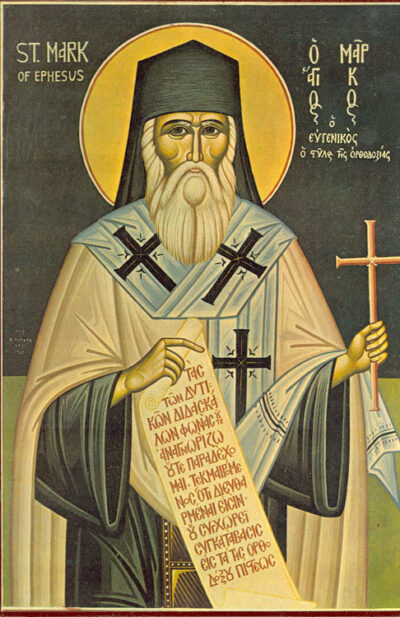
Mark of Ephesus
Mark of Ephesus was an archbishop of Ephesus. Born 1392, in Constantinople. Died June 1445, in Constantinople. Positions held include archbishop and bishop.
Facts
13 facts · 0 confirmed by two sources · 2 cited · 9 from one source · 2 where the sources disagree
What’s different
- Born: we show 1392 (Sources disagree). Wikipedia says 1438
- Died: we show June 1445 (Sources disagree). Wikipedia says 1439
Where this comes from
Papalocal keeps its own record. It started from these sources; what each one said is kept here as it was copied, so a change on their side never changes this page by itself. Tap one to read its version.
What Wikidata says · copied November 16, 2026 · revision 2546234404
- Described as
- archbishop of Ephesus
- Other names
- Mark Eugenikos
- Born
- 1392
- Died
- June 1445
- Born in
- Constantinople
- Died in
- Constantinople
- Citizen of
- Byzantine Empire
- Occupation
- philosopher; theologian · 1 reference; Eastern Orthodox priest; monk · 1 reference
- Positions held
- archbishop; bishop
- Siblings
- John Eugenikos
- Religion
- Eastern Orthodoxy
- Wikipedias with a page
- 29
Wikidata item Q738727 (wikidata.org/wiki/Q738727), public domain (CC0). Copied November 16, 2026.
What Wikipedia says · copied November 16, 2026 · revision 1366847655
Mark of Ephesus (Greek: Μᾶρκος ὁ Ἐφέσιος, born Manuel Eugenikos, also called Markos Eugenikos) was a hesychast theologian of the late Palaiologan period of the Byzantine Empire who became famous for his rejection of the Council of Ferrara–Florence (1438–1439). As a monk in Constantinople, Mark was a prolific hymnographer and a follower of Gregory Palamas' theological views. As a theologian and a scholar, he was instrumental in the preparations for the Council of Ferrara–Florence, and as Metropolitan of Ephesus and delegate for the Patriarch of Alexandria, he was one of the most important voices at the synod. At the beginning of the Council, Mark was initially favorable toward accepting the union. During the commission's work, he authored several theological works, including Ten Arguments Against the Existence of Purgatory, Summa of Sayings on the Holy Spirit, Chapters Against the Latins, Confession of Faith, and On the Time of the Transubstantiation. Over this period, he distanced himself from the idea of accepting the union, concluding that the teachings of the Western Church were inconsistent with the dogmas of the Ecumenical Councils. After renouncing the council as a lost cause, Mark became the leader of the Orthodox opposition to the Union of Florence, thus sealing his reputation as a defender of Eastern Orthodoxy and pillar of the Eastern Orthodox Church.
- Born, in its opening lines
- 1438
- Died, in its opening lines
- 1439
From the Wikipedia article “Mark of Ephesus” (en.wikipedia.org/wiki/Mark_of_Ephesus), by its contributors, under CC BY-SA 4.0 (creativecommons.org/licenses/by-sa/4.0/). Copied November 16, 2026; not changed.
Confirmed Two sources agree. Cited One source, and it names where it got it. One source One source, without a reference of its own. Sources disagree The sources disagree. We show the best-supported value and keep theirs below.
