
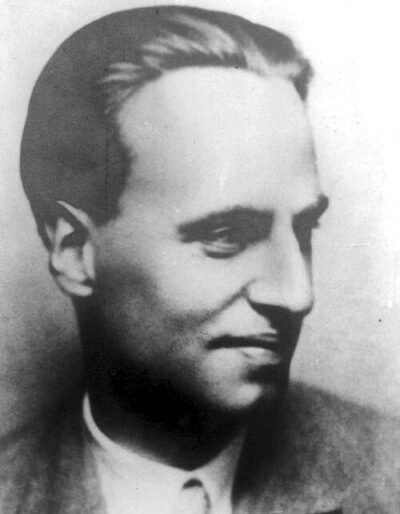
Mart Stam
Mart Stam was a Dutch architect. Born August 5, 1899, in Purmerend. Died February 21, 1986, in Zurich.
Facts
19 facts · 2 confirmed by two sources · 10 cited · 7 from one source
Where this comes from
Papalocal keeps its own record. It started from these sources; what each one said is kept here as it was copied, so a change on their side never changes this page by itself. Tap one to read its version.
What Wikidata says · copied November 18, 2026 · revision 2568782867
- Described as
- Dutch architect (1899–1986)
- Other names
- Martin Stam, Martinus Adrianus Stam
- Born
- August 5, 1899 · 11 references
- Died
- February 21, 1986 · 6 references
- Born in
- Purmerend · 3 references
- Died in
- Zurich · 1 reference
- Citizen of
- Kingdom of the Netherlands · 2 references; Weimar Republic; Soviet Union; East Germany
- Occupation
- architect · 4 references; university teacher; industrial designer · 2 references; urban planner; furniture designer · 2 references; interior designer · 1 reference
- Worked for
- Weißensee Academy of Art Berlin; Bauhaus · 1 reference
- Field
- product design · 1 reference
- Spouse
- Lotte Stam-Beese (1934–1944) · 1 reference
- Children
- Ariane Stam · 1 reference
- Wikipedias with a page
- 23
Wikidata item Q708333 (wikidata.org/wiki/Q708333), public domain (CC0). Copied November 18, 2026.
What Wikipedia says · copied November 18, 2026 · revision 1368427247
Mart Stam (5 August 1899 – 21 February 1986) was a Dutch architect, urban planner, and furniture designer. Stam was extraordinarily well-connected, and his career intersects with important moments in the history of 20th-century European architecture, including the invention of the cantilever chair, teaching at the Bauhaus, contributions to the Weissenhof Estate, the Van Nelle Factory, (an important modernist landmark in Rotterdam), buildings for Ernst May's New Frankfurt housing estates, followed by work in the USSR with the idealistic May Brigade, to teaching positions in Amsterdam and post-war East Germany. Upon return to the Netherlands he contributed to postwar reconstruction and finally retired, (or rather self-isolated), in Switzerland, where he died.
His design philosophy was inspired by both functionalism and scientific communism and his style of design is in line with the New Objectivity, an art movement formed during the depression in 1920s Germany, as a counter-movement and an outgrowth of expressionist architecture.
- Born, in its opening lines
- August 5, 1899
- Died, in its opening lines
- February 21, 1986
From the Wikipedia article “Mart Stam” (en.wikipedia.org/wiki/Mart_Stam), by its contributors, under CC BY-SA 4.0 (creativecommons.org/licenses/by-sa/4.0/). Copied November 18, 2026; not changed.
Confirmed Two sources agree. Cited One source, and it names where it got it. One source One source, without a reference of its own. Sources disagree The sources disagree. We show the best-supported value and keep theirs below.
