
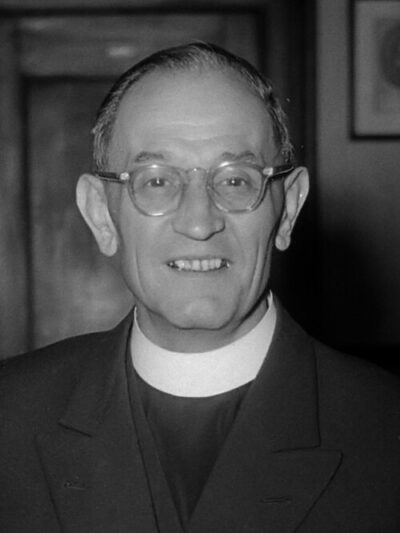
Martin Niemöller
Martin Niemöller was a German theologian. Born January 14, 1892, in Lippstadt. Died March 6, 1984, in Wiesbaden. Awards include Wilhelm Leuschner Medal, Medal Carl von Ossietzky and Grand Cross 1st class of the Order of Merit of the Federal Republic of Germany.
Facts
29 facts · 2 confirmed by two sources · 11 cited · 16 from one source
Where this comes from
Papalocal keeps its own record. It started from these sources; what each one said is kept here as it was copied, so a change on their side never changes this page by itself. Tap one to read its version.
What Wikidata says · copied November 16, 2026 · revision 2568739347
- Described as
- German theologian (1892–1984)
- Other names
- Friedrich Gustav Emil Martin Niemöller
- Born
- January 14, 1892 · 10 references
- Died
- March 6, 1984 · 10 references
- Born in
- Lippstadt · 2 references
- Died in
- Wiesbaden · 2 references
- Buried in
- Osnabrück
- Name at birth
- Friedrich Gustavo Emilo Martin Niemöller
- Citizen of
- Germany · 2 references; German Empire · 1 reference; Nazi Germany · 1 reference
- Occupation
- poet; submariner; resistance fighter · 1 reference; peace activist; Lutheran pastor; priest · 1 reference; preacher · 1 reference; opinion journalist · 1 reference
- Awards
- Wilhelm Leuschner Medal (1972); Medal Carl von Ossietzky (1983); Grand Cross 1st class of the Order of Merit of the Federal Republic of Germany (1970); Iron Cross; Lenin Peace Prize; Carl von Ossietzky Medal (1983) · 1 reference; Joseph E. Drexel award (1977)
- Spouse
- Else Bruner
- Children
- Martin Niemöller · 1 reference
- Father
- Heinrich Niemöller · 1 reference
- Siblings
- Wilhelm Niemöller · 1 reference
- Religion
- Lutheranism
- Wikipedias with a page
- 75
Wikidata item Q153839 (wikidata.org/wiki/Q153839), public domain (CC0). Copied November 16, 2026.
What Wikipedia says · copied November 16, 2026 · revision 1384611691
Friedrich Gustav Emil Martin Niemöller (German: [ˈmaʁtiːn ˈniːmœlɐ] ; 14 January 1892 – 6 March 1984) was a German theologian and Lutheran pastor. He opposed the Nazi regime during the late 1930s, and was sent to a concentration camp for his affiliation with the Confessing Church and his opposition to state involvement in Church. After the war, he went on tour around the world to condemn the Nazi cause and educate people about the importance of human rights. In 1946 he published the confessional piece "First They Came".
Niemöller was a national conservative and initially a supporter of Adolf Hitler and a self-identified antisemite. He became one of the founders of the Confessing Church, which opposed the Nazification of German Protestant churches. He opposed the Nazis' Aryan Paragraph. For his opposition to the Nazis' state control of the churches, Niemöller was imprisoned in Sachsenhausen concentration camp and Dachau concentration camps from 1938 to 1945. He narrowly escaped execution.
After his imprisonment, he expressed his deep regret about not having done enough to help victims of the Nazis. He turned away from his earlier nationalistic beliefs and was one of the initiators of the Stuttgart Declaration of Guilt. From the 1950s on, he was a vocal pacifist and anti-war activist, and vice-chair of War Resisters' International from 1966 to 1972. He met with Ho Chi Minh during the Vietnam War and was a committed campaigner for nuclear disarmament.
- Born, in its opening lines
- January 14, 1892
- Died, in its opening lines
- March 6, 1984
From the Wikipedia article “Martin Niemöller” (en.wikipedia.org/wiki/Martin_Niemöller), by its contributors, under CC BY-SA 4.0 (creativecommons.org/licenses/by-sa/4.0/). Copied November 16, 2026; not changed.
Confirmed Two sources agree. Cited One source, and it names where it got it. One source One source, without a reference of its own. Sources disagree The sources disagree. We show the best-supported value and keep theirs below.
