
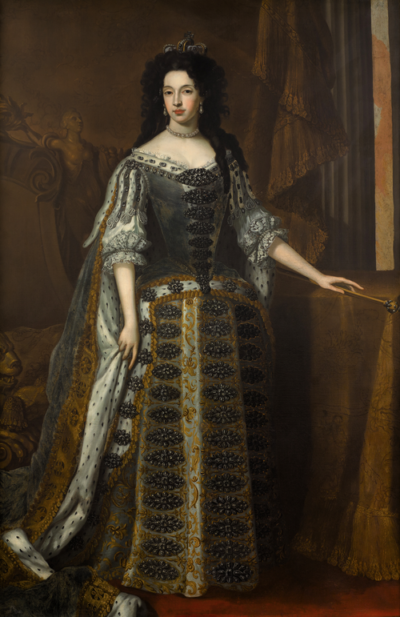
Mary of Modena
Mary of Modena was a Queen consort of England. Born October 5, 1658, in Ducal Palace of Modena. Died May 7, 1718, in Saint-Germain-en-Laye. Positions held include Consort of England (1685–1688), Consort of Scotland (1685–1688) and Consort of Ireland (1685–1688).
Facts
28 facts · 2 confirmed by two sources · 12 cited · 14 from one source
Where this comes from
Papalocal keeps its own record. It started from these sources; what each one said is kept here as it was copied, so a change on their side never changes this page by itself. Tap one to read its version.
What Wikidata says · copied November 16, 2026 · revision 2558153621
- Described as
- Queen consort of England (1685-1688)
- Other names
- Maria d'Este
- Born
- October 5, 1658 · 2 references
- Died
- May 7, 1718 · 2 references
- Born in
- Ducal Palace of Modena
- Died in
- Saint-Germain-en-Laye · 1 reference
- Buried in
- Saint-Germain-en-Laye · 1 reference
- Cause of death
- breast cancer
- Citizen of
- Kingdom of Great Britain
- Occupation
- aristocrat
- Positions held
- Consort of England (1685–1688); Consort of Scotland (1685–1688); Consort of Ireland (1685–1688)
- Spouse
- James II of England (1673–) · 2 references
- Children
- James Francis Edward Stuart, Prince of Wales · 1 reference; Louisa Maria Stuart; Princess Isabel of York · 2 references; Charles Stuart, Duke of Cambridge; Charlotte Maria Stuart · 2 references; Catherine Laura Stuart · 2 references; child1 Stuart · 2 references; child2 Stuart · 2 references; child3 Stuart · 2 references; child4 Stuart · 2 references; Elizabeth Stuart · 2 references; child5 Stuart · 2 references
- Father
- Alfonso IV d'Este, Duke of Modena
- Mother
- Laura Martinozzi
- Siblings
- Francesco II d'Este, Duke of Modena
- Religion
- Catholicism
- Wikipedias with a page
- 45
Wikidata item Q232475 (wikidata.org/wiki/Q232475), public domain (CC0). Copied November 16, 2026.
What Wikipedia says · copied November 16, 2026 · revision 1383957001
Mary of Modena (Italian: Maria Beatrice Eleonora Anna Margherita Isabella d'Este; 5 October [O.S. 25 September] 1658 – 7 May [O.S. 26 April] 1718) was Queen of England, Scotland and Ireland as the second wife of James VII and II. A devout Roman Catholic, Mary married the widower James, who was then the younger brother and heir presumptive of Charles II. She was devoted to James and their children, two of whom survived to adulthood: the Jacobite claimant to the thrones, James Francis Edward Stuart, and Louisa Maria Stuart.
Born a princess of the northwestern Italian Duchy of Modena, Mary is primarily remembered for the controversial birth of Prince James Francis Edward, her only surviving son. It was widely rumoured that he was smuggled into the birth chamber in a warming pan in order to perpetuate her husband's Roman Catholic Stuart dynasty. James Francis Edward's birth was a contributing factor to the "Glorious Revolution", the revolution which deposed James VII and II, and replaced him with Mary II, a Protestant, the elder of James II's daughters from his first marriage to Anne Hyde (1637–1671). Mary II and her husband, William III of Orange, would reign jointly over all three kingdoms.
Mary went into exile in France, being known as the "Queen over the Water" among the Jacobites. She lived with her husband and children in the Château de Saint-Germain-en-Laye, provided by King Louis XIV. Mary was popular among Louis's courtiers; James, however, was considered a bore. In widowhood, Mary spent time with the nuns at the Convent of Chaillot, frequently during summers with her daughter, Louisa Maria Teresa. In 1701, when James II died, young James Francis Edward, aged 13, became king in the eyes of the Jacobites. Given that he was too young to assume the nominal reins of government, Mary represented him until he reached the age of 16. When James Francis Edward was asked to leave France as part of the settlement from the Treaty of Utrecht in 1713, which ended the War of the Spanish Succession (1701–1714), Mary stayed despite having no family there, her daughter having died of smallpox. Fondly remembered by her French contemporaries, Mary died of breast cancer in 1718.
- Born, in its opening lines
- October 5, 1658
- Died, in its opening lines
- May 7, 1718
From the Wikipedia article “Mary of Modena” (en.wikipedia.org/wiki/Mary_of_Modena), by its contributors, under CC BY-SA 4.0 (creativecommons.org/licenses/by-sa/4.0/). Copied November 16, 2026; not changed.
Confirmed Two sources agree. Cited One source, and it names where it got it. One source One source, without a reference of its own. Sources disagree The sources disagree. We show the best-supported value and keep theirs below.
