
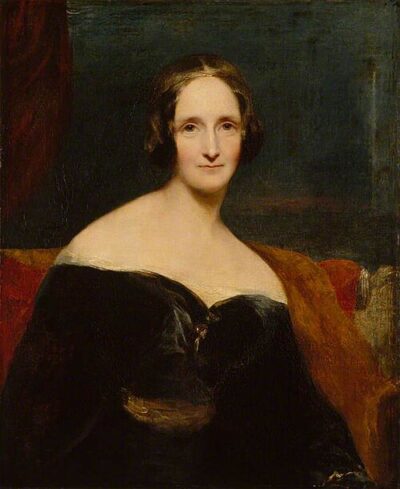
Mary Shelley
Mary Shelley was an English writer. Born August 30, 1797, in Somers Town. Died February 1, 1851, in Bournemouth. Known for The Last Man and Frankenstein; or, The Modern Prometheus. Awards include Science Fiction and Fantasy Hall of Fame.
Facts
38 facts · 2 confirmed by two sources · 14 cited · 21 from one source · 1 where the sources disagree
What’s different
- Died in: we show Bournemouth (Sources disagree). Wikidata also lists Chester Square
Where this comes from
Papalocal keeps its own record. It started from these sources; what each one said is kept here as it was copied, so a change on their side never changes this page by itself. Tap one to read its version.
What Wikidata says · copied November 16, 2026 · revision 2570029270
- Described as
- English writer (1797–1851)
- Other names
- Mary Wollstonecraft Shelley, Mary Wollstonecraft Godwin, Mary Godwin
- Born
- August 30, 1797 · 13 references
- Died
- February 1, 1851 · 12 references
- Born in
- Somers Town · 2 references
- Died in
- Chester Square; Bournemouth · 1 reference
- Buried in
- St Peter's Church, Bournemouth
- Cause of death
- brain tumor · 3 references
- Name at birth
- Mary Godwin
- Citizen of
- United Kingdom of Great Britain and Ireland; Kingdom of Great Britain (–1801); United Kingdom · 1 reference
- Occupation
- writer · 3 references; travel writer; novelist · 1 reference; essayist; playwright; biographer; science fiction writer; poet · 1 reference
- Genre
- travel book; Gothic literature; Gothic novel; speculative fiction
- Known for
- The Last Man; Frankenstein; or, The Modern Prometheus
- Awards
- Science Fiction and Fantasy Hall of Fame (2004) · 1 reference
- Field
- fiction · 1 reference
- Spouse
- Percy Bysshe Shelley (1816–) · 4 references
- Children
- Clara Everina Shelley · 1 reference; William Shelley · 2 references; Percy Florence Shelley · 2 references; Clara Shelley · 1 reference
- Father
- William Godwin · 2 references
- Mother
- Mary Wollstonecraft · 3 references
- Siblings
- William Godwin the Younger; Fanny Imlay · 1 reference; Claire Clairmont; Charles Gaulis Clairmont
- Lived in
- London
- Wikipedias with a page
- 136
Wikidata item Q47152 (wikidata.org/wiki/Q47152), public domain (CC0). Copied November 16, 2026.
What Wikipedia says · copied November 16, 2026 · revision 1384670567
Mary Wollstonecraft Shelley (née Godwin; 30 August 1797 – 1 February 1851) was an English novelist who wrote the Gothic novel Frankenstein; or, The Modern Prometheus (1818), which is considered an early example of science fiction. She also edited and promoted the works of her husband, the Romantic poet and philosopher Percy Bysshe Shelley. Her father was the political philosopher William Godwin and her mother was the philosopher and women's rights advocate Mary Wollstonecraft.
Mary's mother died 11 days after giving birth to her. She was raised by her father, who provided her with a rich informal education, encouraging her to adhere to his own anarchist political theories. When she was four, her father married a neighbour, Mary Jane Clairmont, with whom Mary had a troubled relationship.
In 1814, Mary began a romance with one of her father's political followers, Percy Bysshe Shelley, who was already married. Together with her stepsister, Claire Clairmont, she and Percy left for France and travelled through Europe. Upon their return to England, Mary was pregnant with Percy's child. Over the next two years, she and Percy faced ostracism, constant debt and the death of their daughter. They married in late 1816, after the suicide of Percy's wife, Harriet.
In 1816, the couple and Mary's stepsister famously spent a summer with Lord Byron and John William Polidori near Geneva, Switzerland, where Mary conceived the idea for her novel Frankenstein. The Shelleys left Britain in 1818 for Italy, where their second and third children died before Mary gave birth to her last and only surviving child, Percy Florence Shelley. In 1822, her husband drowned when his sailing boat sank during a storm near Viareggio. A year later, Mary returned to England and from then on devoted herself to raising her son and to her career as a professional author. The last decade of her life was dogged by illness, most likely caused by the brain tumour which killed her at the age of 53.
Until the 1970s, Mary Shelley was known mainly for her efforts to publish her husband's works and for her novel Frankenstein, which remains widely read and has inspired many theatrical and film adaptations. Recent scholarship has yielded a more comprehensive view of her achievements. Scholars have shown increasing interest in her literary output, particularly in her novels, which include the historical novels Valperga (1823) and Perkin Warbeck (1830), the apocalyptic novel The Last Man (1826) and her final two novels, Lodore (1835) and Falkner (1837). Studies of her lesser-known works, such as the travel book Rambles in Germany and Italy (1844) and the biographical articles for Dionysius Lardner's Cabinet Cyclopaedia (1829–1846), support the growing view that Mary Shelley remained a political radical throughout her life. Mary Shelley's works often argue that cooperation and sympathy, particularly as practised by women in the family, were the ways to reform civil society. This view was a direct challenge to the individualistic Romantic ethos promoted by Percy Shelley and the Enlightenment political theories articulated by Mary's father, William Godwin.
- Born, in its opening lines
- August 30, 1797
- Died, in its opening lines
- February 1, 1851
From the Wikipedia article “Mary Shelley” (en.wikipedia.org/wiki/Mary_Shelley), by its contributors, under CC BY-SA 4.0 (creativecommons.org/licenses/by-sa/4.0/). Copied November 16, 2026; not changed.
Confirmed Two sources agree. Cited One source, and it names where it got it. One source One source, without a reference of its own. Sources disagree The sources disagree. We show the best-supported value and keep theirs below.
