
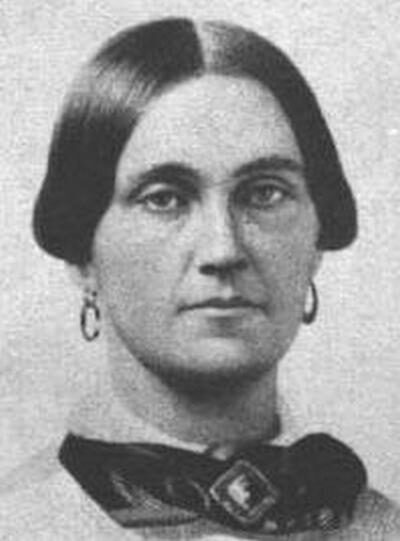
Mary Surratt
Mary Surratt was a Lincoln assassination conspirator. Born 1820, in Prince George's County. Died July 7, 1865, in Fort Lesley J. McNair.
Facts
15 facts · 1 confirmed by two sources · 10 cited · 3 from one source · 1 where the sources disagree
What’s different
- Born: we show 1820 (Sources disagree). Wikipedia says May 4, 1823
Where this comes from
Papalocal keeps its own record. It started from these sources; what each one said is kept here as it was copied, so a change on their side never changes this page by itself. Tap one to read its version.
What Wikidata says · copied November 16, 2026 · revision 2535044288
- Described as
- Lincoln assassination conspirator
- Other names
- Mary Elizabeth Surratt, Mary Elizabeth Jenkins, Mary Eugenia Jenkins, Maria Eugenia, Mary Eugenia Jenkins Surratt, Mary Elizabeth Jenkins Surratt, Mary E. Surratt
- Born
- 1820 · 10 references
- Died
- July 7, 1865 · 7 references
- Born in
- Prince George's County · 3 references
- Died in
- Fort Lesley J. McNair · 1 reference
- Buried in
- Mount Olivet Cemetery · 1 reference
- Cause of death
- hanging to death · 3 references
- Citizen of
- United States
- Occupation
- lawyer; businessperson · 1 reference
- Political party
- Democratic Party · 1 reference
- Children
- John Surratt · 1 reference
- Religion
- Episcopal Church · 1 reference; Catholicism · 2 references
- Lived in
- Mary E. Surratt Boarding House (1864–1865) · 3 references; Surratt House & Tavern (–1864)
- Wikipedias with a page
- 20
Wikidata item Q459991 (wikidata.org/wiki/Q459991), public domain (CC0). Copied November 16, 2026.
What Wikipedia says · copied November 16, 2026 · revision 1380790325
Mary Elizabeth Surratt (née Jenkins; May 4, 1823 – July 7, 1865) was an American boarding house owner in Washington, D.C., who was convicted of taking part in the conspiracy which led to the assassination of U.S. president Abraham Lincoln in 1865. Sentenced to death by hanging, she became the first woman executed by the U.S. federal government. Surratt maintained her innocence until her death, and the case against her was and remains controversial. She was the mother of John Surratt, who was later tried in the conspiracy, but was not convicted.
Born in Waterloo, Maryland in the 1820s, she attended school in Alexandria, Virginia. She wed John Harrison Surratt in 1840 and had three children with him. An entrepreneur, John became the owner of a tavern, an inn, and a hotel. The Surratts were sympathetic to the Confederate States of America and often hosted fellow Confederate sympathizers at their tavern. Upon her husband's death in 1862, Surratt had to manage his estate. Tired of doing so without help, Surratt moved to her townhouse in Washington, D.C., which she then ran as a boardinghouse. There, she was introduced to John Wilkes Booth, a stage actor. Booth visited the boardinghouse numerous times, as did George Atzerodt and Lewis Powell, Booth's co-conspirators in the Lincoln assassination. Shortly before killing Lincoln, Booth spoke with Surratt and handed her a package containing binoculars for one of her tenants, John M. Lloyd.
After Lincoln was assassinated, Surratt was arrested, then tried by a military tribunal the following month, along with the other conspirators. She was convicted primarily due to the testimonies of Lloyd, who said that she told him to have the "shooting irons" ready, and Louis J. Weichmann, who testified about Surratt's relationships with Booth. Five of the nine judges at her trial asked that Surratt be granted clemency by President Andrew Johnson because of her age and sex. Johnson did not grant her clemency, though accounts differ as to whether or not he received the clemency request. Surratt was hanged on July 7, 1865, and later buried in Mount Olivet Cemetery.
- Born, in its opening lines
- May 4, 1823
- Died, in its opening lines
- July 7, 1865
From the Wikipedia article “Mary Surratt” (en.wikipedia.org/wiki/Mary_Surratt), by its contributors, under CC BY-SA 4.0 (creativecommons.org/licenses/by-sa/4.0/). Copied November 16, 2026; not changed.
Confirmed Two sources agree. Cited One source, and it names where it got it. One source One source, without a reference of its own. Sources disagree The sources disagree. We show the best-supported value and keep theirs below.
