
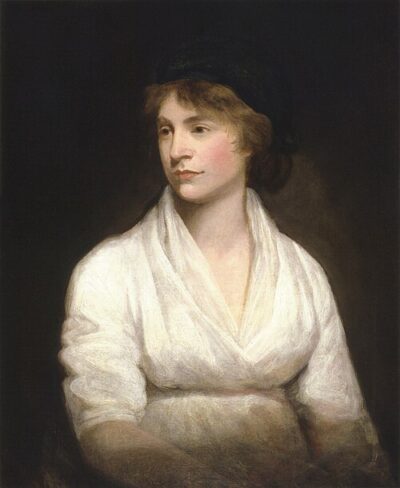
Mary Wollstonecraft
Mary Wollstonecraft was an English writer and intellectual. Born April 27, 1759, in London. Died September 10, 1797, in Somers Town. Known for A Vindication of the Rights of Woman and Letters Written During a Short Residence in Sweden, Norway, and Denmark.
Facts
37 facts · 0 confirmed by two sources · 16 cited · 19 from one source · 2 where the sources disagree
What’s different
- Born in: we show London (Sources disagree). Wikidata also lists Spitalfields
- Died in: we show Somers Town (Sources disagree). Wikidata also lists London
Where this comes from
Papalocal keeps its own record. It started from these sources; what each one said is kept here as it was copied, so a change on their side never changes this page by itself. Tap one to read its version.
What Wikidata says · copied November 16, 2026 · revision 2568944959
- Described as
- English writer and intellectual (1759–1797)
- Other names
- Mr. Cresswick, Mary Godwin, Mary Wollstonecraft Godwin
- Born
- April 27, 1759 · 12 references
- Died
- September 10, 1797 · 12 references
- Born in
- Spitalfields · 1 reference; London · 2 references
- Died in
- Somers Town · 1 reference; London · 1 reference
- Buried in
- St Pancras Gardens (1797–1851) · 1 reference; Gravestones To Tregonwell Campbell And Shelley Families And To Vicars Of St Peters In Churchyard Of St Peters (1851–) · 1 reference
- Cause of death
- puerperal infection · 2 references
- Citizen of
- Kingdom of Great Britain
- Occupation
- translator; philosopher; historian; novelist; essayist; governess; proprietor; travel writer
- Known for
- A Vindication of the Rights of Woman; Letters Written During a Short Residence in Sweden, Norway, and Denmark
- Field
- essay; gender studies; women's rights · 1 reference; political activity · 1 reference; creative and professional writing · 1 reference
- Spouse
- William Godwin (1797–) · 2 references; Gilbert Imlay · 1 reference
- Children
- Mary Shelley · 2 references; Fanny Imlay · 1 reference
- Father
- Edward John Wollstonecraft · 2 references
- Mother
- Elizabeth Dixon · 2 references
- Siblings
- Charles Wollstonecraft · 1 reference
- Religion
- deism; Anglicanism · 1 reference
- Lived in
- Barking; Epping Forest; Wales; Newington Green; Ireland
- Wikipedias with a page
- 132
Wikidata item Q101638 (wikidata.org/wiki/Q101638), public domain (CC0). Copied November 16, 2026.
What Wikipedia says · copied November 16, 2026 · revision 1384457372
Mary Wollstonecraft () 27 April 1759 – 10 September 1797) was an English writer and philosopher best known for her advocacy of women's rights. Until the late twentieth century, Wollstonecraft's life, which encompassed several unconventional (at the time) personal relationships, received more attention than her writing. Wollstonecraft is regarded as one of the founding feminist philosophers, and feminists often cite both her life and her works as important influences.
During her brief career she wrote novels, treatises, a travel narrative, a history of the French Revolution, a conduct book, and a children's book. Wollstonecraft is best known for A Vindication of the Rights of Woman (1792), in which she argues that women are not naturally inferior to men but appeared to be only because they lack education. She suggests that both men and women should be treated as rational beings and imagines a social order founded on reason.
After two ill-fated affairs, with Henry Fuseli and Gilbert Imlay (by whom she had a daughter, Fanny Imlay), Wollstonecraft married the philosopher William Godwin, one of the forefathers of the anarchist movement. Wollstonecraft died at the age of 38, leaving behind several unfinished manuscripts. She died 11 days after giving birth to her second daughter, Mary, who became an accomplished writer and the author of Frankenstein.
Wollstonecraft's widower published a Memoir (1798) of her life, revealing her unorthodox lifestyle, which inadvertently destroyed her reputation for almost a century. However, with the emergence of the feminist movement at the turn of the twentieth century, Wollstonecraft's advocacy of women's equality and critiques of conventional femininity were increasingly recognized.
From the Wikipedia article “Mary Wollstonecraft” (en.wikipedia.org/wiki/Mary_Wollstonecraft), by its contributors, under CC BY-SA 4.0 (creativecommons.org/licenses/by-sa/4.0/). Copied November 16, 2026; not changed.
Confirmed Two sources agree. Cited One source, and it names where it got it. One source One source, without a reference of its own. Sources disagree The sources disagree. We show the best-supported value and keep theirs below.
