
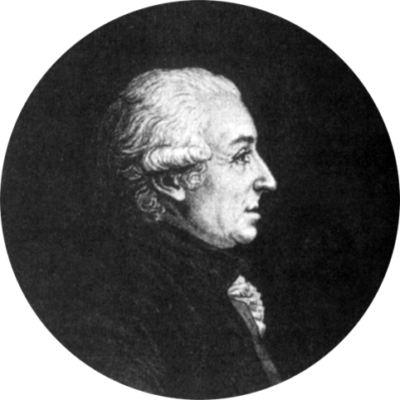
Mathurin Jacques Brisson
Mathurin Jacques Brisson was a French zoologist and natural philosopher. Born April 30, 1723, in Fontenay-le-Comte. Died June 23, 1806, in Paris. Educated at University of Poitiers.
Facts
17 facts · 2 confirmed by two sources · 2 cited · 13 from one source
Where this comes from
Papalocal keeps its own record. It started from these sources; what each one said is kept here as it was copied, so a change on their side never changes this page by itself. Tap one to read its version.
What Wikidata says · copied November 16, 2026 · revision 2564326871
- Described as
- French zoologist and natural philosopher
- Other names
- Briss., Brisson
- Born
- April 30, 1723 · 2 references
- Died
- June 23, 1806 · 3 references
- Born in
- Fontenay-le-Comte
- Died in
- Paris
- Citizen of
- France
- Occupation
- ornithologist; entomologist; physicist · 1 reference; zoologist; philosopher · 1 reference; chemist · 1 reference
- Education
- University of Poitiers
- Member of
- French Academy of Sciences (1759–)
- Field
- philosophy; zoology; physics
- Lived in
- France · 1 reference
- Wikipedias with a page
- 43
Wikidata item Q299547 (wikidata.org/wiki/Q299547), public domain (CC0). Copied November 16, 2026.
What Wikipedia says · copied November 16, 2026 · revision 1363652046
Mathurin Jacques Brisson (French pronunciation: [matyʁɛ̃ ʒak bʁisɔ̃]; 30 April 1723 – 23 June 1806) was a French zoologist and natural philosopher.
Brisson was born on 30 April 1723 at Fontenay-le-Comte in the Vendée department of western France. His parents wished him to take ecclesiastic orders, but in 1747, he abandoned his studies, and from 1749, was employed by the wealthy French naturalist René Antoine Ferchault de Réaumur as the curator of a large private collection of objects related to natural history that de Réaumur kept at his ancestral home at Réaumur in the Vendée.
Brisson became interested in the classification of animals and was influenced by the works of Carl Linnaeus and Jacob Theodor Klein. His book Le Règne animal was published in 1756, and the highly regarded six-volume work Ornithologie was published in 1760.
The English ornithologist Alfred Newton wrote of Brisson's Ornithologie that it was "a work of very great merit so far as it goes, for as a descriptive ornithologist the author stands even now unsurpassed; ...". For each species Brisson clearly indicated whether he had examined a specimen or whether he was relying on descriptions by other authors. Although in Brisson coined a Latin name for each bird species, these do not conform to the binomial system and are not recognised by the International Commission on Zoological Nomenclature (ICZN). However, Brisson also introduced names for genera and these are accepted by the ICZN. Linnaeus relied heavily on Brisson's work when updating his Systema Naturae for the twelfth edition in 1766. Linnaeus added 386 bird species of which 240 were based exclusively on Brisson.
De Réaumur died in 1757 and although in his will he left his large collection to the French Academy of Sciences, it was instead absorbed into the "Cabinet du roi", the royal natural history collection in Paris. Brisson abandoned zoology and in 1762 succeeded Jean-Antoine Nollet as professor of physics at the College of Navarre in Paris.
For a period of time, Brisson was an instructor of physical sciences and natural history to the family of the monarch. From 1759, he was a member of the Academy of Sciences.
A significant work involving the "specific weight of bodies" was his Pesanteur Spécifique des Corps published in 1787. In his investigations of electricity, Brisson was opposed to the theories of Priestley and Franklin.
He married Marie-Denise Foliot de Foucherolles on 24 April 1775. They had three children.
He died on 23 June 1806 at Magny-les-Hameaux near Versailles.
- Born, in its opening lines
- April 30, 1723
- Died, in its opening lines
- June 23, 1806
From the Wikipedia article “Mathurin Jacques Brisson” (en.wikipedia.org/wiki/Mathurin_Jacques_Brisson), by its contributors, under CC BY-SA 4.0 (creativecommons.org/licenses/by-sa/4.0/). Copied November 16, 2026; not changed.
Confirmed Two sources agree. Cited One source, and it names where it got it. One source One source, without a reference of its own. Sources disagree The sources disagree. We show the best-supported value and keep theirs below.
