
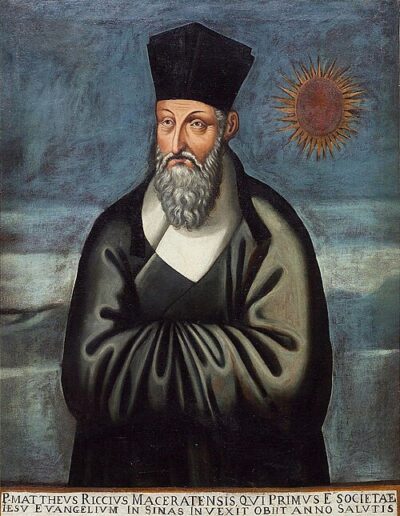
Matteo Ricci
Matteo Ricci was an Italian Catholic missionary. Born October 6, 1552, in Macerata. Died May 11, 1610, in Beijing. Known for Kunyu Wanguo Quantu, Ten Discourses by a Paradoxical Man and Jihe Yuanben. Educated at Sapienza University of Rome and Jesuit College.
Facts
22 facts · 2 confirmed by two sources · 6 cited · 14 from one source
Where this comes from
Papalocal keeps its own record. It started from these sources; what each one said is kept here as it was copied, so a change on their side never changes this page by itself. Tap one to read its version.
What Wikidata says · copied November 16, 2026 · revision 2567964623
- Described as
- Italian Catholic missionary (1552–1610)
- Other names
- Li Madou, Mateo Ricci
- Born
- October 6, 1552 · 3 references
- Died
- May 11, 1610 · 9 references
- Born in
- Macerata
- Died in
- Beijing
- Buried in
- Zhalan Cemetery · 1 reference
- Citizen of
- Papal States
- Occupation
- explorer; cartographer; translator; missionary · 2 references; presbyter; mathematician · 1 reference; sinologist; Catholic theologian · 1 reference
- Education
- Sapienza University of Rome (1568–1569) · 1 reference; Jesuit College (1561–1568) · 1 reference; Roman College (1569–1577) · 1 reference
- Known for
- Kunyu Wanguo Quantu; Ten Discourses by a Paradoxical Man; Jihe Yuanben; Explication of the Structure of Heaven and Earth
- Religion
- Catholicism
- Wikipedias with a page
- 64
Wikidata item Q233340 (wikidata.org/wiki/Q233340), public domain (CC0). Copied November 16, 2026.
What Wikipedia says · copied November 16, 2026 · revision 1385654551
Matteo Ricci (Italian: [matˈtɛːo ˈrittʃi]; Latin: Matthaeus Riccius; Chinese: 利玛窦; pinyin: Lì Mǎdòu; 6 October 1552 – 11 May 1610) was an Italian Jesuit who served in the court of Ming dynasty China and one of the founding figures of the Jesuit China missions. He created the Kunyu Wanguo Quantu, a 1602 world map written in Chinese characters. In 2022, the Apostolic See declared its recognition of Ricci's heroic virtue, thereby bestowing upon him the honorific of a Venerable.
Ricci arrived at the Portuguese settlement of Macau in 1582 where he began his missionary work in China. He mastered the Chinese language and writing system. He became the first European to enter the Forbidden City of Beijing in 1601 when invited by the Wanli Emperor, who sought his services in matters such as court astronomy and calendrical science. He emphasized parallels between Catholicism and Confucianism, and he converted several prominent Chinese officials to Catholicism. He also worked with several Chinese elites, such as Xu Guangqi, in translating Euclid's Elements into Chinese as well as the Confucian classics into Latin for the first time in history.
- Born, in its opening lines
- October 6, 1552
- Died, in its opening lines
- May 11, 1610
From the Wikipedia article “Matteo Ricci” (en.wikipedia.org/wiki/Matteo_Ricci), by its contributors, under CC BY-SA 4.0 (creativecommons.org/licenses/by-sa/4.0/). Copied November 16, 2026; not changed.
Confirmed Two sources agree. Cited One source, and it names where it got it. One source One source, without a reference of its own. Sources disagree The sources disagree. We show the best-supported value and keep theirs below.
