
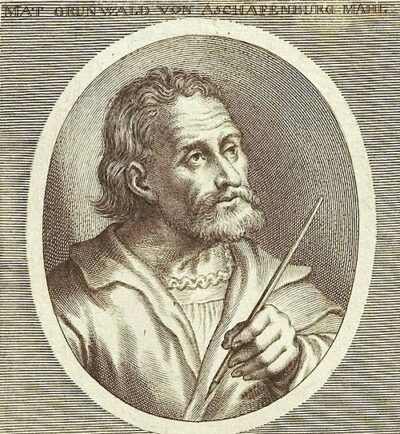
Matthias Grünewald
Matthias Grünewald was a German Renaissance painter (c.1480–1528). Born 1480, in Würzburg. Died August 31, 1528, in Halle (Saale). Known for Stuppach Madonna, Isenheim Altarpiece and Trias Romana.
Facts
22 facts · 1 confirmed by two sources · 11 cited · 9 from one source · 1 where the sources disagree
What’s different
- Born: we show 1480 (Sources disagree). Wikipedia says c. 1470
Where this comes from
Papalocal keeps its own record. It started from these sources; what each one said is kept here as it was copied, so a change on their side never changes this page by itself. Tap one to read its version.
What Wikidata says · copied November 16, 2026 · revision 2569334391
- Described as
- German Renaissance painter (c.1480–1528)
- Other names
- Mathaeus Grünewald, Matthias Griuneval'd, Mathis Gotthardt, der Maler Mathis, Matthias Neithardt, Mathis Grün, Mathes Grunewald, Mathis Gothart-Nithart, Mathis Grunewald, Mathis Neithardt, Gothardt Grunewald, Mathis Gothart Nithart
- Born
- 1480 · 4 references
- Died
- August 31, 1528 · 1 reference
- Born in
- Würzburg · 2 references
- Died in
- Halle (Saale) · 1 reference
- Buried in
- Halle (Saale)
- Cause of death
- plague
- Citizen of
- Germany
- Occupation
- painter · 4 references; engineer; architect · 2 references; draftsperson · 3 references; general contractor · 1 reference; architectural drafter · 1 reference; sculptor · 1 reference; master builder · 1 reference
- Genre
- religious art · 2 references; figure · 1 reference
- Known for
- Stuppach Madonna; Isenheim Altarpiece; Trias Romana
- Field
- painting
- Religion
- Catholic Church
- Wikipedias with a page
- 52
Wikidata item Q154338 (wikidata.org/wiki/Q154338), public domain (CC0). Copied November 16, 2026.
What Wikipedia says · copied November 16, 2026 · revision 1384235942
Matthias Grünewald (c. 1470 – 31 August 1528; also known as Mathis Gothart Nithart) was a German Renaissance painter of religious works who ignored Renaissance classicism to continue the style of late medieval Central European art into the 16th century.
Only ten paintings—including several polyptychs—and thirty-five drawings survive, all religious, although many others were lost at sea on their way to Sweden as war booty. He was obscure until the late nineteenth century, when many of his paintings were attributed to Albrecht Dürer, who is now seen as his stylistic antithesis. His largest and most famous work is the Isenheim Altarpiece created c. 1512 to 1516.
- Born, in its opening lines
- c. 1470
- Died, in its opening lines
- August 31, 1528
From the Wikipedia article “Matthias Grünewald” (en.wikipedia.org/wiki/Matthias_Grünewald), by its contributors, under CC BY-SA 4.0 (creativecommons.org/licenses/by-sa/4.0/). Copied November 16, 2026; not changed.
Confirmed Two sources agree. Cited One source, and it names where it got it. One source One source, without a reference of its own. Sources disagree The sources disagree. We show the best-supported value and keep theirs below.
