
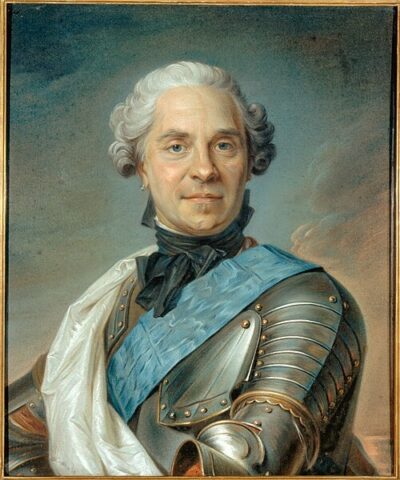
Maurice de Saxe
Maurice de Saxe was a Marshal General of France. Born October 28, 1696, in Goslar. Died November 30, 1750, in Château de Chambord. Awards include Marshal of France and Order of the White Eagle.
Facts
31 facts · 1 confirmed by two sources · 9 cited · 20 from one source · 1 where the sources disagree
What’s different
- Died: we show November 30, 1750 (Sources disagree). Wikipedia says November 20, 1750
Where this comes from
Papalocal keeps its own record. It started from these sources; what each one said is kept here as it was copied, so a change on their side never changes this page by itself. Tap one to read its version.
What Wikidata says · copied November 16, 2026 · revision 2570043531
- Described as
- Marshal General of France (1696-1750)
- Other names
- Maurice Saxe, Moritz Herzog von Sachsen, Moritz von Sachsen (1696-1750)
- Born
- October 28, 1696 · 5 references
- Died
- November 30, 1750 · 2 references
- Born in
- Goslar · 3 references
- Died in
- Château de Chambord
- Buried in
- Saint Thomas Church, Strasbourg
- Citizen of
- Germany; France; Russian Empire
- Occupation
- military leader · 1 reference; military officer; politician · 1 reference; writer · 1 reference; marshal · 1 reference
- Awards
- Marshal of France; Order of the White Eagle
- Field
- military affairs · 1 reference; military art · 1 reference
- Spouse
- Johanna Victoria Tugendreich von Loeben (1714–) · 1 reference
- Children
- Marie-Aurore de Saxe; August Adolf von Sachsen · 1 reference
- Father
- Augustus II the Strong · 1 reference
- Mother
- Maria Aurora von Königsmarck · 1 reference
- Siblings
- Anna Karolina Orzelska; Maria Anna Katharina Rutowska; Friederike Alexandrine Moszyńska; Augustus III of Poland; Friedrich August Cosel; Frederick Augustus Rutowsky; Johann Georg, Chevalier de Saxe
- Military rank
- Marshal of France; Marshal General of France · 1 reference
- Wikipedias with a page
- 45
Wikidata item Q76723 (wikidata.org/wiki/Q76723), public domain (CC0). Copied November 16, 2026.
What Wikipedia says · copied November 16, 2026 · revision 1384032288
Maurice de Saxe (28 October 1696 – 20 November 1750) was a prominent soldier, general and military theorist in the first half of the 18th century. The illegitimate son of Augustus II the Strong, he initially served in the Army of the Holy Roman Empire, then the Imperial Army, before entering French service.
Saxe was appointed first Marshal of France, then promoted further to Marshal General of France. He is best known for his victories in the 1740 to 1748 War of the Austrian Succession, particularly the Battle of Fontenoy.
- Born, in its opening lines
- October 28, 1696
- Died, in its opening lines
- November 20, 1750
From the Wikipedia article “Maurice de Saxe” (en.wikipedia.org/wiki/Maurice_de_Saxe), by its contributors, under CC BY-SA 4.0 (creativecommons.org/licenses/by-sa/4.0/). Copied November 16, 2026; not changed.
Confirmed Two sources agree. Cited One source, and it names where it got it. One source One source, without a reference of its own. Sources disagree The sources disagree. We show the best-supported value and keep theirs below.
