
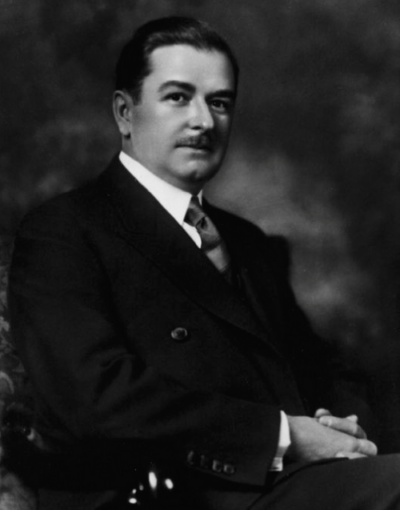
Maurice Duplessis
Maurice Duplessis was a former Premier of Quebec. Born April 20, 1890, in Trois-Rivières. Died September 7, 1959, in Schefferville. Positions held include Premier of Quebec (2 times) (1936–1959), Member of the National Assembly of Quebec (1923–1959) and Bâtonnier du Québec (1937–1938). Educated at Collège Notre-Dame and Séminaire Saint-Joseph de Trois-Rivières. Awards include honorary doctorate at the Laval University, honorary doctor of Caen University and Person of National Historic Significance.
Facts
23 facts · 2 confirmed by two sources · 5 cited · 16 from one source
Where this comes from
Papalocal keeps its own record. It started from these sources; what each one said is kept here as it was copied, so a change on their side never changes this page by itself. Tap one to read its version.
What Wikidata says · copied November 16, 2026 · revision 2568972051
- Described as
- former Premier of Quebec (1890-1959)
- Other names
- Maurice Le Noblet Duplessis
- Born
- April 20, 1890 · 6 references
- Died
- September 7, 1959 · 5 references
- Born in
- Trois-Rivières · 1 reference
- Died in
- Schefferville
- Buried in
- Cimetière Saint-Louis
- Citizen of
- Canada
- Occupation
- politician · 1 reference; lawyer
- Positions held
- Premier of Quebec (2 times) (1936–1959); Member of the National Assembly of Quebec (1923–1959); Bâtonnier du Québec (1937–1938); Bâtonnier de la Mauricie (1937–1938)
- Political party
- Union Nationale; Conservative Party of Quebec · 1 reference
- Education
- Collège Notre-Dame; Séminaire Saint-Joseph de Trois-Rivières; Université de Montréal
- Awards
- honorary doctorate at the Laval University (1937) · 1 reference; honorary doctor of Caen University (1946) · 1 reference; Person of National Historic Significance · 1 reference
- Father
- Nérée Le Noblet Duplessis
- Mother
- Berthe Duplessis
- Religion
- Catholic Church
- Wikipedias with a page
- 20
Wikidata item Q113941 (wikidata.org/wiki/Q113941), public domain (CC0). Copied November 16, 2026.
What Wikipedia says · copied November 16, 2026 · revision 1378134847
Maurice Le Noblet Duplessis (French pronunciation: [mɔʁis lə nɔblɛ dyplɛsi]; April 20, 1890 – September 7, 1959), popularly known as "Le Chef" ([lə ʃɛf], "The Boss"), was a Canadian lawyer and politician who served as the 16th premier of Quebec. A conservative, nationalist, populist, anti-communist, anti-unionist, and fervent Catholic, Duplessis and his party, the Union Nationale, dominated provincial politics from the 1920s to the 1950s. With a total of 18 years and 82 days in office, he remains the longest-serving premier in Quebec history.
Son of Nérée Duplessis, a lawyer who served as a Conservative member of the Legislative Assembly (MLA), Maurice studied law in Montreal and became a member of the Bar of Quebec in 1913. He then returned to his home town of Trois-Rivières, where he founded a successful legal consultancy. Duplessis narrowly lost his first campaign for the Trois-Rivières seat in the 1923 election, but managed to get elected in 1927 as a Conservative MLA. His rhetorical skills helped him become the leader of the Official Opposition in the Legislative Assembly in 1933 in the place of Camillien Houde. As opposition leader, he agreed to a coalition with Paul Gouin's Action libérale nationale (ALN), which they called the Union Nationale. It lost in 1935 but gained a majority the following year as Gouin retired from politics and Duplessis took over the leadership, thus breaking almost 40 years of uninterrupted rule by the Quebec Liberal Party. In addition to his premiership duties, Duplessis served as attorney general and briefly held other ministerial posts as well.
The first three years in government were difficult for Duplessis as the government struggled to respond to the ongoing hardships of the Great Depression. That term saw the introduction of several key welfare policies (such as the universal minimum wage and old-age pensions), but the effort to strengthen his rule by calling a snap election in 1939 failed as his campaigning on the issue of World War II backfired and his government left the economy in a poor state. However, the Conscription Crisis of 1944 propelled him back to power in that year's election. Duplessis then served as premier until his death.
As was the general trend of the time, he presided over a period of robust economic growth due to the rising demand in resources, which the province used to develop Côte-Nord and rural areas. Duplessis was a strong proponent of economic liberalism and implemented pro-business policies by keeping taxes low, refraining from regulation and adopting pro-employer labour policies, in particular by cracking down on trade unions. He usually met the federal government's initiatives with strong resistance due to his convictions on provincial autonomy. In the social domain, Duplessis maintained and protected the traditional role of the Catholic Church in Quebec's society, notably in healthcare and education. He was ruthless to the perceived enemies of the Church or of the Catholic nature of the province, such as Jehovah's Witnesses, whom he harassed using his government's apparatus. Communists were persecuted under the Padlock Law, which Duplessis authored in 1937.
Duplessis's legacy remains controversial more than 60 years after his death. Compared to the Anglophones, the French Canadians remained worse off in the province where they constituted a majority just as his government was courting Anglophone and out-of-province businessmen to invest. This clientelist relationship with the business spheres often morphed into outright corruption. Duplessis's authoritarian inclinations, his all-powerful electoral machine, staunch conservatism and nationalism, a cozy relationship with the Catholic Church, the mistreatment of Duplessis Orphans and the apparent backwardness of his model of development were also subject of criticism. His critics label his tenure as the Grande Noirceur ('Great Darkness'), a term popularized during the Quiet Revolution in the 1960s. Since the 1990s, academics have revisited Duplessism and concluded that the assessment of his rule requires nuance and, in some cases, have advocated outright rejection of the pejorative label.
- Born, in its opening lines
- April 20, 1890
- Died, in its opening lines
- September 7, 1959
From the Wikipedia article “Maurice Duplessis” (en.wikipedia.org/wiki/Maurice_Duplessis), by its contributors, under CC BY-SA 4.0 (creativecommons.org/licenses/by-sa/4.0/). Copied November 16, 2026; not changed.
Confirmed Two sources agree. Cited One source, and it names where it got it. One source One source, without a reference of its own. Sources disagree The sources disagree. We show the best-supported value and keep theirs below.
