
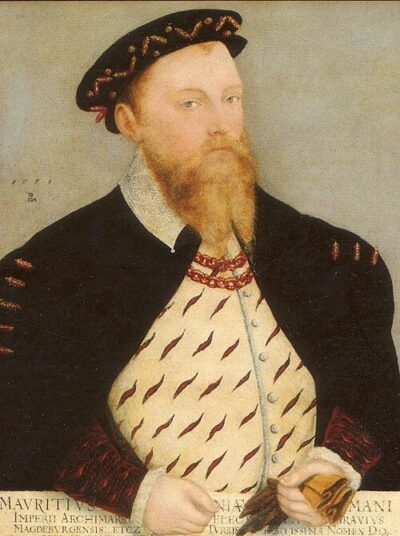
Maurice of Saxony
Maurice of Saxony was a Duke of Saxony and later Elector of Saxony. Born March 21, 1521, in Freiberg. Died July 11, 1553, in Sievershausen. Positions held include Prince-Elector of Saxony (1547–1553).
Facts
20 facts · 1 confirmed by two sources · 3 cited · 15 from one source · 1 where the sources disagree
What’s different
- Died: we show July 11, 1553 (Sources disagree). Wikipedia says July 9, 1553
Where this comes from
Papalocal keeps its own record. It started from these sources; what each one said is kept here as it was copied, so a change on their side never changes this page by itself. Tap one to read its version.
What Wikidata says · copied November 16, 2026 · revision 2570271431
- Described as
- Duke of Saxony and later Elector of Saxony (1521–1553)
- Other names
- Moritz
- Born
- March 21, 1521 · 2 references
- Died
- July 11, 1553 · 4 references
- Born in
- Freiberg · 1 reference
- Died in
- Sievershausen
- Buried in
- Freiberg Cathedral
- Citizen of
- Electorate of Saxony · 1 reference
- Occupation
- military personnel
- Positions held
- Prince-Elector of Saxony (1547–1553)
- Spouse
- Agnes of Hesse (1541–) · 1 reference
- Children
- Anna of Saxony; Albrecht von Sachsen · 1 reference
- Father
- Henry IV · 1 reference
- Mother
- Catherine of Mecklenburg
- Siblings
- Sibylle of Saxony; Emilie of Saxony; Sidonie of Saxony; Augustus, Elector of Saxony; Severinus of Saxony
- Religion
- Lutheranism (1536–); Catholicism (–1536)
- Wikipedias with a page
- 31
Wikidata item Q317710 (wikidata.org/wiki/Q317710), public domain (CC0). Copied November 16, 2026.
What Wikipedia says · copied November 16, 2026 · revision 1382893563
Maurice (German: Moritz; 21 March 1521 – 9 July 1553) was Duke of Saxony from 1541 to 1553, who became Prince-Elector and Arch-Marshal of the Holy Roman Empire in 1547. Through shrewd political maneuvering, skillfully exploiting alliances and rivalries, he secured extensive territories and the electoral title for the Albertine branch of the Wettin dynasty.
Maurice succeeded his father as duke of Saxony in 1541. Though a Protestant, he initially backed Emperor Charles V in several wars, then in 1545 accepted the Emperor's promise of the Saxon electorship and turned against the rival Ernestine branch—helping seize Electoral Saxony. After John Frederick's defeat at Mühlberg (1547), Maurice was rewarded with the electoral title and large new lands.
He soon broke with Charles, angered by plans to restore Catholicism in Protestant territories and by the continued imprisonment of his father-in-law, Philip I of Hesse. Although sent to subdue Magdeburg in 1550, Maurice used the mission to raise an army and forge alliances with France and Protestant princes. In 1552, their campaign forced the Emperor to flee and Philip to be released, and the Treaty of Passau (1552) temporarily safeguarded Lutheran interests. Maurice later returned to the imperial side, but was killed in 1553 after defeating Albert Alcibiades at the Battle of Sievershausen.
- Born, in its opening lines
- March 21, 1521
- Died, in its opening lines
- July 9, 1553
From the Wikipedia article “Maurice, Elector of Saxony” (en.wikipedia.org/wiki/Maurice,_Elector_of_Saxony), by its contributors, under CC BY-SA 4.0 (creativecommons.org/licenses/by-sa/4.0/). Copied November 16, 2026; not changed.
Confirmed Two sources agree. Cited One source, and it names where it got it. One source One source, without a reference of its own. Sources disagree The sources disagree. We show the best-supported value and keep theirs below.
