
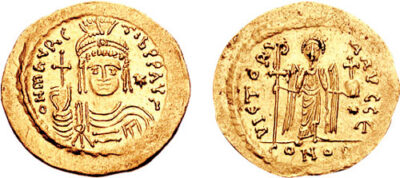
Maurice
Maurice was a Byzantine Emperor. Born 539, in Arabissus. Died November 27, 602, in Harbor of Eutropius. Positions held include Byzantine emperor (582–602), ancient Roman senator and Roman emperor.
Facts
32 facts · 2 confirmed by two sources · 0 cited · 30 from one source
Where this comes from
Papalocal keeps its own record. It started from these sources; what each one said is kept here as it was copied, so a change on their side never changes this page by itself. Tap one to read its version.
What Wikidata says · copied November 16, 2026 · revision 2549936789
- Described as
- Byzantine Emperor (539-602)
- Other names
- Mauricius, Mauricius Tiberius, Flavius Mauricius Tiberius Augustus, Mauritius, Maurikios
- Born
- 539 · 4 references
- Died
- November 27, 602
- Born in
- Arabissus
- Died in
- Harbor of Eutropius
- Buried in
- Monastery of Saint Mamas
- Cause of death
- decapitation
- Name at birth
- Φλάβιος Μαυρίκιος Τιβέριος Αὔγουστος
- Citizen of
- Byzantine Empire
- Occupation
- military leader; politician; emperor
- Positions held
- Byzantine emperor (582–602); ancient Roman senator; Roman emperor; commanding officer
- Spouse
- Constantina (582–602)
- Children
- Theodosius; Tiberius; Maria; Paulus; Justin; Justinian; Anastasia; Cleopatra; Theoctista; Petrus
- Father
- Paul
- Siblings
- Peter; Gordia
- Religion
- Chalcedonian Christianity
- Military branch
- Byzantine army
- Military rank
- magister militum per Orientem
- Wikipedias with a page
- 68
Wikidata item Q181764 (wikidata.org/wiki/Q181764), public domain (CC0). Copied November 16, 2026.
What Wikipedia says · copied November 16, 2026 · revision 1383597765
Maurice (Latin: Mauricius; Ancient Greek: Μαυρίκιος, romanised: Maurikios; 539 – 27 November 602) was Eastern Roman emperor from 582 to 602 and the last member of the Justinian dynasty. A successful general, Maurice was chosen as heir and son-in-law by his predecessor Tiberius II.
Maurice's reign was troubled by almost constant warfare. After he became emperor, he brought the war with Sasanian Persia to a victorious conclusion. The empire's eastern border in the South Caucasus was vastly expanded and, for the first time in nearly two centuries, the Romans were no longer obliged to pay the Persians thousands of pounds of gold annually for peace.
Afterward, Maurice campaigned extensively in the Balkans against the Avars—pushing them back across the Danube by 599. He also conducted campaigns across the Danube, the first Roman emperor to do so in over two centuries. In the west, he established two large semi-autonomous provinces called exarchates, ruled by exarchs, or viceroys of the emperor. In Italy, Maurice established the Exarchate of Italy in 584, the first real effort by the empire to halt the advance of the Lombards. With the creation of the Exarchate of Africa in 591 he further solidified the power of Constantinople in the western Mediterranean.
Maurice's successes on the battlefield and in foreign policy were counterbalanced by the empire's mounting financial difficulties. Maurice attempted to remedy this with several unpopular measures which ended up alienating both the army and the general populace. In 602, dissatisfied soldiers elected an officer named Phocas to lead them, who after usurping the throne, ordered the execution of Maurice and his six sons. This event would prove a disaster for the empire, sparking a twenty-six-year war with a resurgent Sassanid Persia which left both empires devastated prior to the Arab conquests.
Maurice's reign is a relatively well-documented era of late antiquity, in particular by the historian Theophylact Simocatta. The Strategikon, a manual of war which influenced European and Middle Eastern military traditions for well over a millennium, is traditionally attributed to Maurice.
- Born, in its opening lines
- 539
- Died, in its opening lines
- November 27, 602
From the Wikipedia article “Maurice (emperor)” (en.wikipedia.org/wiki/Maurice_(emperor)), by its contributors, under CC BY-SA 4.0 (creativecommons.org/licenses/by-sa/4.0/). Copied November 16, 2026; not changed.
Confirmed Two sources agree. Cited One source, and it names where it got it. One source One source, without a reference of its own. Sources disagree The sources disagree. We show the best-supported value and keep theirs below.
