
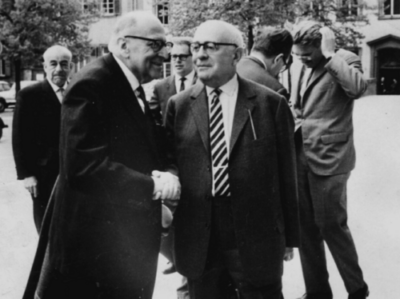
Max Horkheimer
Max Horkheimer was a German philosopher and sociologist. Born February 14, 1895, in Zuffenhausen. Died July 7, 1973, in Nuremberg. Known for Gesammelte Schriften, Dialectic of Enlightenment and Eclipse of Reason. Educated at LMU Munich and Goethe University Frankfurt. Awards include honorary citizen of Frankfurt am Main, Goethe Plaque of the City of Frankfurt and Goethe-Plakette des Landes Hessen.
Facts
29 facts · 2 confirmed by two sources · 4 cited · 23 from one source
Where this comes from
Papalocal keeps its own record. It started from these sources; what each one said is kept here as it was copied, so a change on their side never changes this page by itself. Tap one to read its version.
What Wikidata says · copied November 13, 2026 · revision 2564038013
- Described as
- German philosopher and sociologist (1895–1973)
- Other names
- Heinrich Regius
- Born
- February 14, 1895 · 15 references
- Died
- July 7, 1973 · 16 references
- Born in
- Zuffenhausen · 1 reference
- Died in
- Nuremberg · 3 references
- Citizen of
- Germany; United States
- Occupation
- philosopher · 3 references; pedagogue; sociologist · 1 reference; university teacher · 1 reference; literary critic
- Worked for
- Goethe University Frankfurt; Columbia University; University of Chicago
- Education
- LMU Munich; Goethe University Frankfurt; Dillmann-Gymnasium Stuttgart; University of Freiburg · 1 reference
- Known for
- Gesammelte Schriften; Dialectic of Enlightenment; Eclipse of Reason
- Awards
- honorary citizen of Frankfurt am Main; Goethe Plaque of the City of Frankfurt (1953); Goethe-Plakette des Landes Hessen (1970); Bürgermedaille der Stadt Stuttgart (1970)
- Field
- philosophy; social theory · 1 reference; Age of Enlightenment · 1 reference
- Father
- Moritz Horkheimer
- Wikipedias with a page
- 66
Wikidata item Q76826 (wikidata.org/wiki/Q76826), public domain (CC0). Copied November 13, 2026.
What Wikipedia says · copied November 13, 2026 · revision 1380851438
Max Horkheimer ( HORK-hy-mər; German: [ˈhɔɐ̯kˌhaɪmɐ]; 14 February 1895 – 7 July 1973) was a German philosopher and sociologist best known for his role in developing critical theory as director of the Institute for Social Research, commonly associated with the Frankfurt School.
Advancing a materialist theory of reason and society, Horkheimer analyzed the rise of instrumental reason, the erosion of the concept of truth, the decline of individual autonomy, the social-psychological roots of authoritarianism, and the reproduction of domination under modern capitalism. These concerns became fundamental to critical theory.
His most influential works include Eclipse of Reason (1947), Dialectic of Enlightenment (1947, with Theodor W. Adorno), and a series of foundational essays written in the 1930s for the Zeitschrift für Sozialforschung, later collected in Between Philosophy and Social Science and Critical Theory: Selected Essays. He also composed aphoristic reflections between the late 1920s and the 1960s, published posthumously as Dämmerung (Dawn and Decline). As director of the institute, Horkheimer planned, supported, and made possible many other significant works.
- Born, in its opening lines
- February 14, 1895
- Died, in its opening lines
- July 7, 1973
From the Wikipedia article “Max Horkheimer” (en.wikipedia.org/wiki/Max_Horkheimer), by its contributors, under CC BY-SA 4.0 (creativecommons.org/licenses/by-sa/4.0/). Copied November 13, 2026; not changed.
Confirmed Two sources agree. Cited One source, and it names where it got it. One source One source, without a reference of its own. Sources disagree The sources disagree. We show the best-supported value and keep theirs below.
