
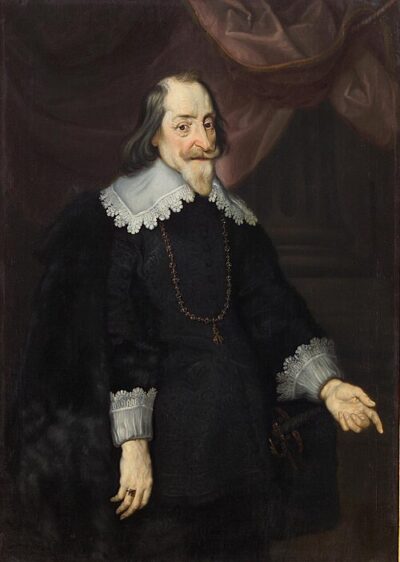
Maximilian I, Elector of Bavaria
Maximilian I, Elector of Bavaria was a Wittelsbach ruler of Bavaria and prince-elector (Kurfürst) of the Holy Roman Empire. Born April 17, 1573, in Munich. Died September 27, 1651, in Ingolstadt. Positions held include prince-elector of Bavaria (1623–1651), Duke of Bavaria (1597–1623) and Count Palatine of the Rhine (1623–1648).
Facts
23 facts · 2 confirmed by two sources · 7 cited · 13 from one source · 1 where the sources disagree
What’s different
- Buried in: we show Brother Konrad Monastery (Sources disagree). Wikidata also lists St. Michael's Church, Munich
Where this comes from
Papalocal keeps its own record. It started from these sources; what each one said is kept here as it was copied, so a change on their side never changes this page by itself. Tap one to read its version.
What Wikidata says · copied November 16, 2026 · revision 2569004181
- Described as
- Wittelsbach ruler of Bavaria and prince-elector (Kurfürst) of the Holy Roman Empire (1573–1651)
- Other names
- Maximilian the Great, Maximilian I, Duke of Bavaria, Maximilian I
- Born
- April 17, 1573 · 2 references
- Died
- September 27, 1651 · 7 references
- Born in
- Munich · 1 reference
- Died in
- Ingolstadt · 1 reference
- Buried in
- St. Michael's Church, Munich; Brother Konrad Monastery · 1 reference
- Citizen of
- Electorate of Bavaria
- Occupation
- aristocrat · 1 reference
- Positions held
- prince-elector of Bavaria (1623–1651); Duke of Bavaria (1597–1623); Count Palatine of the Rhine (1623–1648); Elector Palatine (1623–1648)
- Spouse
- Elisabeth of Lorraine (1595–) · 2 references; Archduchess Maria Anna of Austria (1635–) · 1 reference
- Children
- Ferdinand Maria, Elector of Bavaria · 1 reference; Maximilian Philipp Hieronymus, Duke of Bavaria-Leuchtenberg
- Father
- Wilhelm V, Duke of Bavaria · 1 reference
- Mother
- Renata of Lorraine
- Siblings
- Albert VI, Duke of Bavaria · 1 reference; Philipp of Bavaria; Ferdinand of Bavaria; Maria Anna of Bavaria; Magdalene of Bavaria
- Religion
- Catholic Church
- Wikipedias with a page
- 47
Wikidata item Q57206 (wikidata.org/wiki/Q57206), public domain (CC0). Copied November 16, 2026.
What Wikipedia says · copied November 16, 2026 · revision 1385498723
Maximilian I (17 April 1573 – 27 September 1651), occasionally called the Great, a member of the House of Wittelsbach, ruled as Duke of Bavaria from 1597. His reign was marked by the Thirty Years' War during which his title was elevated to that of prince-elector of the Holy Roman Empire at the 1623 Diet of Regensburg.
Maximilian was a capable monarch who, by overcoming the feudal rights of the local estates (Landstände), laid the foundations for absolutist rule in Bavaria. A devout Catholic, he was one of the leading proponents of the Counter-Reformation and founder of the Catholic League of Imperial Princes. In the Thirty Years' War, he was able to conquer the Upper Palatinate region, as well as the Electoral Palatinate affiliated with the electoral dignity of his Wittelsbach cousin, the "Winter King" Frederick V. The 1648 Peace of Westphalia affirmed his possession of Upper Palatinate and the hereditary electoral title, though it returned the Electoral Palatinate to Frederick's heir and created an eighth electoral dignity for them.
- Born, in its opening lines
- April 17, 1573
- Died, in its opening lines
- September 27, 1651
From the Wikipedia article “Maximilian I, Elector of Bavaria” (en.wikipedia.org/wiki/Maximilian_I,_Elector_of_Bavaria), by its contributors, under CC BY-SA 4.0 (creativecommons.org/licenses/by-sa/4.0/). Copied November 16, 2026; not changed.
Confirmed Two sources agree. Cited One source, and it names where it got it. One source One source, without a reference of its own. Sources disagree The sources disagree. We show the best-supported value and keep theirs below.
