
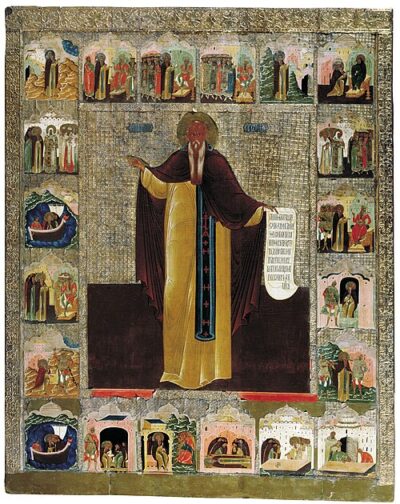
Maximus the Confessor
Maximus the Confessor was a Christian monk, theologian, scholar and saint (c. 580 - 662). Born 579, in Palestine. Died August 13, 662, in Tsageri. Positions held include monk. Known for Capita theologica et oeconomica, Quaestiones ad Thalassium and Ambigua ad Iohannem.
Facts
13 facts · 1 confirmed by two sources · 3 cited · 8 from one source · 1 where the sources disagree
What’s different
- Born: we show 579 (Sources disagree). Wikipedia says c. 580
Where this comes from
Papalocal keeps its own record. It started from these sources; what each one said is kept here as it was copied, so a change on their side never changes this page by itself. Tap one to read its version.
What Wikidata says · copied November 16, 2026 · revision 2567673887
- Described as
- Christian monk, theologian, scholar and saint (c. 580 - 662)
- Other names
- Maximus of Constantinople, Maximus the Theologian, Saint Maximus
- Born
- 579
- Died
- August 13, 662
- Born in
- Palestine · 1 reference
- Died in
- Tsageri
- Citizen of
- Byzantine Empire
- Occupation
- theologian · 2 references; philosopher; monk · 1 reference
- Positions held
- monk
- Known for
- Capita theologica et oeconomica; Quaestiones ad Thalassium; Ambigua ad Iohannem
- Religion
- Chalcedonian Christianity
- Wikipedias with a page
- 58
Wikidata item Q206842 (wikidata.org/wiki/Q206842), public domain (CC0). Copied November 16, 2026.
What Wikipedia says · copied November 16, 2026 · revision 1382337906
Maximus the Confessor (Greek: Μάξιμος ὁ Ὁμολογητής, romanized: Maximos ho Homologētēs), also spelled Maximos, otherwise known as Maximus the Theologian and Maximus of Constantinople (c. 580 – 13 August 662), was a Christian monk, theologian, and Neoplatonic scholar.
In his early life, Maximus was a civil servant, and an aide to the Byzantine Emperor Heraclius. He gave up this life in the political sphere to enter the monastic life. Maximus had studied diverse schools of philosophy, and certainly what was common for his time, the Platonic dialogues, the works of Aristotle, and numerous later Neoplatonic commentators on Aristotle and Plato, like Plotinus, Porphyry, Iamblichus, and Proclus. When one of his friends began espousing the Christological position known as Monothelitism, Maximus was drawn into the controversy, in which he supported an interpretation of the Chalcedonian formula on the basis of which it was asserted that Jesus had both a human and a divine will. Maximus is venerated in both the Catholic and Eastern Orthodox Churches. He was eventually persecuted for his Christological positions; following a trial, his tongue and right hand were mutilated.
He was then exiled and died on 13 August 662, in Tsageri in present-day Georgia. However, his theology was upheld by the Third Council of Constantinople and he was venerated as a saint soon after his death. His title of "Confessor" means that he suffered for the Christian faith, but was not directly martyred.
- Born, in its opening lines
- c. 580
- Died, in its opening lines
- August 13, 662
From the Wikipedia article “Maximus the Confessor” (en.wikipedia.org/wiki/Maximus_the_Confessor), by its contributors, under CC BY-SA 4.0 (creativecommons.org/licenses/by-sa/4.0/). Copied November 16, 2026; not changed.
Confirmed Two sources agree. Cited One source, and it names where it got it. One source One source, without a reference of its own. Sources disagree The sources disagree. We show the best-supported value and keep theirs below.
