
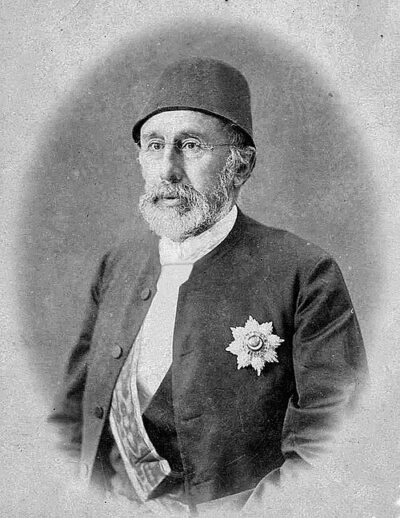
Mehmed Fuad Paşa
Mehmed Fuad Paşa was an Ottoman administrator and statesman. Born January 17, 1814, in Istanbul. Died February 13, 1869, in Nice. Positions held include grand vizier of the Ottoman Empire (1861–1866), ambassador and Beylerbey of Sidon. Awards include Knight Grand Cross in the Order of the Netherlands Lion.
Facts
16 facts · 1 confirmed by two sources · 4 cited · 10 from one source · 1 where the sources disagree
What’s different
- Died: we show February 13, 1869 (Sources disagree). Wikipedia says February 12, 1869
Where this comes from
Papalocal keeps its own record. It started from these sources; what each one said is kept here as it was copied, so a change on their side never changes this page by itself. Tap one to read its version.
What Wikidata says · copied November 17, 2026 · revision 2562650841
- Described as
- Ottoman administrator and statesman (1814–1869)
- Other names
- Fuad-Mahmed Pasha
- Born
- January 17, 1814 · 1 reference
- Died
- February 13, 1869 · 1 reference
- Born in
- Istanbul
- Died in
- Nice
- Buried in
- Tomb of Fuad Pasha
- Citizen of
- Ottoman Empire · 1 reference
- Occupation
- politician; translator; writer · 1 reference
- Positions held
- grand vizier of the Ottoman Empire (1861–1866); ambassador; Beylerbey of Sidon; Beylerbey of Damascus
- Awards
- Knight Grand Cross in the Order of the Netherlands Lion (1858) · 1 reference
- Father
- Keçecizade İzzet Molla
- Religion
- Islam · 1 reference
- Wikipedias with a page
- 24
Wikidata item Q715917 (wikidata.org/wiki/Q715917), public domain (CC0). Copied November 17, 2026.
What Wikipedia says · copied November 17, 2026 · revision 1368717700
Mehmed Fuad Pasha (1814 – February 12, 1869), sometimes known as Keçecizade Mehmed Fuad Pasha and commonly known as Fuad Pasha, was an Ottoman administrator and statesman, who is known for his prominent role in the Tanzimat reforms of the mid-19th-century Ottoman Empire, as well as his leadership during the 1860 Mount Lebanon civil war in Syria. He represented a modern Ottoman era, given his openness to European-style modernization as well as the reforms he helped to enact.
Among other posts, he served as Grand Vizier, the equivalent of Prime Minister, on two occasions between 1861 and 1866. He is often regarded, along with Mehmed Emin Âli Pasha, as one of the most influential Ottoman statesmen, who favoured a French-inspired civil code for the newly established civil courts in 1868.
Fuad Pasha was a fervent supporter of keeping the empire an absolute monarchy, rejecting the ideas of being legally bounded or restricted by a constitution or legislature. He often clashed with liberal Young Ottoman intellectuals like Namık Kemal, Ziya Pasha and İbrahim Şinasi.
- Born, in its opening lines
- 1814
- Died, in its opening lines
- February 12, 1869
From the Wikipedia article “Mehmed Fuad Pasha” (en.wikipedia.org/wiki/Mehmed_Fuad_Pasha), by its contributors, under CC BY-SA 4.0 (creativecommons.org/licenses/by-sa/4.0/). Copied November 17, 2026; not changed.
Confirmed Two sources agree. Cited One source, and it names where it got it. One source One source, without a reference of its own. Sources disagree The sources disagree. We show the best-supported value and keep theirs below.
