
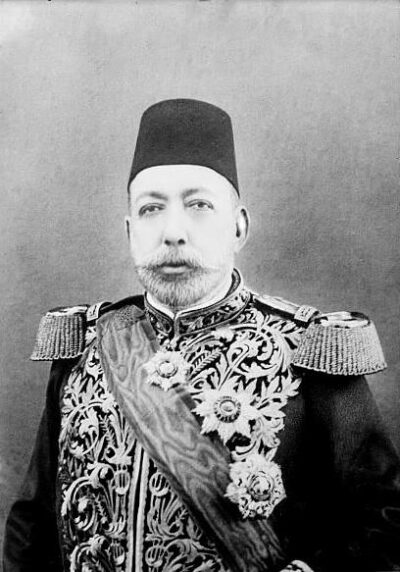
Mehmed V
Mehmed V was the 35th Sultan of the Ottoman Empire. Born November 2, 1844, in Çırağan Palace. Died July 3, 1918, in Istanbul. Positions held include sultan of the Ottoman Empire (1909–1918). Awards include Military Merit Cross I. Class, Order of the Crescent and Order of the Medjidie.
Facts
38 facts · 2 confirmed by two sources · 5 cited · 31 from one source
Where this comes from
Papalocal keeps its own record. It started from these sources; what each one said is kept here as it was copied, so a change on their side never changes this page by itself. Tap one to read its version.
What Wikidata says · copied November 16, 2026 · revision 2558165475
- Described as
- 35th Sultan of the Ottoman Empire (1909–1918)
- Other names
- V. Mehmet, Mehmed Reşad, V. Mehmed
- Born
- November 2, 1844 · 6 references
- Died
- July 3, 1918 · 6 references
- Born in
- Çırağan Palace
- Died in
- Istanbul · 1 reference
- Buried in
- Tomb of Mehmed V
- Citizen of
- Ottoman Empire · 1 reference
- Occupation
- ruler; writer · 1 reference
- Positions held
- sultan of the Ottoman Empire (1909–1918) · 1 reference
- Member of
- Ottoman dynasty · 1 reference
- Awards
- Military Merit Cross I. Class; Order of the Crescent; Order of the Medjidie; Order of Osmanieh; Military Order of Max Joseph; 1st class, Order of the Medjidie · 1 reference
- Spouse
- Kamures Kadın; Mihrengiz Kadın · 1 reference; Dilfirib Kadınefendi; Dürriaden Kadın; Nazperver Kadın · 1 reference
- Children
- Şehzade Ömer Hilmi; Mehmed Ziyaeddin Efendi; Şehzade Mahmud Necmeddin
- Father
- Abdülmecid I
- Mother
- Gülcemal Kadin
- Siblings
- Abdul Hamid II; Mehmed VI; Şehzade Ahmed Kemaleddin; Murad V; Şehzade Mehmed Burhaneddin; Refia Sultan · 1 reference; Fatma Sultan · 1 reference; Mediha Sultan
- Religion
- Sunni Islam; Islam · 1 reference
- Military rank
- Generalfeldmarschall
- Lived in
- Dolmabahçe Palace · 1 reference
- Wikipedias with a page
- 73
Wikidata item Q151494 (wikidata.org/wiki/Q151494), public domain (CC0). Copied November 16, 2026.
What Wikipedia says · copied November 16, 2026 · revision 1384374105
Mehmed V Reşâd (Ottoman Turkish: محمد خامس, romanized: Meḥmed-i ḫâmis; Turkish: V. Mehmed or Mehmed Reşad; 2 November 1844 – 3 July 1918) was the penultimate sultan of the Ottoman Empire from 1909 to 1918. Mehmed V reigned as a constitutional monarch. He had little influence over government affairs and his ministries showed little regard for the constitution. The first half of his reign was marked by increasingly polarizing politics, and the second half by war and domination of the Committee of Union and Progress (CUP) and the Three Pashas.
Reşad was the son of Sultan Abdul Mejid I. He was sympathetic to the Young Turks, and while Crown Prince was kept under house arrest by his reigning half-brother Abdul Hamid II. Reşad was elevated to the throne at his expense in the aftermath of the 31 March Incident, taking the regal name Mehmed V. Coming to power in the aftermath of the failed coup attempt, his nine-year reign featured three coups d'etat, four wars, eleven governments, and numerous uprisings. The Italo-Turkish War saw the cession of the Empire's North African territories and the Dodecanese Islands, including Rhodes, during which the CUP was forced out of power by the military. This was followed by the traumatic loss of Turkey's European territories west of Constantinople (now Istanbul) in the First Balkan War, and the return of a now radicalized CUP rule in another coup. Eastern Thrace was retaken in the Second Balkan War.
Turkey entered World War I in November 1914, upon which Mehmed declared a jihad against the Allies. In 1915, Turkish forces successfully fended off an Allied invasion at Gallipoli and captured a large British garrison at Kut. During that year, the CUP initiated the Armenian genocide against the Sultan's wishes, though his private disapproval of his government's actions was inconsequential. By Mehmed V's death on 3 July 1918, defeat loomed on the Palestinian and Macedonian fronts. With military collapse in the field and the Arab Revolt spelling impending disaster, the Turks signed the Armistice of Mudros during the reign of his successor Mehmed VI.
- Born, in its opening lines
- November 2, 1844
- Died, in its opening lines
- July 3, 1918
From the Wikipedia article “Mehmed V” (en.wikipedia.org/wiki/Mehmed_V), by its contributors, under CC BY-SA 4.0 (creativecommons.org/licenses/by-sa/4.0/). Copied November 16, 2026; not changed.
Confirmed Two sources agree. Cited One source, and it names where it got it. One source One source, without a reference of its own. Sources disagree The sources disagree. We show the best-supported value and keep theirs below.
