
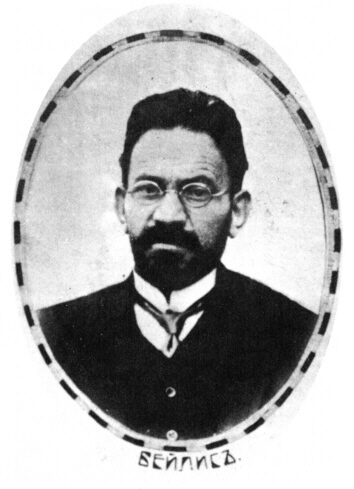
Menahem Mendel Beilis
Menahem Mendel Beilis was a Russian Jew accused of murder. Born 1874, in Kyiv. Died July 7, 1934, in Saratoga Springs.
Facts
13 facts · 2 confirmed by two sources · 6 cited · 5 from one source
Where this comes from
Papalocal keeps its own record. It started from these sources; what each one said is kept here as it was copied, so a change on their side never changes this page by itself. Tap one to read its version.
What Wikidata says · copied November 18, 2026 · revision 2567378924
- Described as
- Russian Jew accused of murder (1874–1934)
- Born
- 1874 · 5 references
- Died
- July 7, 1934
- Born in
- Kyiv · 1 reference
- Died in
- Saratoga Springs · 1 reference
- Buried in
- Mount Carmel Cemetery
- Citizen of
- Russian Empire (–1914); Ottoman Palestine; United States
- Occupation
- soldier; merchant · 1 reference; laborer · 1 reference
- Field
- memoir literature · 1 reference; commerce · 1 reference
- Wikipedias with a page
- 14
Wikidata item Q814751 (wikidata.org/wiki/Q814751), public domain (CC0). Copied November 18, 2026.
What Wikipedia says · copied November 18, 2026 · revision 1378082286
Menahem Mendel Beilis (1874 – July 7, 1934; sometimes spelled Beiliss) was a Russian Jew accused of ritual murder in Kiev in a notorious 1913 trial, known as the "Beilis trial" or the "Beilis affair". Although Beilis was eventually acquitted after a lengthy process, the legal process sparked international criticism of antisemitism in the Russian Empire.
Beilis' story was fictionalized in Bernard Malamud's 1966 novel The Fixer, which won the Pulitzer Prize for Fiction and the U.S. National Book Award for Fiction. Maurice Samuel's book Blood Accusation: the Strange Case of the Beilis Trial, a non-fiction account, was published by Alfred A. Knopf the same year.
- Born, in its opening lines
- 1874
- Died, in its opening lines
- July 7, 1934
From the Wikipedia article “Menahem Mendel Beilis” (en.wikipedia.org/wiki/Menahem_Mendel_Beilis), by its contributors, under CC BY-SA 4.0 (creativecommons.org/licenses/by-sa/4.0/). Copied November 18, 2026; not changed.
Confirmed Two sources agree. Cited One source, and it names where it got it. One source One source, without a reference of its own. Sources disagree The sources disagree. We show the best-supported value and keep theirs below.
