
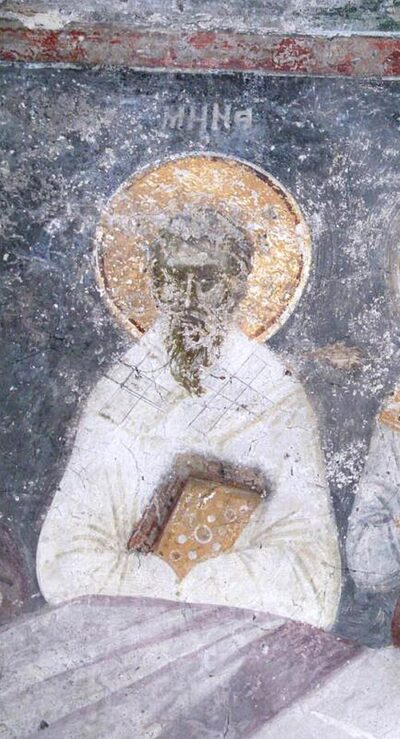
Menas of Constantinople was a Patriarch of Constatinople. Died August 25, 552, in Constantinople. Positions held include Ecumenical Patriarch of Constantinople.
Facts
8 facts · 1 confirmed by two sources · 1 cited · 6 from one source
What’s different
- Died: we show August 25, 552 (Confirmed). Wikidata also lists August 552
Where this comes from
Papalocal keeps its own record. It started from these sources; what each one said is kept here as it was copied, so a change on their side never changes this page by itself. Tap one to read its version.
What Wikidata says · copied November 18, 2026 · revision 2561045475
- Described as
- Patriarch of Constatinople
- Other names
- Patriarch Menas of Constantinople, St. Mena
- Died
- August 25, 552; August 552
- Born in
- Alexandria
- Died in
- Constantinople
- Citizen of
- Byzantine Empire
- Occupation
- bishop; presbyter
- Positions held
- Ecumenical Patriarch of Constantinople
- Religion
- Christianity · 1 reference
- Wikipedias with a page
- 24
Wikidata item Q1269184 (wikidata.org/wiki/Q1269184), public domain (CC0). Copied November 18, 2026.
What Wikipedia says · copied November 18, 2026 · revision 1377969775
Menas of Constantinople (also Minas; Ancient Greek: Μηνᾶς; died 25 August 552) was the 55th Ecumenical Patriarch of Constantinople from 13 March 536 until his death on 25 August 552.
Menas was born in Alexandria, and enters the records in high ecclesiastical office as presbyter and director of the Hospital of Sampson in Constantinople, where tradition has him linked to saint Sampson the Hospitable directly, and in the healing of Byzantine emperor Justinian I from the bubonic plague in 542.
He was appointed Patriarch of Constantinople by the Byzantine emperor Justinian I on 13 March 536. Pope Agapetus I consecrated him to succeed Anthimus I of Constantinople, who was condemned by Agapetus as a monophysite. This was the first time that a Pope consecrated a Patriarch of Constantinople.
At some date, very soon after his election, he received the order (keleusis) from the Emperor, whose text is not preserved, but which instructed him to call a synodos endemousa to examine the case of Anthimus, which would be heard at a series of five sessions, beginning on 2 May and ending 4 June 536. The Synod condemned Anthimus, as noted in Novellae Constitutiones XLII from Justinian, addressed directly to Menas. Within this same effort from Justinian to seal the growing rift between the Patriarch in Constantinople and that of Jerusalem, Menas later took a position against Origen, a crisis merging into the Three-Chapter Controversy, an attempt to condemn the writings of certain non-Chalcedonian figures. Menas' patriarchate represents the greatest extent of papal influence in Constantinople.
Almost immediately after the events of 536, which may be viewed as a Chalcedonian victory over monophysites, the ordination of an independent network of alleged monophysite / self-professed miaphysite bishops claiming apostolic authority would begin, leading eventually to the formation of a separate non-Chalcedonian church, the still-existing Syrian Orthodox Church that would be in communion with other excommunicated sees of the same theological persuasion. Justinian and Menas' efforts for doctrinal church unity would meet with failure.
It was during his patriarchate that emperor Justinian's church of Hagia Sophia, then the largest building in the world and the seat of the Patriarchs, was consecrated. Also, in 551 the Emperor compelled Menas to call what would be the Second Council of Constantinople, to reconcile the Western and Eastern Churches around the Three-Chapter Controversy, to be chaired ultimately by his successor Patriarch Eutychius of Constantinople in 553.
He died peacefully in 552. Menas is venerated a Saint in the Eastern Orthodox Church and Catholic Church today. His feast day in both the Eastern Orthodox and Catholic Church traditions are observed on 25 August.
- Died, in its opening lines
- August 25, 552
From the Wikipedia article “Menas of Constantinople” (en.wikipedia.org/wiki/Menas_of_Constantinople), by its contributors, under CC BY-SA 4.0 (creativecommons.org/licenses/by-sa/4.0/). Copied November 18, 2026; not changed.
Confirmed Two sources agree. Cited One source, and it names where it got it. One source One source, without a reference of its own. Sources disagree The sources disagree. We show the best-supported value and keep theirs below.
