
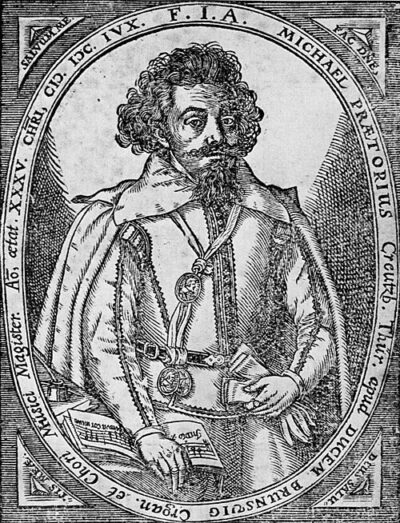
Michael Praetorius
Michael Praetorius was a German composer, organist, and music theorist. Born 1571, in Creuzburg. Died February 15, 1621, in Wolfenbüttel. Positions held include chapelmaster. Educated at University of Frankfurt an der Oder.
Facts
20 facts · 2 confirmed by two sources · 8 cited · 10 from one source
Where this comes from
Papalocal keeps its own record. It started from these sources; what each one said is kept here as it was copied, so a change on their side never changes this page by itself. Tap one to read its version.
What Wikidata says · copied November 16, 2026 · revision 2569190969
- Described as
- German composer, organist, and music theorist
- Born
- 1571 · 2 references
- Died
- February 15, 1621 · 9 references
- Born in
- Creuzburg · 1 reference
- Died in
- Wolfenbüttel · 1 reference
- Buried in
- Wolfenbüttel
- Citizen of
- Brunswick-Lüneburg
- Occupation
- composer · 2 references; musicologist · 1 reference; music theorist; librettist; organist · 3 references; conductor · 2 references; teacher · 1 reference; independent publisher · 1 reference
- Positions held
- chapelmaster
- Education
- University of Frankfurt an der Oder
- Instrument
- organ
- Father
- Michael Praetorius senior
- Siblings
- Brigitte Sachse
- Religion
- Lutheranism
- Wikipedias with a page
- 39
Wikidata item Q108278 (wikidata.org/wiki/Q108278), public domain (CC0). Copied November 16, 2026.
What Wikipedia says · copied November 16, 2026 · revision 1378399698
Michael Praetorius (probably 28 September 1571 – 15 February 1621) was a German composer, organist, and music theorist. He was one of the most versatile composers of his age, being particularly significant in the development of musical forms based on Protestant hymns.
- Born, in its opening lines
- September 28, 1571
- Died, in its opening lines
- February 15, 1621
From the Wikipedia article “Michael Praetorius” (en.wikipedia.org/wiki/Michael_Praetorius), by its contributors, under CC BY-SA 4.0 (creativecommons.org/licenses/by-sa/4.0/). Copied November 16, 2026; not changed.
Confirmed Two sources agree. Cited One source, and it names where it got it. One source One source, without a reference of its own. Sources disagree The sources disagree. We show the best-supported value and keep theirs below.
