
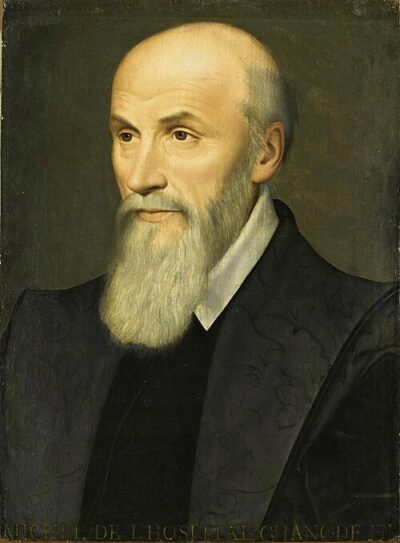
Michel de l'Hôpital
Michel de l'Hôpital was a French statesman. Born 1500s, in Chaptuzat. Died March 13, 1573, in Boutigny-sur-Essonne. Positions held include Lord Chancellor of France (1560–1573). Educated at University of Bologna and University of Padua.
Facts
17 facts · 1 confirmed by two sources · 6 cited · 9 from one source · 1 where the sources disagree
What’s different
- Born: we show 1500s (Sources disagree). Wikipedia says 1506
Where this comes from
Papalocal keeps its own record. It started from these sources; what each one said is kept here as it was copied, so a change on their side never changes this page by itself. Tap one to read its version.
What Wikidata says · copied November 16, 2026 · revision 2564353372
- Described as
- French statesman
- Other names
- Michel de l'Hospital, L'Hôpital, L'Hospital, L'Hopital, Michel de l'Hopital, Michel de L'Hopital, M. de l'Hospital, Michel de L'Hôpital, M. de L'Hôpital
- Born
- 1500s · 4 references
- Died
- March 13, 1573 · 1 reference
- Born in
- Chaptuzat
- Died in
- Boutigny-sur-Essonne
- Buried in
- Église Sainte-Madeleine de Champmotteux
- Citizen of
- Kingdom of France; France · 1 reference
- Occupation
- writer · 3 references; politician; poet; jurist · 2 references; chancellor · 1 reference
- Positions held
- Lord Chancellor of France (1560–1573)
- Education
- University of Bologna; University of Padua
- Spouse
- Marie Morin (1537–) · 1 reference
- Children
- Madeleine de L'Hospital · 1 reference
- Wikipedias with a page
- 29
Wikidata item Q551804 (wikidata.org/wiki/Q551804), public domain (CC0). Copied November 16, 2026.
What Wikipedia says · copied November 16, 2026 · revision 1385266603
Michel de l'Hôpital (or l'Hospital; 1506 – 13 March 1573) was a French lawyer, diplomat and chancellor during the latter Italian Wars and the early French Wars of Religion. The son of a doctor in the service of Charles III, Duke of Bourbon he spent his early life exiled from France at Bourbon's and then the emperors court. When his father entered the service of the House of Lorraine, he entered the patronage network of Charles, Cardinal of Lorraine. Through his marriage to Marie Morin, he acquired a seat in the Parlement of Paris. In this capacity he drew up the charges for the king, concerning the defenders of Boulogne who surrendered the city in 1544, before taking a role as a diplomat to the Council of Trent in 1547. The following year he assisted Anne d'Este in the details of her inheritance to ensure she could marry Francis, Duke of Guise.
In 1553 he entered Lorraine's service, providing support to the family in return for receiving offices from them. That year they secured for him the position of maître des requêtes for the hôtel du roi, an important post. The following year he was elevated to the chambre des comptes as président, granting him considerable influence in the financial administration of the kingdom. With his patron assuming overall control of the kingdoms finances in the late 1550s, he entered the conseil privé. Early into the reign of Francis II the old chancellor, François Olivier died. Lorraine nominated L'Hôpital as his replacement. An energetic reformer, L'Hôpital moved into conflict with the Parlements to ensure the passing of the Edict of Romorantin. Later that year, conscious of the scale of the financial and religious problems that were affecting the kingdom, he was among those advocating for an Assembly of Notables. The Assembly in turn called for a Estates General, which L'Hôpital opened and sought to direct towards widescale reforms. Unable to achieve quite what he sought, he fought the Parlement to push through the Ordinance of Orléans that resulted from the sessions.
Upon the death of Francis II, L'Hôpital did not fall from the centre of royal politics with his patrons. Instead, he supported Queen mother Catherine de' Medici in her religious policy which increasingly put him at odds with Lorraine. He helped formulate and championed the Edict of 19 April, the Edict of July and the Edict of Saint-Germain. The former two which moderated persecution of Protestantism and the latter of which legalised Protestant worship in France. Throughout this he found himself in opposition to Parlement, which resisted both the intrusions on their authority and any legalisation of Protestantism. After the first civil war in the French Wars of Religion, L'Hôpital entered his period of ascendency. He championed King Charles IX's decision to declare his majority at Rouen, to punish the Paris Parlement for its failure to register the peace treaty. He successfully opposed Lorraine's attempt to implement the Tridentine decrees upon his return from Trent. The next year he accompanied the court on its grand tour, with L'Hôpital berating each Parlement in turn for their impudence and failure to follow the king's will. When the court stopped at Moulins he promulgated a wide reaching set of legal reforms, which sought to combat Venal office, severely curtail the number of jurisdictions and overlapping law codes, and limit the power of governors and certain judges to interpret and execute justice that rightfully flowed from the king. By now his influence was waning and he was forced to abandon much of the edict due to the crown's monetary needs during the second civil war. Lorraine had by now returned to court, and he succeeded in besting L'Hôpital concerning a petition raised by the Dijon Parlement against him.
During the civil war he negotiated with the Prince of Condé who was besieging Paris, and urged concessions to the rebels, for which he received a cold reception. After the Peace of Longjumeau in March 1568, he retired from court in May, increasingly aware that his opinions were no longer received well by Catherine or the court. Returning to court in September he made a last attempt to oppose the crown's acceptance of alienated church lands in return for a war on heresy offered by the Pope. Failing in this he was relieved of his seals of office, and though he remained chancellor until his death, he would no longer exercise its authority. Threatened during the Massacre of Saint Bartholomew he and his daughter survived under Catherine and the duke of Guise's protection, he died in March the following year, his daughter inheriting his lands under the administration of his wife.
- Born, in its opening lines
- 1506
- Died, in its opening lines
- March 13, 1573
From the Wikipedia article “Michel de l'Hôpital” (en.wikipedia.org/wiki/Michel_de_l'Hôpital), by its contributors, under CC BY-SA 4.0 (creativecommons.org/licenses/by-sa/4.0/). Copied November 16, 2026; not changed.
Confirmed Two sources agree. Cited One source, and it names where it got it. One source One source, without a reference of its own. Sources disagree The sources disagree. We show the best-supported value and keep theirs below.
