
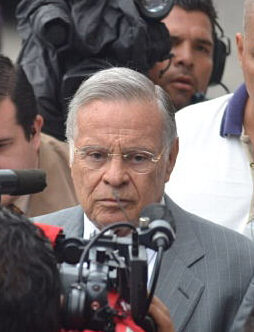
Miguel Ángel Rodríguez Echeverría
Miguel Ángel Rodríguez Echeverría is a President of Costa Rica. Born January 9, 1940, in San José. Positions held include General Secretariat of the Organization of American States (2004) and President of Costa Rica (1998–2002). Educated at University of Costa Rica and University of California, Berkeley. Awards include Collar of the Order of Isabella the Catholic, Gold medal of Galicia and Medal of the Oriental Republic of Uruguay.
Facts
19 facts · 1 confirmed by two sources · 4 cited · 14 from one source
Where this comes from
Papalocal keeps its own record. It started from these sources; what each one said is kept here as it was copied, so a change on their side never changes this page by itself. Tap one to read its version.
What Wikidata says · copied November 17, 2026 · revision 2558168889
- Described as
- President of Costa Rica
- Other names
- Miguel Angel Rodriguez Echeverria, Miguel Rodríguez Echeverría
- Born
- January 9, 1940
- Born in
- San José · 1 reference
- Citizen of
- Costa Rica
- Occupation
- economist · 1 reference; politician · 1 reference; lawyer
- Positions held
- General Secretariat of the Organization of American States (2004); President of Costa Rica (1998–2002) · 1 reference
- Political party
- Social Christian Unity Party
- Worked for
- University of Costa Rica
- Education
- University of Costa Rica; University of California, Berkeley
- Awards
- Collar of the Order of Isabella the Catholic (2001) · 1 reference; Gold medal of Galicia (1999); Medal of the Oriental Republic of Uruguay (2001) · 1 reference; Grand Cross, Special Class of the Order of the Sun of Peru; Order of Brilliant Jade
- Spouse
- Lorena Clare Facio · 1 reference
- Religion
- Catholic Church
- Wikipedias with a page
- 27
Wikidata item Q562577 (wikidata.org/wiki/Q562577), public domain (CC0). Copied November 17, 2026.
What Wikipedia says · copied November 17, 2026 · revision 1369568073
Miguel Ángel Rodríguez Echeverría (born 9 January 1940) is a Costa Rican economist, lawyer, businessman and politician who served as the 43rd President of Costa Rica from 1998 to 2002. A liberal member of the Social Christian Unity Party, he has remained active as a writer and columnist since leaving public office.
Before the presidency, Rodríguez served as Minister of Planning from 1968 to 1970 and as Minister of the Presidency in 1970 during the administration of José Joaquín Trejos Fernández. He was also a member of the board of the Central Bank of Costa Rica from 1966 to 1969, and served as a deputy in the Legislative Assembly of Costa Rica from 1990 to 1994, including as president of the assembly from 1991 to 1992.
In 2004, Rodríguez was elected Secretary General of the Organization of American States. He later voluntarily resigned from the post to return to Costa Rica and face allegations of financial misconduct related to his presidential administration, including accusations that he had received bribes from the French company Alcatel in connection with telecommunications contracts. On 27 April 2011, he was sentenced to five years in prison. However, the ruling was overturned in December 2012 by an appeals court, which acquitted him of all charges.
Rodríguez was elected to the presidency with an agenda that included opening state-run monopolies in insurance and telecommunications, restructuring the public sector through a greater private-sector role in infrastructure, trade liberalization, and the expansion and modernization of the welfare system. Proposed reforms to the insurance and telecommunications sectors provoked the 2000 Costa Rican protests and were abandoned at the time, though similar measures were later implemented after Costa Rica joined the CAFTA-DR in 2009.
- Born, in its opening lines
- January 9, 1940
From the Wikipedia article “Miguel Ángel Rodríguez” (en.wikipedia.org/wiki/Miguel_Ángel_Rodríguez), by its contributors, under CC BY-SA 4.0 (creativecommons.org/licenses/by-sa/4.0/). Copied November 17, 2026; not changed.
Confirmed Two sources agree. Cited One source, and it names where it got it. One source One source, without a reference of its own. Sources disagree The sources disagree. We show the best-supported value and keep theirs below.
