
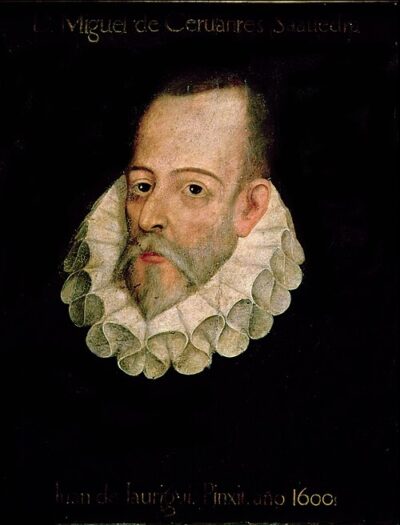
Miguel de Cervantes
Miguel de Cervantes was a Spanish novelist, poet, and playwright. Born September 29, 1547, in Alcalá de Henares. Died April 22, 1616, in Madrid. Known for Don Quixote and Exemplary Novels. Educated at Estudio de la Villa and University of Salamanca.
Facts
30 facts · 2 confirmed by two sources · 10 cited · 18 from one source
Where this comes from
Papalocal keeps its own record. It started from these sources; what each one said is kept here as it was copied, so a change on their side never changes this page by itself. Tap one to read its version.
What Wikidata says · copied November 16, 2026 · revision 2569759801
- Described as
- Spanish novelist, poet, and playwright (1547-1616)
- Other names
- Miguel de Cervantes Cortinas, Miguel de Cervantes y Saavedra, Miguel de Cervantes y Cortinas, Miguel de Cervantes-Saavedra, Miguel de Cerbantes, Miguel de Cerbantes Saavedra, Cervantes
- Born
- September 29, 1547 · 4 references
- Died
- April 22, 1616 · 11 references
- Born in
- Alcalá de Henares · 2 references
- Died in
- Madrid · 2 references
- Buried in
- convent of the Barefoot Trinitarians · 1 reference
- Cause of death
- type 2 diabetes
- Citizen of
- Crown of Castile · 1 reference
- Occupation
- novelist; playwright · 1 reference; poet · 1 reference; lyricist; soldier; writer · 5 references; accountant; tax collector
- Education
- Estudio de la Villa; University of Salamanca
- Genre
- tragedy; comedy
- Known for
- Don Quixote (1605); Exemplary Novels
- Field
- fiction · 1 reference; literature · 1 reference; theatre · 1 reference; military affairs · 1 reference
- Spouse
- Catalina de Salazar y Palacios · 1 reference
- Children
- Isabel de Saavedra
- Father
- Rodrigo de Cervantes
- Mother
- Leonor de Cortinas
- Religion
- Catholic Church
- Wikipedias with a page
- 250
Wikidata item Q5682 (wikidata.org/wiki/Q5682), public domain (CC0). Copied November 16, 2026.
What Wikipedia says · copied November 16, 2026 · revision 1385216499
Miguel de Cervantes Saavedra ( sur-VAN-teez, -tiz; Spanish: [miˈɣel de θeɾˈβantes sa(.a)ˈβeðɾa]; 29 September 1547 (assumed) – 22 April 1616) was a Spanish writer widely regarded as the greatest writer in the Spanish language and one of the world's pre-eminent novelists. He is best known for his two-part novel Don Quixote, a work considered to be the first modern novel. Don Quixote has been labelled by many well-known authors as the "best book of all time" and the "best and most central work in world literature".
Much of his life was spent in relative poverty and obscurity, which led to many of his early works being lost. Despite this, his influence and literary contribution are reflected by the fact that Spanish is often referred to as "the language of Cervantes".
In 1569, Cervantes was forced to leave Spain and move to Rome, where he worked in the household of a cardinal. In 1570, he enlisted in a Spanish Navy infantry regiment, and was badly wounded at the Battle of Lepanto in October 1571 and lost the use of his left arm and hand. He served as a soldier until 1575, when he was captured by Barbary pirates; after five years in captivity, he was ransomed, and returned to Madrid.
His first significant novel, titled La Galatea, was published in 1585, but he continued to work as a purchasing agent, and later as a government tax collector. Part One of Don Quixote was published in 1605, and Part Two in 1615. Other works include the 12 Novelas ejemplares (Exemplary Novels); a long poem, the Viaje del Parnaso (Journey to Parnassus); and Ocho comedias y ocho entremeses (Eight Plays and Eight Interludes). The novel Los trabajos de Persiles y Sigismunda (The Travails of Persiles and Sigismunda), was published posthumously in 1617.
- Born, in its opening lines
- September 29, 1547
- Died, in its opening lines
- April 22, 1616
From the Wikipedia article “Miguel de Cervantes” (en.wikipedia.org/wiki/Miguel_de_Cervantes), by its contributors, under CC BY-SA 4.0 (creativecommons.org/licenses/by-sa/4.0/). Copied November 16, 2026; not changed.
Confirmed Two sources agree. Cited One source, and it names where it got it. One source One source, without a reference of its own. Sources disagree The sources disagree. We show the best-supported value and keep theirs below.
