
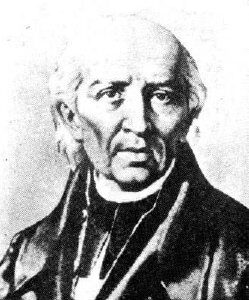
Miguel Hidalgo Y Costilla
Miguel Hidalgo Y Costilla was a Catholic priest, leader of the Mexican War of Independence. Born May 8, 1753, in Corralejo de Hidalgo. Died July 30, 1811, in Chihuahua City. Educated at Universidad Michoacana de San Nicolás de Hidalgo and Royal and Pontifical University of Mexico.
Facts
19 facts · 2 confirmed by two sources · 5 cited · 12 from one source
Where this comes from
Papalocal keeps its own record. It started from these sources; what each one said is kept here as it was copied, so a change on their side never changes this page by itself. Tap one to read its version.
What Wikidata says · copied November 16, 2026 · revision 2568879408
- Described as
- Catholic priest, leader of the Mexican War of Independence
- Other names
- Miguel Hidalgo, Miguel Gregorio Antonio Francisco Ignacio Hidalgo-Costilla y Gallaga Mandarte Villaseñor, Miguel Gregorio Antonio Ignacio Hidalgo y Costilla Gallaga Mandarte y Villaseñor
- Born
- May 8, 1753 · 8 references
- Died
- July 30, 1811 · 4 references
- Born in
- Corralejo de Hidalgo
- Died in
- Chihuahua City · 1 reference
- Buried in
- Angel of Independence
- Cause of death
- gunshot wound
- Name at birth
- Miguel Gregorio Antonio Ignacio Hidalgo y Costilla y Gallaga Mondarte Villaseñor
- Citizen of
- Spain
- Occupation
- Catholic priest · 2 references; politician · 1 reference; rebel leader; theologian · 1 reference
- Worked for
- Universidad Michoacana de San Nicolás de Hidalgo (1779–1792)
- Education
- Universidad Michoacana de San Nicolás de Hidalgo; Royal and Pontifical University of Mexico
- Field
- Catholicism · 1 reference; independentism · 1 reference
- Religion
- Catholic Church
- Military rank
- generalissimo
- Wikipedias with a page
- 60
Wikidata item Q55636 (wikidata.org/wiki/Q55636), public domain (CC0). Copied November 16, 2026.
What Wikipedia says · copied November 16, 2026 · revision 1384319641
Don Miguel Gregorio Antonio Ignacio Hidalgo y Costilla Gallaga Mandarte y Villaseñor (8 May 1753 – 30 July 1811), commonly known as Miguel Hidalgo y Costilla or simply Miguel Hidalgo (Spanish: [miˈɣel iˈðalɣo]), was a Mexican Catholic priest, teacher and leader of the early phase of the Mexican War of Independence. He is widely recognized as the Father of the Nation for issuing the Grito de Dolores on 16 September 1810, which initiated the armed struggle against Spanish colonial rule.
A professor at the Colegio de San Nicolás Obispo in Valladolid, Hidalgo was influenced by Enlightenment ideas, which contributed to his ouster in 1792. He served in a church in Colima and then in Dolores where he promoted practical economic improvements for local indigenous and mestizo communities.
On the night of 15–16 September 1810, following the discovery of the Conspiracy of Querétaro, he rang the parish church bells and called the population to arms. The exact wording of his call to arms is unknown; contemporary and later accounts vary, and there is no scholarly consensus on the precise initial goals of the conspirators. Modern Mexican historiography distinguishes between Hidalgo’s perceived preference for absolute independence and the more autonomist leanings of figures such as Ignacio Allende.
Hidalgo rapidly assembled a large, poorly disciplined popular army that scored early successes in the Bajío. He headed a provincial government in Guadalajara from where he issued various decrees before suffering a decisive defeat at the Battle of Calderón Bridge in January 1811. While fleeing north, he was captured, tried, defrocked, and executed by firing squad in Chihuahua on 30 July 1811. His short leadership phase radicalized the independence movement and opened the way for subsequent leaders such as his former student José María Morelos.
- Born, in its opening lines
- May 8, 1753
- Died, in its opening lines
- July 30, 1811
From the Wikipedia article “Miguel Hidalgo y Costilla” (en.wikipedia.org/wiki/Miguel_Hidalgo_y_Costilla), by its contributors, under CC BY-SA 4.0 (creativecommons.org/licenses/by-sa/4.0/). Copied November 16, 2026; not changed.
Confirmed Two sources agree. Cited One source, and it names where it got it. One source One source, without a reference of its own. Sources disagree The sources disagree. We show the best-supported value and keep theirs below.
