
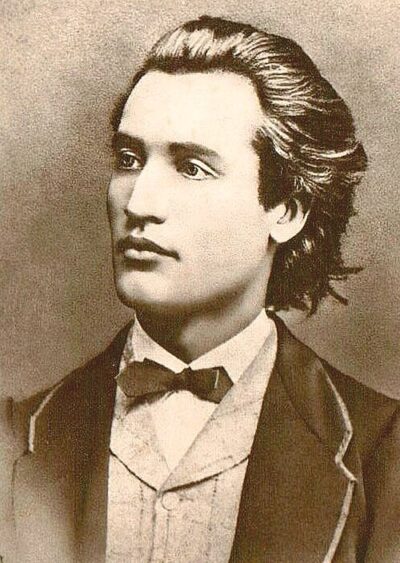
Mihai Eminescu
Mihai Eminescu was a Romanian poet, novelist and journalist. Born January 15, 1850, in Botoșani. Died June 15, 1889, in Bucharest. Known for Luceafărul. Educated at University of Vienna and Staatsgymnasium Czernowitz.
Facts
31 facts · 2 confirmed by two sources · 4 cited · 25 from one source
Where this comes from
Papalocal keeps its own record. It started from these sources; what each one said is kept here as it was copied, so a change on their side never changes this page by itself. Tap one to read its version.
What Wikidata says · copied November 16, 2026 · revision 2568485162
- Described as
- Romanian poet, novelist and journalist (1850–1889)
- Born
- January 15, 1850 · 12 references
- Died
- June 15, 1889 · 4 references
- Born in
- Botoșani · 1 reference
- Died in
- Bucharest · 1 reference
- Buried in
- Bellu Cemetery
- Name at birth
- Михай Эмин
- Citizen of
- Principality of Moldavia (1850–1856); United Principalities of Moldavia and Wallachia (1856–1881); Kingdom of Romania (1881–1889)
- Occupation
- actor; prose writer; journalist; librarian; essayist; writer · 3 references; poet · 1 reference; politician
- Education
- University of Vienna · 1 reference; Staatsgymnasium Czernowitz; Humboldt-Universität zu Berlin
- Member of
- Romanian Academy (1948–); Junimea; Timpul
- Genre
- poetry
- Known for
- Luceafărul · 1 reference
- Father
- Gheorghe Eminovici
- Mother
- Raluca Eminovici
- Siblings
- Henriette Eminescu; Matei Eminescu; Aglaia Eminovici
- Lived in
- Botoșani
- Wikipedias with a page
- 89
Wikidata item Q184935 (wikidata.org/wiki/Q184935), public domain (CC0). Copied November 16, 2026.
What Wikipedia says · copied November 16, 2026 · revision 1382989605
Mihai Eminescu (Romanian pronunciation: [miˈhaj emiˈnesku] ; born Mihail Eminovici; 15 January [O.S. 3 January] 1850 – 15 June [O.S. 3 June] 1889) was a Romanian Romantic poet, novelist, and journalist from Moldavia, generally regarded as the most famous and influential Romanian poet. Eminescu was an active member of the Junimea literary society and worked as an editor for the newspaper Timpul ("The Time"), the official newspaper of the Conservative Party (1880–1918). His poetry was first published when he was 16 and he went to Vienna, Austria to study when he was 19. The poet's manuscripts, containing 46 volumes and approximately 14,000 pages, were offered by Titu Maiorescu as a gift to the Romanian Academy during the meeting that was held on 25 January 1902. Notable works include Luceafărul, Odă în metru antic (Ode in Ancient Meter), and the five Letters (Epistles/Satires). In his poems, he frequently used metaphysical, mythological and historical subjects.
Eminescu's father was Gheorghe Eminovici, an aristocrat from Bukovina, which was then part of the Austrian Empire (while his grandfather came from Banat). He crossed the border into Moldavia, settling in Ipotești, near the town of Botoșani. He married Raluca Iurașcu, an heiress of an old noble family. In a Junimea register, Eminescu wrote down his birth date as 22 December 1849, while in the documents of Cernăuți Gymnasium, where Eminescu studied, his birth date is 15 January 1850. Nevertheless, Titu Maiorescu, in his work Eminescu and His Poems (1889), quoted N. D. Giurescu's research and adopted his conclusion regarding the date and place of Mihai Eminescu's birth, as being 15 January 1850, in Botoșani. This date resulted from several sources, among which there was a file of notes on christenings from the archives of the Uspenia (Princely) Church of Botoșani; inside this file, the date of birth was "15 January 1850" and the date of christening was the 21st of the same month. The date of his birth was confirmed by the poet's elder sister, Aglae Drogli, who affirmed that the place of birth was the village of Ipotești, Botoșani County.
- Born, in its opening lines
- January 15, 1850
- Died, in its opening lines
- June 15, 1889
From the Wikipedia article “Mihai Eminescu” (en.wikipedia.org/wiki/Mihai_Eminescu), by its contributors, under CC BY-SA 4.0 (creativecommons.org/licenses/by-sa/4.0/). Copied November 16, 2026; not changed.
Confirmed Two sources agree. Cited One source, and it names where it got it. One source One source, without a reference of its own. Sources disagree The sources disagree. We show the best-supported value and keep theirs below.
