
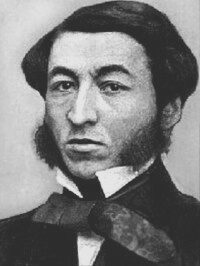
Mikael Nalbandian
Mikael Nalbandian was an Armenian writer. Born November 2, 1829, in Nakhichevan-on-Don. Died March 31, 1866, in Kamyshin. Known for Mer Hayrenik. Educated at Medical faculty of Moscow University.
Facts
13 facts · 0 confirmed by two sources · 8 cited · 3 from one source · 2 where the sources disagree
What’s different
- Born: we show November 2, 1829 (Sources disagree). Wikipedia says November 14, 1829
- Died: we show March 31, 1866 (Sources disagree). Wikipedia says April 12, 1866
Where this comes from
Papalocal keeps its own record. It started from these sources; what each one said is kept here as it was copied, so a change on their side never changes this page by itself. Tap one to read its version.
What Wikidata says · copied November 16, 2026 · revision 2554308679
- Described as
- Armenian writer (1829-1866)
- Other names
- Mikael Nalbandyan, Mikael Ghazari Nalbandyan, Nalbandyan, Mikael Ghazari
- Born
- November 2, 1829 · 1 reference
- Died
- March 31, 1866 · 1 reference
- Born in
- Nakhichevan-on-Don · 1 reference
- Died in
- Kamyshin · 1 reference
- Cause of death
- tuberculosis
- Citizen of
- Russian Empire
- Occupation
- writer · 1 reference; opinion journalist · 1 reference; literary scholar · 1 reference
- Worked for
- Lazarev Institute of Oriental Languages (1853–1854) · 1 reference
- Education
- Medical faculty of Moscow University (1854–1858) · 1 reference
- Known for
- Mer Hayrenik · 1 reference
- Field
- philosophy
- Wikipedias with a page
- 30
Wikidata item Q3308432 (wikidata.org/wiki/Q3308432), public domain (CC0). Copied November 16, 2026.
What Wikipedia says · copied November 16, 2026 · revision 1375166019
Mikayel Nalbandian (Armenian: Միքայել Նալբանդյան; 14 November [O.S. 2 November] 1829 – 12 April [O.S. 31 March] 1866) was a Russian Armenian writer, poet, political theorist and revolutionary.
Nalbandian was born in Nakhichevan-on-Don, an Armenian town in southern Russia, and traveled extensively, although he visited Armenia itself only once. A radical intellectual, Nalbandian was an avid advocate of secularism and anti-clericalism, the use of modern Armenian (as opposed to classical Armenian) and a vocal critic of the conservative clergy of the Armenian Apostolic Church. He also espoused anti-Catholicism. Inspired by the Enlightenment and the Italian unification, Nalbandian advocated reform, cultural nationalism and agrarianism among Armenians. In his later years he was influenced by Russian radicals such as Alexander Herzen and Nikolay Chernyshevsky. For his association with them, he was persecuted and died in exile at 37.
A champion of modernism, he is seen as a follower of Khachatur Abovian. In turn, he influenced many others, including the novelist Raffi, Armenian nationalist revolutionaries (especially the Dashnaks), and Armenian Marxists, such as Alexander Miasnikian. Nalbandian was widely revered in Soviet Armenia, while Dashnaks adopted "Mer Hayrenik", based on his poem "The Song of an Italian Girl", as the anthem of the First Republic of Armenia in 1918. It was re-adopted by independent Armenia in 1991. Another poem by Nalbandian, glorifying freedom, has become a celebrated anthem since it was written in 1859.
- Born, in its opening lines
- November 14, 1829
- Died, in its opening lines
- April 12, 1866
From the Wikipedia article “Mikayel Nalbandian” (en.wikipedia.org/wiki/Mikayel_Nalbandian), by its contributors, under CC BY-SA 4.0 (creativecommons.org/licenses/by-sa/4.0/). Copied November 16, 2026; not changed.
Confirmed Two sources agree. Cited One source, and it names where it got it. One source One source, without a reference of its own. Sources disagree The sources disagree. We show the best-supported value and keep theirs below.
