
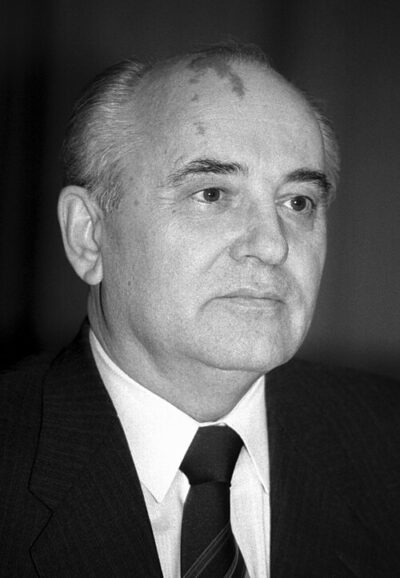
Mikhail Gorbachev
Mikhail Gorbachev was a leader of the Soviet Union from 1985 to 1991. Born March 2, 1931, in Privolnoye. Died August 30, 2022, in Central Clinical Hospital. Positions held include General Secretary of the Communist Party of the Soviet Union (1985–1991), President of the Soviet Union (1990–1991) and Chairman of the Supreme Soviet of the USSR (1989–1990). Educated at Moscow State University, Faculty of Law and Stavropol State Agrarian University. Awards include Nobel Peace Prize, Commandeur des Arts et des Lettres and honorary citizen of Berlin.
Facts
60 facts · 2 confirmed by two sources · 16 cited · 42 from one source
Where this comes from
Papalocal keeps its own record. It started from these sources; what each one said is kept here as it was copied, so a change on their side never changes this page by itself. Tap one to read its version.
What Wikidata says · copied November 16, 2026 · revision 2568757753
- Described as
- leader of the Soviet Union from 1985 to 1991 (1931–2022)
- Other names
- M.S. Gorbachev, M. Gorbachev, Mikhail Sergeyevich Gorbachyov, Gorbachev, Mikhail Gorbachyov, Gorby, Mikhail Sergeevich Gorbachev, Gorbi, Mikhail Gorbachov, Михаил Горбачёв, Mikhail Sergeyevich Gorbachev
- Born
- March 2, 1931 · 7 references
- Died
- August 30, 2022 · 3 references
- Born in
- Privolnoye
- Died in
- Central Clinical Hospital · 1 reference
- Buried in
- Novodevichy Cemetery · 1 reference
- Cause of death
- kidney failure
- Citizen of
- Russia (1991–); Soviet Union (–1991)
- Occupation
- politician · 1 reference; jurist; environmentalist; economist · 1 reference; lawyer; film actor · 1 reference
- Positions held
- General Secretary of the Communist Party of the Soviet Union (1985–1991); President of the Soviet Union (1990–1991) · 2 references; Chairman of the Supreme Soviet of the USSR (1989–1990); Chairman of the Presidium of the Supreme Soviet of the Soviet Union (1988–1989); Secretary of the Communist Party of the Soviet Union (1978–1985)
- Political party
- Communist Party of the Soviet Union (1950–1991); Russian United Social Democratic Party (2000–2001); Social Democratic Party of Russia (2001–2007); Union of Social Democrats (2007–)
- Worked for
- All-Union Leninist Young Communist League · 1 reference; The Gorbachev Foundation · 1 reference
- Education
- Moscow State University, Faculty of Law (–1955); Stavropol State Agrarian University (–1967); Lomonosov Moscow State University · 1 reference
- Member of
- International Academy of Sciences San Marino (1996–) · 1 reference; Central Committee of the Communist Party of the Soviet Union · 1 reference; Politburo of the Central Committee of the Communist Party of the Soviet Union; Club of Rome; All-Union Leninist Young Communist League · 1 reference
- Awards
- Nobel Peace Prize (1990) · 2 references; Commandeur des Arts et des Lettres (1997); honorary citizen of Berlin (1992) · 1 reference; Order of Honour (2001) · 1 reference; Order of the October Revolution (1978) · 1 reference; Collar of the Order of the White Lion; Order of the Badge of Honour (1966) · 1 reference; Princess of Asturias Award for International Cooperation (1989); Philadelphia Liberty Medal · 1 reference; Free Your Mind (2008); North–South Prize; Alexander Men Prize; Ronald Reagan Freedom Award; Delta Prize for Global Understanding; Champions of the Earth (2006)
- Field
- politics · 1 reference; economic reform · 1 reference; democratization · 1 reference; perestroika · 1 reference; political reform · 1 reference
- Spouse
- Raisa Gorbacheva (1953–1999) · 1 reference
- Children
- Irina Virganskaya · 1 reference
- Father
- Sergey Gorbachev
- Mother
- Maria Gorbacheva
- Religion
- atheism · 3 references
- Military rank
- colonel · 1 reference
- Website
- http://www.gorby.ru
- Wikipedias with a page
- 203
Wikidata item Q30487 (wikidata.org/wiki/Q30487), public domain (CC0). Copied November 16, 2026.
What Wikipedia says · copied November 16, 2026 · revision 1385278416
Mikhail Sergeyevich Gorbachev (2 March 1931 – 30 August 2022) was a Soviet and Russian politician who was the last leader of the Soviet Union from 1985 until the country's dissolution in 1991. He served as General Secretary of the Communist Party from 1985, and additionally as head of state from 1988. Ideologically, he initially adhered to Marxism–Leninism, but moved towards social democracy by the early 1990s.
Born in Privolnoye, North Caucasus Krai, into a peasant family of Russian and Ukrainian heritage, Gorbachev grew up under the rule of Joseph Stalin. In his youth, Gorbachev operated combine harvesters on a collective farm, before joining the Communist Party, which then governed the Soviet Union as a one-party state. Studying at Moscow State University, he married fellow student Raisa Titarenko in 1953 and received his law degree in 1955. Moving to Stavropol, he worked for the Komsomol youth organization and, after Stalin's death, became a keen proponent of the de-Stalinization reforms of Soviet leader Nikita Khrushchev. Gorbachev was appointed the first party secretary of the Stavropol Regional Committee in 1970, overseeing the construction of the Great Stavropol Canal. In 1978, Gorbachev returned to Moscow to become a secretary of the party's Central Committee. He joined the governing Politburo (25th term) as a non-voting member the following year and as a voting member in 1980.
Three years after the death of Soviet leader Leonid Brezhnev, and following the brief tenures of Yuri Andropov and Konstantin Chernenko, the Politburo elected Gorbachev as general secretary in 1985. Although committed to preserving the Soviet state and its Marxist–Leninist principles, Gorbachev believed significant reform was necessary for its survival. He withdrew troops from the Soviet–Afghan War, and embarked on summits with United States president Ronald Reagan to limit nuclear weapons and end the Cold War. Domestically, Gorbachev's policy of glasnost ("openness") and demokratizatsiya ("democratization") allowed for enhanced freedom of speech and the press, while his perestroika ("restructuring") sought to decentralize economic decision-making to improve its efficiency. Ultimately, his democratization measures and formation of the elected Congress of People's Deputies undermined the one-party state. When various Warsaw Pact countries abandoned Marxist–Leninist governance in 1989, he declined to intervene militarily. Growing nationalist sentiment within constituent republics threatened to break up the Soviet Union, leading hardliners within the party to launch an unsuccessful coup against him in August 1991. In the wake of the coup, the Soviet Union dissolved against Gorbachev's wishes.
After resigning from the presidency, he launched the Gorbachev Foundation, became a vocal critic of Russian presidents Boris Yeltsin and Vladimir Putin, and campaigned for Russia's social-democratic movement. Considered one of the most significant figures of the second half of the 20th century, Gorbachev remains controversial. The recipient of a wide range of awards, including the Nobel Peace Prize, he was praised for his role in ending the Cold War, introducing new political and economic freedoms in the Soviet Union, and tolerating both the fall of Marxist–Leninist administrations in eastern and central Europe and the German reunification. Critics see him as weakening Russia's global influence and precipitating an economic collapse in the country.
- Born, in its opening lines
- March 2, 1931
- Died, in its opening lines
- August 30, 2022
From the Wikipedia article “Mikhail Gorbachev” (en.wikipedia.org/wiki/Mikhail_Gorbachev), by its contributors, under CC BY-SA 4.0 (creativecommons.org/licenses/by-sa/4.0/). Copied November 16, 2026; not changed.
Confirmed Two sources agree. Cited One source, and it names where it got it. One source One source, without a reference of its own. Sources disagree The sources disagree. We show the best-supported value and keep theirs below.
