
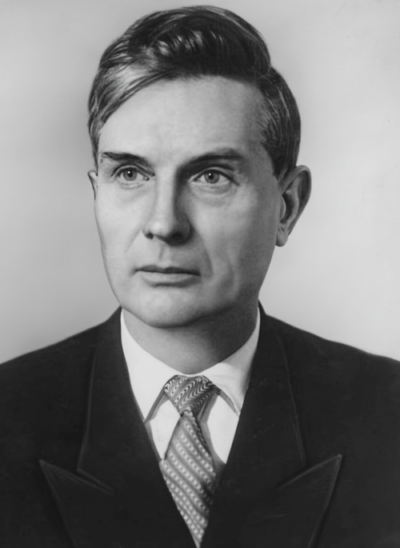
Mikhail Suslov
Mikhail Suslov was a Soviet-era statesman. Born November 8, 1902, in Shakhovskoye. Died January 25, 1982, in Moscow. Positions held include deputy of the Supreme Soviet of the Soviet Union, Secretary of the Communist Party of the Soviet Union (1947–1982) and Member of the Politburo of the CPSU Central Committee (1952–1953). Educated at Institute of Red Professors and Plekhanov Russian Economic University. Awards include Order of Lenin (5 times), Order of the October Revolution and Order of the Patriotic War, 1st class.
Facts
39 facts · 1 confirmed by two sources · 5 cited · 32 from one source · 1 where the sources disagree
What’s different
- Born: we show November 8, 1902 (Sources disagree). Wikipedia says November 21, 1902
Where this comes from
Papalocal keeps its own record. It started from these sources; what each one said is kept here as it was copied, so a change on their side never changes this page by itself. Tap one to read its version.
What Wikidata says · copied November 16, 2026 · revision 2558169915
- Described as
- Soviet-era statesman (1902-1982)
- Other names
- Mikhail Andreyevich Suslov
- Born
- November 8, 1902 · 5 references
- Died
- January 25, 1982 · 7 references
- Born in
- Shakhovskoye · 1 reference
- Died in
- Moscow · 2 references
- Buried in
- Kremlin Wall Necropolis
- Cause of death
- myocardial infarction
- Citizen of
- Russian Empire; Soviet Union
- Occupation
- politician · 1 reference; economist · 1 reference; university teacher · 1 reference
- Positions held
- deputy of the Supreme Soviet of the Soviet Union; Secretary of the Communist Party of the Soviet Union (1947–1982); Member of the Politburo of the CPSU Central Committee (1952–1953) · 1 reference
- Political party
- Communist Party of the Soviet Union (1921–)
- Worked for
- Lomonosov Moscow State University; Industrial Academy
- Education
- Institute of Red Professors (–1929); Plekhanov Russian Economic University (1924–1928); Rabfak (–1924)
- Member of
- Central Committee of the Communist Party of the Soviet Union; Politburo of the Central Committee of the Communist Party of the Soviet Union
- Awards
- Order of Lenin (5 times) (1940, 1952, 1962, 1971, 1972); Order of the October Revolution (1977); Order of the Patriotic War, 1st class (1945); Karl Marx Gold Medal; Jubilee Medal "In Commemoration of the 100th Anniversary of the Birth of Vladimir Ilyich Lenin"; Gold Star Order; Order of Klement Gottwald (1977); "Hammer and Sickle" gold medal (2 times) (1962, 1972); Hero of Socialist Labour of Bulgaria · 2 references; Medal "To a Partisan of the Patriotic War", 1st class · 1 reference; Medal "For the Defence of the Caucasus" · 1 reference; Medal "For the Victory over Germany in the Great Patriotic War 1941–1945" · 1 reference; Medal "For Valiant Labour in the Great Patriotic War 1941–1945" · 1 reference; Order of Georgi Dimitrov · 1 reference; Order of Sukhbaatar · 1 reference
- Religion
- atheism
- Lived in
- Kutuzovsky Prospekt · 1 reference
- Wikipedias with a page
- 54
Wikidata item Q283451 (wikidata.org/wiki/Q283451), public domain (CC0). Copied November 16, 2026.
What Wikipedia says · copied November 16, 2026 · revision 1385199789
Mikhail Andreyevich Suslov (Russian: Михаи́л Андре́евич Су́слов; 21 November [O.S. 8 November] 1902 – 25 January 1982) was a Soviet politician. In addition to serving as the Central Committee's longtime Secretary of Ideology, he held office as Second Secretary of the Communist Party of the Soviet Union from 1965 until his death in 1982.
Born in rural Russia in 1902, Suslov became a member of the All-Union Communist Party (Bolsheviks) in 1921 and studied economics for much of the 1920s. He left his job as a teacher in 1931 to pursue politics full-time, becoming one of the many Soviet politicians who took part in the mass repression begun by Joseph Stalin's regime. He was made First Secretary of Stavropol Krai administrative area in 1939. During World War II, Suslov headed the local Stavropol guerrilla movement.
After the war, Suslov became a member of the Organisational Bureau (Orgburo) of the Central Committee in 1946. In June 1950, he was elected to the Presidium of the Supreme Soviet. From 16 October 1952 onwards, he was a full member of the 19th Presidium of the CPSU. In the ensuing shuffle of the Soviet leadership following Stalin's death, Suslov lost much of the recognition and influence he had previously earned. However, by the late 1950s, he had risen to become the leader of the party opposition to First Secretary Nikita Khrushchev.
When Khrushchev was ousted in 1964, Suslov supported the establishment of a collective leadership. He also supported inner-party democracy and opposed the reestablishment of the one-man rule as seen during the Stalin and Khrushchev eras. Under the leadership of Leonid Brezhnev, Suslov was considered to be the party's chief ideologue and second-in-command. He ultimately died in office on 25 January 1982.
- Born, in its opening lines
- November 21, 1902
- Died, in its opening lines
- January 25, 1982
From the Wikipedia article “Mikhail Suslov” (en.wikipedia.org/wiki/Mikhail_Suslov), by its contributors, under CC BY-SA 4.0 (creativecommons.org/licenses/by-sa/4.0/). Copied November 16, 2026; not changed.
Confirmed Two sources agree. Cited One source, and it names where it got it. One source One source, without a reference of its own. Sources disagree The sources disagree. We show the best-supported value and keep theirs below.
