
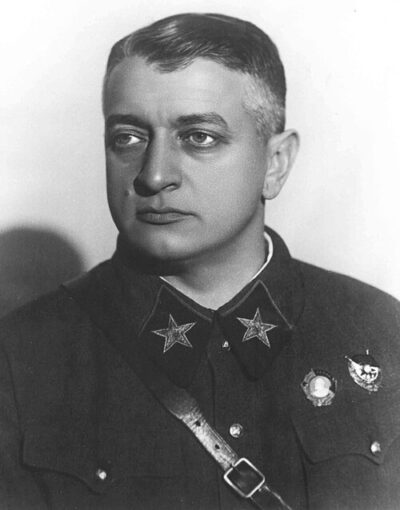
Mikhail Tukhachevsky
Mikhail Tukhachevsky was a Marshal of the Soviet Union (1893—1937). Born February 4, 1893, in Slednevo. Died June 12, 1937, in Moscow. Educated at Alexandrov Military School. Awards include Order of Saint Anna, 2nd class, Order of Lenin and Order of the Red Banner.
Facts
26 facts · 1 confirmed by two sources · 2 cited · 22 from one source · 1 where the sources disagree
What’s different
- Born: we show February 4, 1893 (Sources disagree). Wikipedia says February 16, 1893
Where this comes from
Papalocal keeps its own record. It started from these sources; what each one said is kept here as it was copied, so a change on their side never changes this page by itself. Tap one to read its version.
What Wikidata says · copied November 16, 2026 · revision 2558169930
- Described as
- Marshal of the Soviet Union (1893—1937)
- Other names
- Mikhail Nikolayevich Tukhachevsky
- Born
- February 4, 1893 · 1 reference
- Died
- June 12, 1937 · 3 references
- Born in
- Slednevo
- Died in
- Moscow · 4 references
- Citizen of
- Russian Empire; Russian Soviet Federative Socialist Republic · 1 reference; Soviet Union
- Occupation
- military officer; politician · 1 reference
- Political party
- Communist Party of the Soviet Union
- Education
- Alexandrov Military School
- Awards
- Order of Saint Anna, 2nd class; Order of Lenin; Order of the Red Banner; Order of Saint Anna, 3rd class; Order of Saint Anna, 4th class; Order of St. Vladimir, 4th class; Order of Saint Stanislaus, 3rd class; Order of Saint Stanislaus; Order of St. Vladimir · 1 reference; Order of Saint Anna · 1 reference; Order of Saint Stanislaus · 1 reference; Honorary Revolutionary Weapon · 1 reference
- Military branch
- Imperial Russian Army · 1 reference
- Military rank
- Marshal of the Soviet Union; podporuchik · 1 reference
- Wikipedias with a page
- 61
Wikidata item Q142141 (wikidata.org/wiki/Q142141), public domain (CC0). Copied November 16, 2026.
What Wikipedia says · copied November 16, 2026 · revision 1381044954
Mikhail Nikolayevich Tukhachevsky (Russian: Михаил Николаевич Тухачевский; 16 February [O.S. 4 February] 1893 – 12 June 1937), nicknamed the Red Napoleon, was a Soviet general who was prominent between 1918 and 1937 as a military officer and theoretician. He was later executed during the Moscow trials of 1936–1938.
He served as an officer in World War I of 1914–1917 and in the Russian Civil War of 1917–1923, leading the defense of the Moscow district (1918), commanding forces on the Eastern Front (1918), commanding the Fifth Army in the recapture of Siberia from Alexander Kolchak, and heading Cossack forces against Anton Denikin (1920). From 1920 to 1921 he commanded the Soviet Western Front in the Polish–Soviet War. Soviet forces under his command successfully repelled the Polish forces from Western Ukraine, driving them back into Poland, but the Red Army suffered defeat outside of Warsaw, and the war ended in a Soviet defeat. Tukhachevsky blamed Joseph Stalin for his defeat at the Battle of Warsaw.
He later served as Chief of Staff of the Red Army from 1925 to 1928, as assistant in the People's Commissariat of Defense after 1934 and as commander of the Volga Military District in 1937. He achieved the rank of Marshal of the Soviet Union in 1935.
As a major proponent of modernisation of Soviet armament and army force structure in the 1920s and 1930s, he became instrumental in the development of Soviet aviation, and of mechanized and airborne forces. As a theoretician, he was a driving force behind the Soviet development of the theory of deep operations in the 1920s and 1930s. Soviet authorities accused Tukhachevsky of treason, and after he confessed during torture, he was executed in 1937 during the military purges of 1936–1938, led by Stalin and Nikolai Yezhov.
- Born, in its opening lines
- February 16, 1893
- Died, in its opening lines
- June 12, 1937
From the Wikipedia article “Mikhail Tukhachevsky” (en.wikipedia.org/wiki/Mikhail_Tukhachevsky), by its contributors, under CC BY-SA 4.0 (creativecommons.org/licenses/by-sa/4.0/). Copied November 16, 2026; not changed.
Confirmed Two sources agree. Cited One source, and it names where it got it. One source One source, without a reference of its own. Sources disagree The sources disagree. We show the best-supported value and keep theirs below.
