
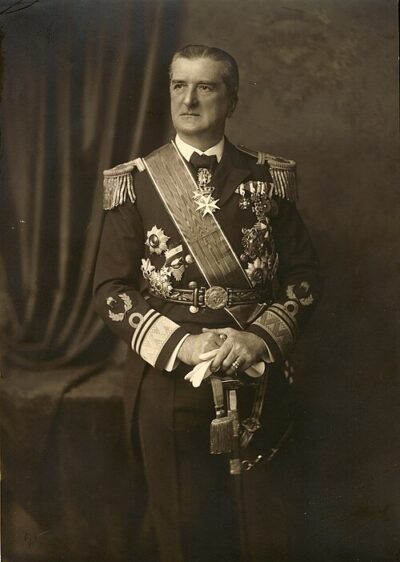
Miklós Horthy
Miklós Horthy was a Regent of Hungary from 1920 to 1944. Born June 18, 1868, in Kenderes. Died February 9, 1957, in Estoril. Positions held include Regent of Hungary (1920–1944) and Minister of Defence of Hungary (1919). Educated at Reformed College of Debrecen. Awards include Order of the White Eagle, Order of the Three Stars, 1st Class and Order of the White Star, Collar Class.
Facts
38 facts · 2 confirmed by two sources · 17 cited · 19 from one source
Where this comes from
Papalocal keeps its own record. It started from these sources; what each one said is kept here as it was copied, so a change on their side never changes this page by itself. Tap one to read its version.
What Wikidata says · copied November 16, 2026 · revision 2569106503
- Described as
- Regent of Hungary from 1920 to 1944 (1868-1957)
- Other names
- Miklos Horthy, Miklós Horthy de Nagybánya
- Born
- June 18, 1868 · 14 references
- Died
- February 9, 1957 · 15 references
- Born in
- Kenderes · 1 reference
- Died in
- Estoril · 3 references
- Buried in
- Kenderes · 1 reference
- Citizen of
- Hungary
- Occupation
- politician · 2 references; military officer · 1 reference; admiral · 1 reference
- Positions held
- Regent of Hungary (1920–1944); Minister of Defence of Hungary (1919) · 1 reference
- Political party
- independent politician
- Education
- Reformed College of Debrecen (1876–1878)
- Awards
- Order of the White Eagle; Order of the Three Stars, 1st Class; Order of the White Star, Collar Class (1939) · 1 reference; Estonian Red Cross Order First Class (1931) · 1 reference; 1st Class of the Order of the Cross of the Eagle (1931) · 1 reference; Cross of Liberty 3rd Division, 1st Class (1925) · 1 reference; Knight's Cross of the Iron Cross · 1 reference; Iron Cross (1914), 1st class · 1 reference; Iron Cross (1914), 2nd class · 1 reference; Grand Cross of the Order of the German Eagle in Gold with Swords (1942) · 1 reference; Order of the Black Eagle; Order of the Red Eagle 2nd Class; Grand Cross of the Military Order of Maria Theresa; Military Merit Cross III. Class; Order of Vitéz
- Spouse
- Magdolna Purgly (1901–1957) · 1 reference
- Children
- Magdolna Horthy · 1 reference; Paulette Horthy · 1 reference; István Horthy · 1 reference; Miklós Horthy · 1 reference
- Father
- István Horthy · 1 reference
- Mother
- Paula Halassy · 1 reference
- Religion
- Reformed Christianity
- Military branch
- Austro-Hungarian Navy (1896–1918)
- Military rank
- vice admiral
- Wikipedias with a page
- 68
Wikidata item Q117144 (wikidata.org/wiki/Q117144), public domain (CC0). Copied November 16, 2026.
What Wikipedia says · copied November 16, 2026 · revision 1384939676
Miklós Horthy de Nagybánya (18 June 1868 – 9 February 1957) was a Hungarian admiral and statesman who was the regent of the Kingdom of Hungary during the interwar period and most of World War II, from 1 March 1920 to 15 October 1944.
Horthy began his career as a sub-lieutenant in the Austro-Hungarian Navy in 1896 and attained the rank of rear admiral by 1918. He participated in the Battle of the Strait of Otranto and ascended to the position of commander-in-chief of the Navy in the final year of World War I. Following mutinies, Emperor-King Charles I and IV appointed him a vice admiral and commander of the Fleet, dismissing the previous admiral. During the revolutions and interventions in Hungary from Czechoslovakia, Romania and Yugoslavia, Horthy returned to Budapest with the National Army. Subsequently, the Diet of Hungary offered him the position of Regent of Hungary, while the House of Habsburg and Hungarian monarchy was formally dethroned.
Throughout the interwar period, Horthy led an administration characterized by national conservatism and antisemitism. Under his leadership, Hungary banned the Hungarian Communist Party and the far-right Arrow Cross Party led by Ferenc Szálasi, and pursued a revanchist foreign policy in response to the 1920 Treaty of Trianon. The former King of Hungary, Charles IV, attempted to return to Hungary twice before the Hungarian government yielded to Allied threats of renewed hostilities in 1921. Subsequently, Charles was escorted out of Hungary and into exile.
Ideologically a national conservative, Horthy has sometimes been labelled as a fascist. In the late 1930s, Horthy's foreign policy led him into an alliance with Nazi Germany against the Soviet Union. With the support of Adolf Hitler, Hungary succeeded in reoccupying certain areas ceded to neighbouring countries by the Treaty of Trianon. Under Horthy's leadership, Hungary provided support to Polish refugees when Germany attacked their country in 1939, and participated in the Axis powers' invasion of the Soviet Union in June 1941. Some historians view Horthy as unenthusiastic about contributing to the German war effort and the Holocaust in Hungary (out of fear that it would sabotage peace deals with Allied forces); in addition, several attempts were made to strike a secret deal with the Allies of World War II after it had become obvious that the Axis would lose the war, therefore eventually leading the Germans to invade and take control of the country in March 1944. However, prior to the Nazi occupation of Hungary, 63,000 Jews were murdered. In late 1944, 437,000 Jews were deported to Auschwitz II-Birkenau, where the majority (80%) were exterminated on arrival in gas chambers. Serbian historian Zvonimir Golubović has claimed that not only was Horthy aware of these genocidal massacres, but had approved of them, such as those in the Novi Sad raid, though British historian Mark Mazower argues that Horthy ordered an investigation into the massacre, helping in bringing criminal charges onto some of the perpetrators.
In October 1944, Horthy announced that Hungary had declared an armistice with the Soviets and had withdrawn from the Axis. He was forced to resign, placed under arrest by the Germans and taken to Bavaria, while the Arrow Cross Party ruled Hungary. At the end of the war, he came under the custody of American troops. After providing evidence for the Ministries Trial of war crimes in 1948, Horthy settled and lived out his remaining years in exile in Portugal. His memoirs, Ein Leben für Ungarn (A Life for Hungary), was first published in 1953. He has a reputation as a controversial historical figure in contemporary Hungary.
- Born, in its opening lines
- June 18, 1868
- Died, in its opening lines
- February 9, 1957
From the Wikipedia article “Miklós Horthy” (en.wikipedia.org/wiki/Miklós_Horthy), by its contributors, under CC BY-SA 4.0 (creativecommons.org/licenses/by-sa/4.0/). Copied November 16, 2026; not changed.
Confirmed Two sources agree. Cited One source, and it names where it got it. One source One source, without a reference of its own. Sources disagree The sources disagree. We show the best-supported value and keep theirs below.
