
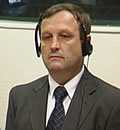
Milan Martić
Milan Martić is a Croatian Serb politician. Born November 18, 1954, in Žagrović. Positions held include president.
Facts
11 facts · 0 confirmed by two sources · 1 cited · 9 from one source · 1 where the sources disagree
What’s different
- Born: we show November 18, 1954 (Sources disagree). Wikipedia says December 18, 1954
Where this comes from
Papalocal keeps its own record. It started from these sources; what each one said is kept here as it was copied, so a change on their side never changes this page by itself. Tap one to read its version.
What Wikidata says · copied November 16, 2026 · revision 2563330886
- Described as
- Croatian Serb politician (born 1954)
- Born
- November 18, 1954
- Born in
- Žagrović
- Citizen of
- Croatia; Socialist Federal Republic of Yugoslavia
- Occupation
- politician · 1 reference; police officer; military personnel
- Positions held
- president
- Political party
- Serbian Party of Socialists
- Religion
- Serbian Orthodox Church
- Military rank
- general
- Wikipedias with a page
- 32
Wikidata item Q352249 (wikidata.org/wiki/Q352249), public domain (CC0). Copied November 16, 2026.
What Wikipedia says · copied November 16, 2026 · revision 1385871208
Milan Martić (Serbian Cyrillic: Милан Мартић; born 18 December 1954) is a Croatian Serb politician who served as the president of the unrecognized Republic of Serbian Krajina, a self-proclaimed state largely populated by Serbs of Croatia that wished to remain in Yugoslavia during the Croatian War of Independence.
After the war, Martić was indicted for war crimes by the International Criminal Tribunal for the former Yugoslavia (ICTY). He was convicted of war crimes on 12 June 2007 and sentenced to 35 years in prison. He is serving his sentence in Estonia since 2009.
- Born, in its opening lines
- December 18, 1954
From the Wikipedia article “Milan Martić” (en.wikipedia.org/wiki/Milan_Martić), by its contributors, under CC BY-SA 4.0 (creativecommons.org/licenses/by-sa/4.0/). Copied November 16, 2026; not changed.
Confirmed Two sources agree. Cited One source, and it names where it got it. One source One source, without a reference of its own. Sources disagree The sources disagree. We show the best-supported value and keep theirs below.
