
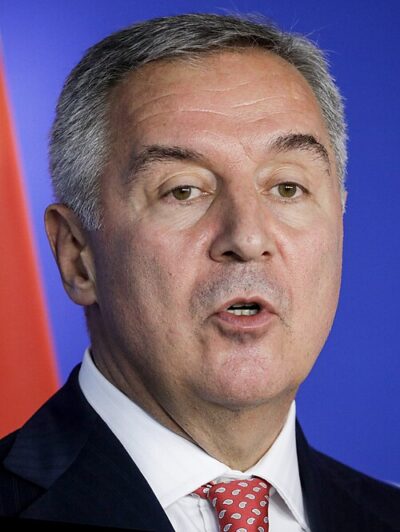
Milo Đukanović
Milo Đukanović is the 2nd President of Montenegro. Born February 15, 1962, in Nikšić. Positions held include Prime Minister of Montenegro (4 times) (1991–2016), President of Montenegro (2 times) (1998–2023) and Minister of Defence (2006). Educated at University of Montenegro Faculty of Economics. Awards include Person of the Year in Organized Crime and Corruption (Ironic denominación, not a real award), Decoration of the National Flag and Order of San Marino.
Facts
20 facts · 1 confirmed by two sources · 1 cited · 18 from one source
Where this comes from
Papalocal keeps its own record. It started from these sources; what each one said is kept here as it was copied, so a change on their side never changes this page by itself. Tap one to read its version.
What Wikidata says · copied November 16, 2026 · revision 2563042434
- Described as
- 2nd President of Montenegro
- Born
- February 15, 1962 · 3 references
- Born in
- Nikšić
- Citizen of
- Montenegro · 3 references; Serbia and Montenegro; Federal Republic of Yugoslavia; Socialist Federal Republic of Yugoslavia
- Occupation
- politician
- Positions held
- Prime Minister of Montenegro (4 times) (1991–2016); President of Montenegro (2 times) (1998–2023); Minister of Defence (2006) · 1 reference; Member of the Parliament of Montenegro (2 times) (2009–2016)
- Political party
- League of Communists of Montenegro (1979–1990); Democratic Party of Socialists of Montenegro (1990–)
- Education
- University of Montenegro Faculty of Economics (–1986)
- Awards
- Person of the Year in Organized Crime and Corruption (Ironic denominación, not a real award) (2015); Decoration of the National Flag; Order of San Marino
- Siblings
- Aleksandar Đukanović; Ana Kolarević
- Religion
- atheism
- Wikipedias with a page
- 71
Wikidata item Q200305 (wikidata.org/wiki/Q200305), public domain (CC0). Copied November 16, 2026.
What Wikipedia says · copied November 16, 2026 · revision 1382127837
Milo Đukanović (Montenegrin Cyrillic: Мило Ђукановић, pronounced [mǐːlo dʑǔkanoʋitɕ] ; born 15 February 1962) is a Montenegrin politician who served as the president of Montenegro from 1998 to 2002 and from 2018 to 2023. He also served as the Prime Minister of Montenegro (1991–1998, 2003–2006, 2008–2010 and 2012–2016) and was the long-term president of the Democratic Party of Socialists of Montenegro, originally the Montenegrin branch of the League of Communists of Yugoslavia, which governed Montenegro alone or in a coalition from the introduction of multi-party politics in the early 1990s until its defeat in the 2020 parliamentary election. He is the longest-ruling contemporary politician in Europe, having held key positions in the country for over 33 years. However, he was defeated by the 36-year-old centrist former economy minister, Jakov Milatović, after the presidential run-off held on 2 April 2023.
When Đukanović first emerged on the political scene, he was a close ally of Slobodan Milošević during the anti-bureaucratic revolution (1988–1989) and the dissolution of SFR Yugoslavia (1991–1992). His cabinet actively participated in the siege of Dubrovnik (1991–1992). Đukanović supported Momir Bulatović's agreement on Lord Carrington's terms, which resulted in the 1992 Montenegrin independence referendum, where voters decided to remain in FR Yugoslavia. In 1996, however, Đukanović distanced himself from Milošević and the federal government, abandoning the traditional joint Serbian and Montenegrin vision in favour of Montenegrin nationalism, which supported state independence and a separate Montenegrin identity. That led to the division of the party and the split of Bulatović's pro-unionist faction. Shortly afterward, Đukanović defeated Bulatović in the 1997 presidential election by a thin margin. In 1999, he negotiated with Western countries in an attempt to limit airstrikes in Montenegro during the NATO bombing of Yugoslavia, while later Đukanović oversaw the implementation of the Deutsche Mark as the new currency in Montenegro, replacing the Yugoslav dinar.
Following the overthrow of Milošević (2000), he signed an agreement with the new Serbian government that led to the Constitutional Charter of Serbia and Montenegro (2003), which allowed for Montenegrin independence. Three years later, the 2006 independence referendum led to a formal separation from the state union and the proclamation of the new Constitution of Montenegro (2007). Đukanović has pursued a NATO and EU accession policy, resulting in Montenegro's NATO membership in 2017. Over the course of his premiership and presidency, he oversaw the privatization of public companies to foreign investors and firms. Several corruption scandals of the ruling party triggered 2019 anti-government protests, while a controversial religion law sparked another wave of protests. For the first time in three decades, in the 2020 parliamentary election, the opposition won more votes than Đukanović's ruling party and its partners.
Several domestic and foreign observers have described Đukanović's rule as either authoritarian, autocratic, or kleptocratic, with some international organizations and research institutions, such as Freedom House, Economist Intelligence Unit, and V-Dem Institute, warning that Montenegro has experienced democratic backsliding under his government. His brother Aco Đukanović, the owner of Montenegro's first private bank, had the upper hand in the privatization process that took place in the country after the fall of communism. Additionally, his sister, the lawyer Ana Kolarevic, controlled the judiciary for a long time. DPS clientelist networks dominated all segments of social life, making party membership necessary to start a business or obtain a position in the administration. In 2020, Freedom House classified Montenegro as a hybrid regime rather than a democracy, mentioning the years of increasing state capture, abuse of power, and strongman tactics employed by Đukanović. He is often described as having strong links to the Montenegrin mafia. Đukanović was listed among the twenty richest world leaders according to the British newspaper The Independent in May 2010, which described the source of his estimated £10 million wealth as "mysterious". In October 2021, Đukanović and his son Blažo were mentioned in the Pandora Papers, linking them to two trusts on the British Virgin Islands.
- Born, in its opening lines
- February 15, 1962
From the Wikipedia article “Milo Đukanović” (en.wikipedia.org/wiki/Milo_Đukanović), by its contributors, under CC BY-SA 4.0 (creativecommons.org/licenses/by-sa/4.0/). Copied November 16, 2026; not changed.
Confirmed Two sources agree. Cited One source, and it names where it got it. One source One source, without a reference of its own. Sources disagree The sources disagree. We show the best-supported value and keep theirs below.
