
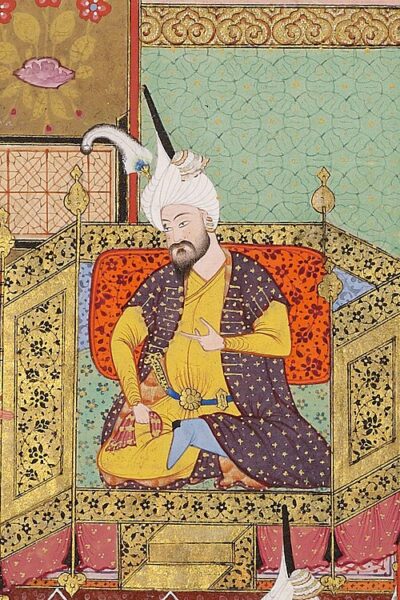
Mirza Abul-Qasim Babur bin Baysonqor
Mirza Abul-Qasim Babur bin Baysonqor was a Timurid ruler in Khurasan. Born 1422, in Herat. Died March 22, 1457, in Mashhad. Positions held include prince.
Facts
10 facts · 1 confirmed by two sources · 4 cited · 4 from one source · 1 where the sources disagree
What’s different
- Born: we show 1422 (Sources disagree). Wikipedia says 1449
Where this comes from
Papalocal keeps its own record. It started from these sources; what each one said is kept here as it was copied, so a change on their side never changes this page by itself. Tap one to read its version.
What Wikidata says · copied November 18, 2026 · revision 2554440155
- Described as
- Timurid ruler in Khurasan
- Other names
- Abul-Qasim Babur Mirza, Mirzá Baber o Babur
- Born
- 1422 · 1 reference
- Died
- March 22, 1457 · 1 reference
- Born in
- Herat
- Died in
- Mashhad · 1 reference
- Citizen of
- Timurid Empire
- Positions held
- prince
- Children
- Mirza Shah Mahmud
- Father
- Baysonqor · 1 reference
- Siblings
- Ala al-Dawla Mirza · 1 reference; Sultan Muhammad bin Baysonqor · 1 reference
- Wikipedias with a page
- 20
Wikidata item Q1049845 (wikidata.org/wiki/Q1049845), public domain (CC0). Copied November 18, 2026.
What Wikipedia says · copied November 18, 2026 · revision 1358511274
Abul-Qasim Babur Mirza (Persian: ابوالقاسم بابر میرزا بن بایسنقر بیگ), was a Timurid ruler in Khurasan (1449–1457). He was the son of Ghiyath-ud-din Baysunghur ibn Shah Rukh Mirza, and thus a great-grandson of Amir Timur.
Babur was one of the many people involved in the succession struggle that took place during Shah Rukh's last years. Together with Khalil Sultan (a great-great-grandson of Timur), he plundered the baggage-train of the army and then made his way to Khurasan. Meanwhile, Ulugh Beg also invaded Khurasan in 1448 in an attempt to defeat Ala al-Dawla Mirza, who held Herat. Ulugh Beg defeated him at Tarnab and took Mashhad, while his son Abdal-Latif Mirza conquered Herat. Ala al-Dawla Mirza fled to south-western Afghanistan. However, Ulugh Beg felt Transoxiana, where he had already ruled for decades, to be more important, and soon left the area. On the way back, Babur sent a force that inflicted heavy losses on his army.With a power vacuum now in Khurasan, Babur quickly seized control. Mashad and Herat fell to him in 1449. Ala al-Dawla Mirza occasionally raided the area but was not a significant factor. Together with Ulugh Beg and Sultan Muhammad (who gained control of central Persia), Babur became one of the three important Timurid rulers. This balance of power was soon upset by Sultan Muhammad, who invaded Khurasan. The campaign started out badly for Babur, with a defeat at Mashad in March 1450 convinced him to cede parts of his territory. However, Babur soon recovered and took Sultan Muhammad prisoner, and then executed him. He then marched to Shiraz to take control of Sultan Muhammad's lands.
At this point, Jahan Shah of the Black Sheep Turkmen ended his loyalty to the Timurids. He quickly put Qum and Saveh to siege. Babur began to march against him but was forced to return to Herat, due to the overwhelming superiority of the Black Sheep's armies and a plot hatched against him by Ala al-Dawla Mirza. Most of Persia was taken from the Timurids by 1452, with the exception of Abarquh, which was conquered by the Black Sheep in 1453. While Kirman was temporarily conquered some time later and a few attempts were made to seize Ray, Persia as a whole was never retaken by the Timurids.
In 1454, Babur invaded Transoxiana, then under the control of Abu Sa'id Mirza in retaliation for the latter's seizure of Balkh. He quickly laid siege to Samarkand. The conflict between the two soon ended, however, with the Oxus River agreed to as the border. This remained in effect until Babur's death in 1457. He was succeeded by his son Mahmud.
- Born, in its opening lines
- 1449
- Died, in its opening lines
- 1457
From the Wikipedia article “Abul-Qasim Babur Mirza” (en.wikipedia.org/wiki/Abul-Qasim_Babur_Mirza), by its contributors, under CC BY-SA 4.0 (creativecommons.org/licenses/by-sa/4.0/). Copied November 18, 2026; not changed.
Confirmed Two sources agree. Cited One source, and it names where it got it. One source One source, without a reference of its own. Sources disagree The sources disagree. We show the best-supported value and keep theirs below.
