
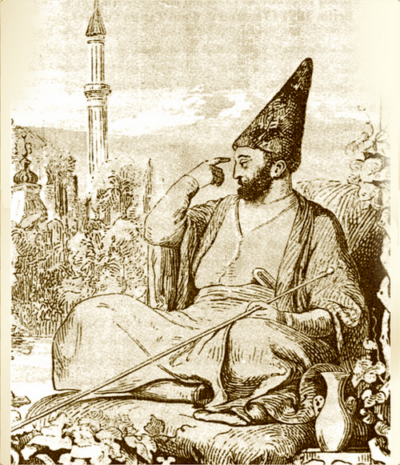
Mirza Shafi Vazeh
Mirza Shafi Vazeh was an Azerbaijani poet. Born 1794, in Ganja. Died November 16, 1852, in Tbilisi.
Facts
18 facts · 1 confirmed by two sources · 3 cited · 13 from one source · 1 where the sources disagree
What’s different
- Born: we show 1794 (Sources disagree). Wikipedia says c. 1800
Where this comes from
Papalocal keeps its own record. It started from these sources; what each one said is kept here as it was copied, so a change on their side never changes this page by itself. Tap one to read its version.
What Wikidata says · copied November 16, 2026 · revision 2565607294
- Described as
- Azerbaijani poet (1794–1852)
- Other names
- Mirzə Şəfi Vazeh, Mīrzā Shafīʿ Wāḍiḥ, Mīrzā Shafīʿ Wāḍiḥ Tabrīzī, Mīrzā S̲h̲afīʿ Wāḍiḥ Tabrīzī
- Born
- 1794 · 1 reference
- Died
- November 16, 1852
- Born in
- Ganja
- Died in
- Tbilisi
- Buried in
- Pantheon of Azeri figures · 1 reference
- Citizen of
- Russian Empire; Ganja khanate
- Occupation
- poet; calligrapher; writer · 1 reference; pedagogue · 1 reference; teacher · 1 reference
- Genre
- ghazal · 1 reference; mukhammas · 1 reference; masnavi · 1 reference; ruba'i · 1 reference
- Field
- creative and professional writing · 1 reference; poetry · 1 reference
- Wikipedias with a page
- 39
Wikidata item Q973869 (wikidata.org/wiki/Q973869), public domain (CC0). Copied November 16, 2026.
What Wikipedia says · copied November 16, 2026 · revision 1371373953
Mirza Shafi Vazeh (Azerbaijani: Mirzə Şəfi Vazeh; میرزا شفیع واضح; c. 1800 – 16 November 1852) was an Azerbaijani poet and teacher. Under the pseudonym "Vazeh", which means "expressive, clear", he wrote in both Azerbaijani and Persian, developing the traditions of poetry in both languages. He compiled the first anthology of Azerbaijani poetry and a Tatar-Russian dictionary for the Tiflis gymnasium with Russian teacher Ivan Grigoriev.
He wrote multiple ghazals, mukhammases, mathnawis and rubais. His poems are mostly intimate, lyrical and satirical. The main theme of Vazeh's works is the glorification of romantic love and the joy of life, but in some of his poems, he denounces the vices of feudal society and opposes slavery and religious fanaticism.
The German poet Friedrich von Bodenstedt, who took oriental language lessons from Vazeh, published translations of Vazeh's poems in his book A Thousand and One Days in the East in 1850. Bodenstedt's book, titled Songs of Mirza Shafi, was published in 1851.
- Born, in its opening lines
- c. 1800
- Died, in its opening lines
- November 16, 1852
From the Wikipedia article “Mirza Shafi Vazeh” (en.wikipedia.org/wiki/Mirza_Shafi_Vazeh), by its contributors, under CC BY-SA 4.0 (creativecommons.org/licenses/by-sa/4.0/). Copied November 16, 2026; not changed.
Confirmed Two sources agree. Cited One source, and it names where it got it. One source One source, without a reference of its own. Sources disagree The sources disagree. We show the best-supported value and keep theirs below.
