
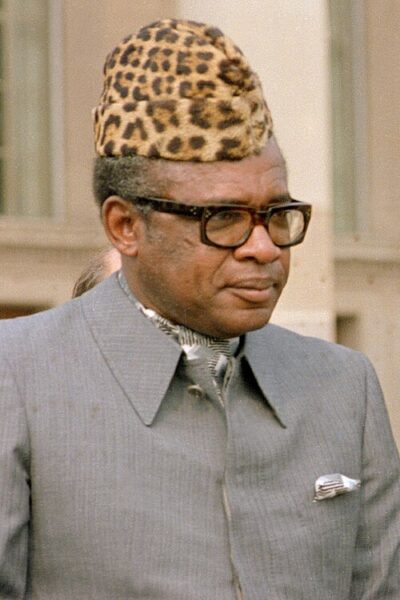
Mobutu Sese Seko
Mobutu Sese Seko was a Congolese politician and military officer, the first and only president of Zaire from 1971 to 1997. Born October 14, 1930, in Lisala. Died September 7, 1997, in Rabat. Positions held include President of the Democratic Republic of the Congo (1965–1997) and chairperson of the Organisation of African Unity (1967–1968). Educated at Collège du Léman. Awards include Collar of the Order of Isabella the Catholic, Commander of the Legion of Merit and Grand Collar of the Order of Prince Henry.
Facts
31 facts · 2 confirmed by two sources · 4 cited · 25 from one source
Where this comes from
Papalocal keeps its own record. It started from these sources; what each one said is kept here as it was copied, so a change on their side never changes this page by itself. Tap one to read its version.
What Wikidata says · copied November 16, 2026 · revision 2569962551
- Described as
- Congolese politician and military officer, the first and only president of Zaire from 1971 to 1997 (1930 – 1997)
- Other names
- The Guide, The Great Heimsman, Mobutu Sese Seko Kuku Ngbendu wa za Banga, Joseph-Désiré Mobutu, Mobutu, MSS, Sese Seko Mobutu, Mobutu Sese Seko Kuku Ngbendu wa Zabangua, J. D. Mobutu, De Banzy
- Born
- October 14, 1930 · 7 references
- Died
- September 7, 1997 · 7 references
- Born in
- Lisala
- Died in
- Rabat · 1 reference
- Buried in
- Rabat
- Cause of death
- prostate cancer
- Name at birth
- Joseph-Désiré Mobutu
- Citizen of
- Republic of the Congo (Léopoldville); Zaire
- Occupation
- politician; journalist; military personnel
- Positions held
- President of the Democratic Republic of the Congo (1965–1997); chairperson of the Organisation of African Unity (1967–1968)
- Political party
- Popular Movement of the Revolution
- Education
- Collège du Léman
- Awards
- Collar of the Order of Isabella the Catholic (1983) · 1 reference; Commander of the Legion of Merit; Grand Collar of the Order of Prince Henry · 1 reference; Knight Grand Cross with Collar of the Order of Merit of the Italian Republic; Order of Propitious Clouds; Order of the Golden Ark (1973)
- Spouse
- Bobi Ladawa Mobutu; Marie-Antoinette Gbiatibwa Gogbe Mobutu · 2 references
- Children
- Nzanga Mobutu
- Religion
- Catholic Church
- Military branch
- Force Publique · 1 reference; Armed Forces of the Democratic Republic of the Congo
- Military rank
- marshal
- Lived in
- Gbadolite (–1997); Rabat (1997–) · 2 references
- Wikipedias with a page
- 91
Wikidata item Q164535 (wikidata.org/wiki/Q164535), public domain (CC0). Copied November 16, 2026.
What Wikipedia says · copied November 16, 2026 · revision 1385403133
Mobutu Sese Seko Nkuku Ngbendu wa za Banga ( mə-BOO-too SESS-ay SEK-oh; born Joseph-Désiré Mobutu; 14 October 1930 – 7 September 1997), often shortened to Mobutu Sese Seko or Mobutu and also known by his initials MSS, was a Congolese politician and military officer who was the first and only president of Zaire from 1971 to 1997. Previously, Mobutu served as the second president of the Democratic Republic of the Congo, from 1965 to 1971.
Mobutu served as the fifth chairperson of the Organisation of African Unity from 1967 to 1968. During the Congo Crisis in 1960, Mobutu, then serving as Chief of Staff of the Congolese Army, deposed the nation's democratically elected government of Patrice Lumumba with the support of the U.S. and Belgium. Mobutu installed a government that arranged for Lumumba's execution in 1961, and continued to lead the country's armed forces until he took power directly in a second coup in 1965.
To consolidate his power, Mobutu established the Popular Movement of the Revolution as the sole legal political party in 1967, changed the Congo's name to Zaire in 1971, and his own name to Mobutu Sese Seko in 1972. Mobutu protected his rule through an intensely totalitarian regime and corrupt patronage network to regime supporters. He presided over widespread human rights violations. He attempted to purge the country of all colonial cultural influence through his program of "national authenticity". Mobutu was the object of a pervasive cult of personality.
Mobutu claimed that his political ideology was "neither left nor right, nor even centre", but was primarily recognized for his opposition to communism within the Françafrique region and received strong support (military, diplomatic and economic) from the United States, France, and Belgium as a result. He built close ties with the governments of apartheid South Africa and Israel. As a result of the Sino-Soviet split, Mobutu established close relations with China.
Mobutu was notorious for corruption and nepotism: estimates of his personal wealth range from $50 million to $5 billion, amassed through economic exploitation and corruption as president. His rule has been called a kleptocracy for allowing this personal fortune even as the economy of Zaire suffered from uncontrolled inflation, a large debt, and massive currency devaluations. Mobutu was further known for extravagances such as shopping trips to Paris via the supersonic Concorde aircraft.
By 1990, economic deterioration and unrest forced Mobutu Sese Seko into a coalition with political opponents and to allow a multiparty system. While he deployed troops to resist change, these efforts were short-lived. In May 1997, rebel forces led by Laurent-Désiré Kabila overran the country and forced him into exile. Already suffering from advanced prostate cancer, he died three months later in Morocco.
- Born, in its opening lines
- October 14, 1930
- Died, in its opening lines
- September 7, 1997
From the Wikipedia article “Mobutu Sese Seko” (en.wikipedia.org/wiki/Mobutu_Sese_Seko), by its contributors, under CC BY-SA 4.0 (creativecommons.org/licenses/by-sa/4.0/). Copied November 16, 2026; not changed.
Confirmed Two sources agree. Cited One source, and it names where it got it. One source One source, without a reference of its own. Sources disagree The sources disagree. We show the best-supported value and keep theirs below.
