
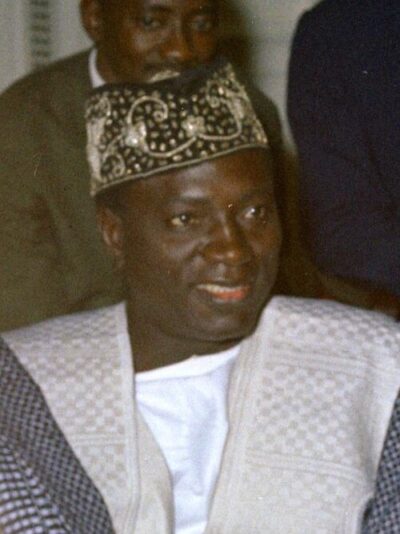
Modibo Keïta
Modibo Keïta was a Malian politician and President of Mali. Born June 4, 1915, in Bamako. Died May 16, 1977, in Bamako. Positions held include member of the French National Assembly (2 times) (1956–1959), President of Mali (1960–1968) and Minister of Foreign Affairs. Educated at École normale supérieure William Ponty. Awards include Knight Grand Cross of the Order of St Michael and St George, Lenin Peace Prize and Grand Cross of the National Order of Mali.
Facts
21 facts · 2 confirmed by two sources · 10 cited · 9 from one source
Where this comes from
Papalocal keeps its own record. It started from these sources; what each one said is kept here as it was copied, so a change on their side never changes this page by itself. Tap one to read its version.
What Wikidata says · copied November 16, 2026 · revision 2563066888
- Described as
- Malian politician and President of Mali (1915-1977)
- Other names
- Modibo Keita
- Born
- June 4, 1915 · 8 references
- Died
- May 16, 1977 · 7 references
- Born in
- Bamako · 3 references
- Died in
- Bamako · 2 references
- Citizen of
- Mali · 1 reference; France · 1 reference
- Occupation
- politician · 2 references; president (1960–1968) · 1 reference
- Positions held
- member of the French National Assembly (2 times) (1956–1959); President of Mali (1960–1968) · 1 reference; Minister of Foreign Affairs
- Political party
- Sudanese Union – African Democratic Rally
- Education
- École normale supérieure William Ponty
- Awards
- Knight Grand Cross of the Order of St Michael and St George; Lenin Peace Prize; Grand Cross of the National Order of Mali · 1 reference; Order of the Companions of O. R. Tambo
- Spouse
- Mariam Travélé (1939–) · 2 references; Keïta Fatoumata Haïdara (1952–) · 1 reference; Fatoumata Diallo Keïta (1962–) · 1 reference
- Religion
- Islam
- Wikipedias with a page
- 51
Wikidata item Q313240 (wikidata.org/wiki/Q313240), public domain (CC0). Copied November 16, 2026.
What Wikipedia says · copied November 16, 2026 · revision 1369598901
Modibo Keïta (4 June 1915 – 16 May 1977) was a Malian politician who served as the first President of Mali from 1960 to 1968. He espoused a form of African socialism. He was deposed in a coup d'état in 1968 by Moussa Traoré.
Born and raised in Bamako, Keïta began a career as a teacher in 1936 under French colonial rule before entering politics during the 1940s. In 1945, he co-founded the Sudanese Union (US) with Mamadou Konaté which became part of the African Democratic Rally (RDA) the following year to form the US-RDA. Being elected to several positions, his political prominence grew in the 1950s, and in 1959, he became Prime Minister of the Mali Federation, a short-lived federation of Mali and Senegal. Following the federation's collapse in 1960, Mali became an independent state, and Keïta became the new country's inaugural president.
As President, Keïta soon established the US-RDA as the only official party, and began implementing socialist policies based on extensive nationalization. In foreign affairs, Keïta supported the Non-Aligned Movement and maintained strong relations with the West despite his socialist leanings. A leading Pan-Africanist, he played important roles in the drafting of the charter of the Organization of African Unity and the negotiation the 1963 Bamako Accords, which ended the Sand War between Morocco and Algeria.
During the late 1960s, dissatisfaction with his regime grew due to progressive economic decline and his repressive responses to dissent. He was overthrown in the 1968 Malian coup d'état by Moussa Traoré, who succeeded him as president and sent him to prison, where he died in 1977.
- Born, in its opening lines
- June 4, 1915
- Died, in its opening lines
- May 16, 1977
From the Wikipedia article “Modibo Keïta” (en.wikipedia.org/wiki/Modibo_Keïta), by its contributors, under CC BY-SA 4.0 (creativecommons.org/licenses/by-sa/4.0/). Copied November 16, 2026; not changed.
Confirmed Two sources agree. Cited One source, and it names where it got it. One source One source, without a reference of its own. Sources disagree The sources disagree. We show the best-supported value and keep theirs below.
