
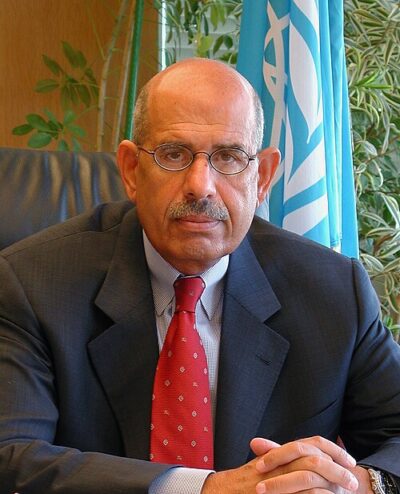
Mohamed ElBaradei
Mohamed ElBaradei is an Egyptian law scholar and diplomat, 4th Director General of the International Atomic Energy Agency, and Nobel Peace Prize recipient. Born June 17, 1942, in Cairo. Positions held include Vice President of Egypt (2013) and Director General of the International Atomic Energy Agency (1997–2009). Educated at Cairo University and New York University School of Law. Awards include Nobel Peace Prize, Great Cross with Star and Sash of the Order of Merit of the Federal Republic of Germany and Indira Gandhi Peace Prize.
Facts
34 facts · 1 confirmed by two sources · 8 cited · 25 from one source
Where this comes from
Papalocal keeps its own record. It started from these sources; what each one said is kept here as it was copied, so a change on their side never changes this page by itself. Tap one to read its version.
What Wikidata says · copied November 16, 2026 · revision 2564225302
- Described as
- Egyptian law scholar and diplomat, 4th Director General of the International Atomic Energy Agency, and Nobel Peace Prize recipient
- Other names
- Mohamed Mustafa ElBaradei, Mohamed El Baradei, Mohamed M. ElBaradei, Mohamed Mostafa ElBaradei
- Born
- June 17, 1942 · 4 references
- Born in
- Cairo
- Citizen of
- Egypt
- Occupation
- politician · 1 reference; diplomat · 1 reference; jurist · 1 reference; human rights defender
- Positions held
- Vice President of Egypt (2013); Director General of the International Atomic Energy Agency (1997–2009)
- Political party
- Constitution Party
- Worked for
- United Nations
- Education
- Cairo University; New York University School of Law
- Awards
- Nobel Peace Prize (2005) · 2 references; Great Cross with Star and Sash of the Order of Merit of the Federal Republic of Germany (2010) · 1 reference; Indira Gandhi Peace Prize (2008); Four Freedoms Award – Freedom Medal (2006) · 1 reference; Steiger Award; Delta Prize for Global Understanding; James Parks Morton Interfaith Award; Grand Cordon of the Order of the Nile; honorary doctor of the Tsinghua University (2006) · 1 reference; Order of Francisc Skorina (2006); Honorary doctorate from the University of Cairo; honorary doctor of the University of Maryland; Honorary doctorate from university of Florence; Honorary Doctorate of University of Buenos Aires; honorary doctorate of Trinity College, Dublin
- Field
- political activity · 1 reference; diplomacy · 1 reference
- Father
- Mostafa ElBaradei · 1 reference
- Religion
- Islam
- Lived in
- Austria
- Website
- http://www.mohamedelbaradei.com
- Wikipedias with a page
- 86
Wikidata item Q133308 (wikidata.org/wiki/Q133308), public domain (CC0). Copied November 16, 2026.
What Wikipedia says · copied November 16, 2026 · revision 1385537219
Mohamed Mostafa ElBaradei (Arabic: محمد مصطفى البرادعي, romanized: Muḥammad Muṣṭafá al-Barādaʿī, Egyptian Arabic: [mæˈħæmːæd mosˈtˤɑfɑ (ʔe)lbæˈɾædʕi]; born 17 June 1942) is an Egyptian lawyer, diplomat, and politician who served as Director General of the International Atomic Energy Agency (IAEA) from 1997 to 2009 and as interim vice president of Egypt in 2013.
As Director General of the IAEA, ElBaradei oversaw the agency during inspections in Iraq preceding the 2003 invasion of Iraq and disputes over the nuclear programs of Iran and North Korea. He and the IAEA were jointly awarded the Nobel Peace Prize in 2005 "for their efforts to prevent nuclear energy from being used for military purposes and to ensure that nuclear energy for peaceful purposes is used in the safest possible way".
After leaving the IAEA, ElBaradei founded the National Association for Change and became a prominent opposition figure during the 2011 Egyptian revolution. Following the 2013 Egyptian coup d'état, ElBaradei was appointed vice president but resigned in protest over the Rabaa massacre.
- Born, in its opening lines
- June 17, 1942
From the Wikipedia article “Mohamed ElBaradei” (en.wikipedia.org/wiki/Mohamed_ElBaradei), by its contributors, under CC BY-SA 4.0 (creativecommons.org/licenses/by-sa/4.0/). Copied November 16, 2026; not changed.
Confirmed Two sources agree. Cited One source, and it names where it got it. One source One source, without a reference of its own. Sources disagree The sources disagree. We show the best-supported value and keep theirs below.
