
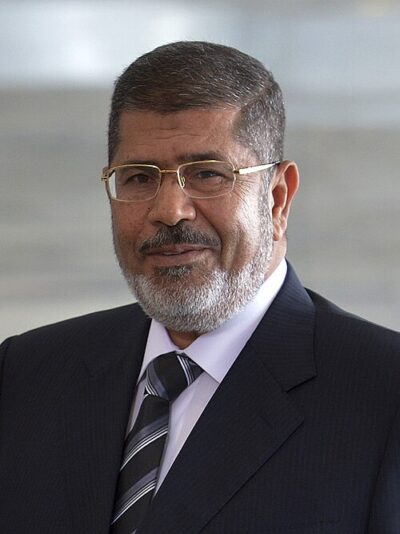
Mohamed Morsi
Mohamed Morsi was a president of Egypt from 2012 to 2013. Born August 8, 1951, in El-Adwah. Died June 17, 2019, in Tora Prison. Positions held include President of Egypt (2012–2013) and Secretary General of the Non-Aligned Movement (2012). Educated at Cairo University and University of Southern California. Awards include Order of the Nile, Order of the Republic and Order of Merit.
Facts
33 facts · 2 confirmed by two sources · 2 cited · 29 from one source
What’s different
- Born: we show August 8, 1951 (Confirmed). Wikidata also lists August 20, 1951
Where this comes from
Papalocal keeps its own record. It started from these sources; what each one said is kept here as it was copied, so a change on their side never changes this page by itself. Tap one to read its version.
What Wikidata says · copied November 16, 2026 · revision 2558174055
- Described as
- president of Egypt from 2012 to 2013
- Other names
- Mohamed Al-Ayyat, Mohamed Morsy, Mohammed Morsi, Mohamed Mursi, Muhammad Morsi, Mohammed Mursi, Mohamad Morsi, Mohammad Morsi, Muhammad Mursi, Morsi, Mohamed Mohamed Morsi Issa Al-Ayyat, Mohamed Morsi Al-Ayyat
- Born
- August 8, 1951 · 1 reference; August 20, 1951 · 3 references
- Died
- June 17, 2019 · 5 references
- Born in
- El-Adwah
- Died in
- Tora Prison · 2 references
- Buried in
- Nasr City (2019–)
- Cause of death
- myocardial infarction
- Citizen of
- Kingdom of Egypt (1951–1952); Republic of Egypt (1953–1958); United Arab Republic (1958–1971); Egypt (1971–2019)
- Occupation
- politician · 1 reference; engineer; university teacher; materials scientist; member of parliament; president
- Positions held
- President of Egypt (2012–2013); Secretary General of the Non-Aligned Movement (2012)
- Political party
- Freedom and Justice Party
- Worked for
- Zagazig University (–2010); California State University, Northridge (1982–1985)
- Education
- Cairo University; University of Southern California (–1982) · 1 reference
- Awards
- Order of the Nile; Order of the Republic; Order of Merit; Order of Independence; Order of the Virtues
- Spouse
- Naglaa Mahmoud (1979–2019)
- Children
- Abdullah Morsi; Shimaa Morsi
- Religion
- Islam
- Website
- https://www.morsi.info
- Wikipedias with a page
- 117
Wikidata item Q4631 (wikidata.org/wiki/Q4631), public domain (CC0). Copied November 16, 2026.
What Wikipedia says · copied November 16, 2026 · revision 1385906649
Mohamed Mohamed Morsi Eissa Al-Ayyat (; Arabic: مُحَمَّد مُحَمَّد مُرْسِي عِيسَى العَيَّاط, romanized: Muḥammad Muḥammad Mursī ʿĪsā al-ʿAyyāṭ, IPA: [mæˈħæmmæd ˈmoɾsi ˈʕiːsæ (ʔe)l.ʕɑjˈjɑːtˤ]; 8 August 1951 – 17 June 2019) was an Egyptian politician, engineer, and professor who served as the fifth president of Egypt from 2012 to 2013, when General Abdel Fattah el-Sisi removed him from office in a coup d'état after protests in June. Affiliated with the Muslim Brotherhood organization, Morsi led the Freedom and Justice Party from 2011 to 2012.
Morsi was born in El Adwah, Sharqia Governorate, before studying metallurgical engineering at Cairo University and then materials science at the University of Southern California. He became an associate professor at California State University, Northridge, from 1982 to 1985 before returning to Egypt to teach at Zagazig University. Associating with the Muslim Brotherhood, which was then barred from office under President Hosni Mubarak, Morsi stood as an independent candidate for the 2000 parliamentary election. Following the Egyptian Revolution of 2011, which resulted in Mubarak's resignation, Morsi came to the forefront as head of the Freedom and Justice Party. It became the largest party in the 2011–12 parliamentary election and Morsi was elected president in the 2012 presidential election. On 30 June 2012, the SCAF handed the authority to Morsi, ending 6 decades of military rule.
In November 2012, Morsi issued a provisional constitutional declaration that granted him unrestricted authority and the authority to legislate without the need for judicial oversight or review. This was a move to stop the Mubarak-era judges from getting rid of the Second Constituent Assembly. The new constitution that was then hastily finalized by the Islamist-dominated constitutional assembly, presented to the president, and scheduled for a referendum before the Supreme Constitutional Court could rule on the constitutionality of the assembly, was described by independent press agencies not aligned with the presidential administration as an "Islamist coup". These issues, along with complaints of prosecutions of journalists and attacks on nonviolent demonstrators, led to the 2012 protests. As part of a compromise, Morsi rescinded the decrees. A new constitution was approved by approximately two-thirds of voters in the referendum, although turnout was less than a third of the electorate.
In June 2013, protests calling for Morsi's resignation erupted. The military, backed by the political opposition and leading religious figures, stepped in and deposed Morsi in a coup. It suspended the constitution and appointed Adly Mansour as interim president. Pro-Morsi demonstrations were crushed, resulting in over 800 deaths. Egyptian prosecutors then charged Morsi with various crimes and sought the death penalty, a move denounced by Amnesty International as "a charade based on null and void procedures". His death sentence was overturned in November 2016 and a retrial ordered. Morsi died during trial on 17 June 2019 amid claims that he was being denied appropriate medical care while in custody.
- Born, in its opening lines
- August 8, 1951
- Died, in its opening lines
- June 17, 2019
From the Wikipedia article “Mohamed Morsi” (en.wikipedia.org/wiki/Mohamed_Morsi), by its contributors, under CC BY-SA 4.0 (creativecommons.org/licenses/by-sa/4.0/). Copied November 16, 2026; not changed.
Confirmed Two sources agree. Cited One source, and it names where it got it. One source One source, without a reference of its own. Sources disagree The sources disagree. We show the best-supported value and keep theirs below.
