
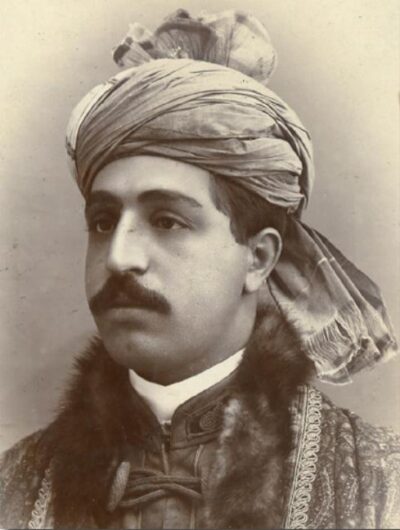
Mohammad Ayub Khan
Mohammad Ayub Khan was an Emir of Afghanistan. Born 1857, in Kabul. Died April 7, 1914, in Lahore. Positions held include Emir of Afghanistan (1879–1880).
Facts
11 facts · 2 confirmed by two sources · 0 cited · 9 from one source
Where this comes from
Papalocal keeps its own record. It started from these sources; what each one said is kept here as it was copied, so a change on their side never changes this page by itself. Tap one to read its version.
What Wikidata says · copied November 17, 2026 · revision 2488852266
- Described as
- Emir of Afghanistan (1879-1880)
- Other names
- The Victor of Maiwand
- Born
- 1857
- Died
- April 7, 1914
- Born in
- Kabul
- Died in
- Lahore
- Buried in
- Peshawar
- Citizen of
- Afghanistan
- Occupation
- military personnel
- Positions held
- Emir of Afghanistan (1879–1880)
- Father
- Sher Ali Khan
- Siblings
- Mohammad Yaqub Khan
- Military rank
- Amir
- Wikipedias with a page
- 27
Wikidata item Q983046 (wikidata.org/wiki/Q983046), public domain (CC0). Copied November 17, 2026.
What Wikipedia says · copied November 17, 2026 · revision 1376624746
Ghazi Mohammad Ayub Khan Barakzai, (1857 – 7 April 1914) nicknamed the Victor of Maiwand, and as the Afghan Prince Charlie was, for a while, the governor of Herat Province in the Emirate of Afghanistan. He was briefly the Emir of Afghanistan, from 12 October 1879 to 31 May 1880. He also led the Afghan troops during the Second Anglo-Afghan War and defeated the British Indian Army at the Battle of Maiwand. Following his defeat at the Battle of Kandahar, Ayub Khan was deposed and exiled to British India. However, Ayub Khan fled to Persia (now Iran). After negotiations in 1888 with Sir Mortimer Durand, the United Kingdom's ambassador at Tehran, Ayub Khan became a pensioner of the British Raj and traveled to British India in 1888, where he lived in Lahore, Punjab, until his death in 1914. He was buried in Peshawar and had eleven wives, fifteen sons, and ten daughters. Two of his grandsons, Sardar Hissam Mahmud el-Effendi and Sardar Muhammad Ismail Khan, served as brigadiers in the Pakistan Army.
In Afghanistan, he is remembered as the "National Hero of Afghanistan."
- Born, in its opening lines
- 1857
- Died, in its opening lines
- April 7, 1914
From the Wikipedia article “Mohammad Ayub Khan (Afghanistan)” (en.wikipedia.org/wiki/Mohammad_Ayub_Khan_(Afghanistan)), by its contributors, under CC BY-SA 4.0 (creativecommons.org/licenses/by-sa/4.0/). Copied November 17, 2026; not changed.
Confirmed Two sources agree. Cited One source, and it names where it got it. One source One source, without a reference of its own. Sources disagree The sources disagree. We show the best-supported value and keep theirs below.
