
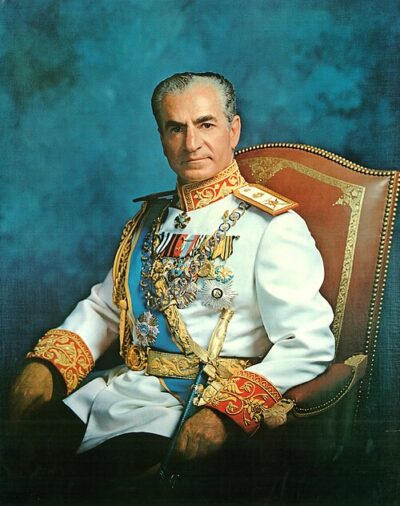
Mohammad Reza I of Iran
Mohammad Reza I of Iran was a Shah of Iran from 1941 to 1979. Born October 26, 1919, in Tehran. Died July 27, 1980, in Cairo. Positions held include shah (1941–1979). Educated at Institut Le Rosey and Madrasa Nezam. Awards include Croix de guerre 1939–1945, Knight Grand Cross with Collar of the Order of Merit of the Italian Republic and Grand Cross of the Legion of Honour.
Facts
50 facts · 2 confirmed by two sources · 18 cited · 30 from one source
Where this comes from
Papalocal keeps its own record. It started from these sources; what each one said is kept here as it was copied, so a change on their side never changes this page by itself. Tap one to read its version.
What Wikidata says · copied November 16, 2026 · revision 2569986308
- Described as
- Shah of Iran from 1941 to 1979
- Other names
- Shah of Iran Muhammed Reza Pahlavi, Shah of Iran Mohammad Reza Pahlavi, Mohammad Rezā Shāh Pahlavī, Shah of Iran Moḥammad Rezā Shāh, Mohammad Reza Shah Pahlavi, Mohammed Reza Pahlavi, last Shah, Mohammed Reza, Shah of Iran Pahlavi, Mohammedreza pahlavi, Mohammed Reza Pahlavi, Shah of Iran
- Born
- October 26, 1919 · 8 references
- Died
- July 27, 1980 · 7 references
- Born in
- Tehran · 2 references
- Died in
- Cairo · 1 reference
- Buried in
- Al-Rifa'i Mosque
- Cause of death
- lymphoma
- Citizen of
- Pahlavi Iran
- Occupation
- politician · 1 reference; monarch
- Positions held
- shah (1941–1979)
- Education
- Institut Le Rosey; Madrasa Nezam
- Member of
- Mohammad Reza Pahlavi and Farah Pahlavi; Mohammad Reza Pahlavi and Soraya
- Awards
- Croix de guerre 1939–1945 (1948) · 1 reference; Knight Grand Cross with Collar of the Order of Merit of the Italian Republic (1957) · 1 reference; Grand Cross of the Legion of Honour (1939) · 1 reference; Knight Grand Cross of the Order of the Bath; Chief Commander of the Legion of Merit (1947) · 1 reference; Collar of the Order of Isabella the Catholic (1957) · 3 references; Order of the White Lion; Order of the Golden Spur (1948) · 1 reference; Order of the Crown of the Realm (1968) · 1 reference; Royal Victorian Chain (1948) · 1 reference; Grand Collar of the Order of Prince Henry (1967) · 1 reference; Grand Cross Special Class of the Order of Merit of the Federal Republic of Germany (1955) · 1 reference; Collar of the Supreme Order of the Chrysanthemum (1958) · 1 reference; Grand Star of the Decoration for Services to the Republic of Austria (1960) · 1 reference; Honorary doctor of Lebanese University
- Spouse
- Princess Fawzia Fuad of Egypt (1939–1945) · 1 reference; Soraya Esfandiari-Bakhtiari (1951–1958) · 1 reference; Farah Pahlavi (1959–1980) · 1 reference
- Children
- Shahnaz Pahlavi; Reza Pahlavi; Farahnaz Pahlavi; Ali Reza Pahlavi; Leila Pahlavi
- Father
- Reza Shah · 1 reference
- Mother
- Tadj ol-Molouk of Iran
- Siblings
- Hamdamsaltaneh Pahlavi; Fatemeh Pahlavi; Ashraf Pahlavi · 1 reference; Prince Ali Reza Pahlavi; Gholam Reza Pahlavi; Ahmad Reza Pahlavi; Abdul Reza Pahlavi; Shams Pahlavi · 1 reference; Hamid Reza Pahlavi
- Religion
- Twelver Shiism
- Military branch
- Imperial Iranian Army
- Wikipedias with a page
- 113
Wikidata item Q128245 (wikidata.org/wiki/Q128245), public domain (CC0). Copied November 16, 2026.
What Wikipedia says · copied November 16, 2026 · revision 1385504571
Mohammad Reza Pahlavi (26 October 1919 – 27 July 1980) was the last Shah of Iran, reigning from 1941 to 1979 as the second monarch of the Pahlavi dynasty. He succeeded his father, Reza Shah, and ruled the Imperial State of Iran until his overthrow in the Islamic Revolution, which abolished the nearly 2,500-year-old Iranian monarchy. During his reign, he assumed the title Shahanshah (lit. 'King of Kings'), and held several other titles, including Aryamehr (lit. 'Light of the Aryans') and Bozorg Arteshtaran (lit. 'Grand Army Commander').
Born in Tehran, Pahlavi was named crown prince upon his father's coronation in 1926, and later served as an officer in the Iranian Army. The Anglo-Soviet invasion of Iran in 1941 forced Reza Shah's abdication and Mohammad Reza's accession to the throne. His early reign was marked by political instability, including the Iran crisis of 1946 and a turbulent struggle for power with prime minister Mohammad Mosaddegh, who nationalized the British-owned oil industry with widespread popular support. However, a subsequent decline in oil exports and mounting economic difficulties weakened Mosaddegh's position. Amid efforts to preserve his premiership by expanding his authority, Mosaddegh was overthrown in the 1953 Iranian coup d'état, carried out by pro-monarchy forces with British and American involvement. The coup consolidated the Shah's power, paving the way for increasingly autocratic rule.
In 1963, the Shah introduced the White Revolution, a broad program of economic and social modernisation accompanied by heavy investment in infrastructure and domestic industry, aimed at realising his vision of a "Great Civilization". Iran subsequently experienced rapid economic growth, with real GDP per capita nearly tripling between 1963 and 1976. Living standards improved substantially, although the economic benefits were unevenly distributed. With American support, the Shah undertook an extensive military buildup, establishing Iran as the preeminent military power in the Persian Gulf, and independently sought to extend the country's influence into the Indian Ocean. The 1973 Sale and Purchase Agreement effectively nationalised Iran's petroleum operations, and surging oil revenues thereafter fuelled an expansion of government investment. However, rapid spending strained the country's absorptive capacity, contributing to inflation, shortages, and persistent economic inequality.
Discontent over Iran's socioeconomic conditions and political repression fuelled growing opposition to the monarchy in the late 1970s. In January 1978, a newspaper article attacking dissident cleric Ruhollah Khomeini sparked protests that rapidly developed into nationwide demonstrations. The crisis intensified with the Cinema Rex fire, the Jaleh Square massacre, and widespread strikes beginning in October, leaving the Shah's position increasingly untenable. On 16 January 1979, the Shah left Iran for exile, transferring his duties to a regency council. Within a month, however, the monarchy collapsed, and Khomeini emerged as the supreme leader of the new Islamic republic. After encountering difficulties obtaining asylum in various countries amid the Iran hostage crisis, Pahlavi died in exile on 27 July 1980 in Egypt, where he had been welcomed by President Anwar Sadat.
Pahlavi's legacy remains divisive, reflecting his authoritarian rule, political repression, human rights violations, and close alignment with Western powers, alongside his efforts to modernize Iran's economy and enhance its geopolitical influence. Positive views of his reign have persisted among segments of the Iranian population and diaspora, becoming particularly visible during the 2025–2026 Iranian protests through pro-Pahlavi and monarchist slogans.
- Born, in its opening lines
- October 26, 1919
- Died, in its opening lines
- July 27, 1980
From the Wikipedia article “Mohammad Reza Pahlavi” (en.wikipedia.org/wiki/Mohammad_Reza_Pahlavi), by its contributors, under CC BY-SA 4.0 (creativecommons.org/licenses/by-sa/4.0/). Copied November 16, 2026; not changed.
Confirmed Two sources agree. Cited One source, and it names where it got it. One source One source, without a reference of its own. Sources disagree The sources disagree. We show the best-supported value and keep theirs below.
